
TL;DR:
- AI roles now emphasize practical skills over academic qualifications, with diverse job opportunities emerging.
- Building real projects and gaining hands-on experience are crucial for breaking into AI careers.
- The AI job market is rapidly growing, with new roles like Prompt Engineer and AI Ethics Specialist gaining prominence.
Most people assume that breaking into AI means owning a PhD and spending years buried in calculus textbooks. That picture is outdated. The range of AI job roles now spans everything from software engineering and product management to ethics and prompt design, and many of those positions reward practical skills over academic pedigree. Whether you are a seasoned tech professional looking to specialize or a career changer eyeing your first role in the field, the AI job market in 2026 is wider and more accessible than most people realize. This guide breaks down what each role actually does, where the market is heading, and how you can position yourself to land one.
Table of Contents
- The landscape of AI jobs: Major roles and what they mean
- AI Engineer, ML Engineer, and Data Scientist: Key differences in action
- AI job market trends and career outlook for 2026
- Crucial skills, real-world challenges, and career transition tips
- Why practical projects and adaptability matter more than your job title
- Start your AI career journey with the right opportunities
- Frequently asked questions
Key Takeaways
| Point | Details |
|---|---|
| AI roles are diverse | AI careers range from engineering to product management to ethics, each with unique responsibilities. |
| Practical skills matter most | Hands-on project experience is often more valuable than formal degrees in landing AI jobs. |
| Job market is growing fast | AI job demand is set to rise sharply, with millions of new roles emerging through 2026. |
| Stay adaptable | Continuous learning and tackling real-world AI problems sets successful professionals apart. |
The landscape of AI jobs: Major roles and what they mean
The rise of AI roles has produced a surprisingly diverse job market. Ten distinct titles now dominate hiring pipelines: AI Engineer, Machine Learning Engineer, Data Scientist, Data Engineer, NLP Engineer, Computer Vision Engineer, MLOps Engineer, AI Product Manager, AI Ethics Specialist, and Prompt Engineer. Each solves a different problem, and each requires a different mix of skills.
If you want to understand where you fit, it helps to see the full picture laid out clearly. Browse top data job types and software jobs explained for context on how AI roles sit within the broader tech landscape.
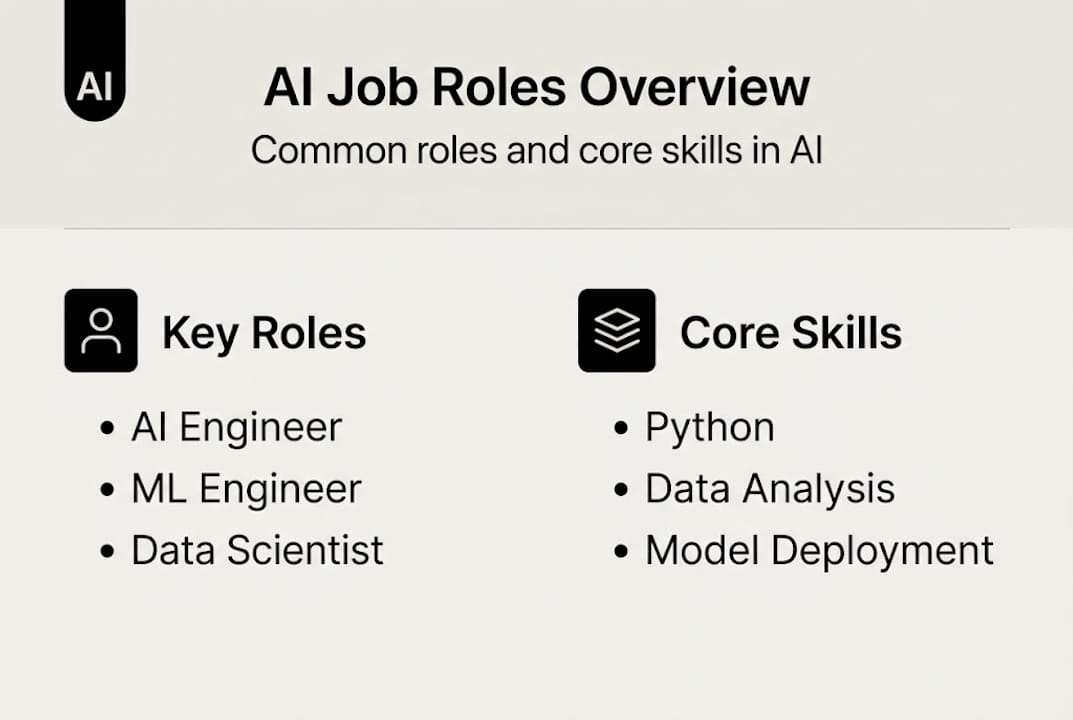
| Job title | Core responsibility | Must-have skills |
|---|---|---|
| AI Engineer | Build and deploy AI-powered applications | Python, LLMs, API integration, RAG |
| ML Engineer | Train, optimize, and productionize ML models | TensorFlow, PyTorch, MLOps |
| Data Scientist | Analyze data and build statistical models | Statistics, SQL, visualization |
| Data Engineer | Build data pipelines and infrastructure | SQL, Spark, cloud platforms |
| NLP Engineer | Develop language understanding systems | Transformers, spaCy, BERT |
| Computer Vision Engineer | Build image and video recognition systems | OpenCV, CNNs, PyTorch |
| MLOps Engineer | Manage model lifecycle and deployment | CI/CD, Kubernetes, monitoring tools |
| AI Product Manager | Define AI product strategy and roadmap | Product sense, stakeholder management |
| AI Ethics Specialist | Ensure responsible and fair AI use | Policy knowledge, bias auditing |
| Prompt Engineer | Design and optimize prompts for LLMs | Prompt design, LLM behavior, testing |
A few of these roles deserve extra attention because they barely existed three years ago. The Prompt Engineer role emerged directly from the explosion of large language models (LLMs), tools like GPT-4 and Claude, and focuses entirely on crafting inputs that produce reliable, useful outputs. The AI Ethics Specialist has grown from a niche academic concern into a full-time position at major tech companies, driven by regulation and public scrutiny. These newer roles are often more accessible to career changers because they reward communication skills and critical thinking alongside technical knowledge. Check out the AI job roles explained overview for a deeper look at how each title is defined across industries.
AI Engineer, ML Engineer, and Data Scientist: Key differences in action
With the core roles defined, understanding their differences helps you target where your interests and strengths best fit. These three titles are often confused, and job postings sometimes use them interchangeably. They are not the same.
An AI Engineer focuses on building end-to-end applications using pre-trained models. Think integrating an LLM into a customer support tool, designing a retrieval-augmented generation (RAG) system, or monitoring production latency and costs. The emphasis is on software engineering, not model training from scratch. An ML Engineer, by contrast, owns the full model lifecycle: designing training pipelines, optimizing model performance, managing data flows, and deploying with frameworks like TensorFlow or PyTorch. A Data Scientist sits closer to analysis: running experiments, building statistical models, and generating insights, with less focus on production deployment.

If you are exploring data job types and unsure which path fits you, this comparison table helps clarify the day-to-day reality.
| Role | Daily tasks | Primary tools | Typical output |
|---|---|---|---|
| AI Engineer | API integration, prompt design, app deployment | Python, LangChain, cloud APIs | Production AI apps |
| ML Engineer | Model training, pipeline management, drift monitoring | PyTorch, TensorFlow, MLflow | Deployed ML models |
| Data Scientist | Data analysis, hypothesis testing, visualization | Python, R, Tableau, SQL | Insights and reports |
Who should pick which role? Use this decision flow:
- You love building user-facing products and working with existing models. Choose AI Engineer.
- You want to own the full model training process and care deeply about optimization. Choose ML Engineer.
- You enjoy finding patterns in data and communicating insights to non-technical stakeholders. Choose Data Scientist.
- You want to bridge both worlds with a focus on reliability and scale. Consider MLOps Engineer.
For a side-by-side breakdown of how these roles compare in practice, the AI vs ML vs Data Science guide is worth reading.
Pro Tip: Entry-level applicants consistently outperform peers who only hold certificates when they show a GitHub portfolio with one or two real projects. Build a RAG-based chatbot or a fine-tuned classifier and document what went wrong and how you fixed it. That story is worth more than any credential.
AI job market trends and career outlook for 2026
Before you chart your personal path, it helps to see where the field as a whole is heading. The numbers are hard to ignore.
Statistic callout: The U.S. Bureau of Labor Statistics projects 20 to 36% job growth for computer research scientists and data scientists, while the World Economic Forum estimates a net gain of 12 million AI-related jobs globally by 2025.
That kind of growth does not happen quietly. Companies are hiring fast, and they are hiring across a wider range of roles than ever before. The AI career outlook for 2026 shows that demand is particularly strong for engineers who can work with agentic AI systems, where models take sequences of actions autonomously rather than just answering single questions.
Emerging titles that are gaining serious traction right now include:
- Prompt Engineer: High demand in enterprise deployments of LLMs
- AI Ethics Specialist: Growing due to EU AI Act compliance requirements
- MLOps Engineer: Critical as companies scale model deployments to production
- AI Product Manager: Needed to translate AI capabilities into real business value
- LLM Evaluation Specialist: A brand-new role focused on testing model reliability
Career changers are finding real traction in this market. Companies increasingly care about what you can build and ship, not where you went to school. If you are looking for practical guidance on finding IT jobs or want to sharpen your tech job search strategies, those resources will help you move faster.
The upskilling wave is real too. Professionals from data analytics, backend development, and even project management are pivoting into AI roles by adding targeted skills. The barrier is lower than most people think.
Crucial skills, real-world challenges, and career transition tips
Even with high demand, expectations for candidates reset quickly as new challenges emerge. Knowing what the job posting says is not enough. You need to know what the job actually requires once you are in the seat.
The most sought-after skills in AI job postings right now include:
- Python (non-negotiable for almost every AI role)
- Prompt engineering and LLM integration
- Cloud platforms (AWS, GCP, Azure)
- MLOps tools (MLflow, Weights and Biases, Kubeflow)
- SQL and data pipeline management
- Statistical reasoning and experimental design
- Communication and stakeholder management (especially for product-adjacent roles)
But here is what most job descriptions leave out. Real-world AI is full of production edge cases that no benchmark measures well. Model drift happens when the data your model sees in production starts to differ from what it trained on. Latency spikes kill user experience. Data contamination in benchmarks makes models look better on paper than they perform in the field. AI also amplifies testing complexity, introducing new failure modes through fuzzing and anomaly detection that traditional QA teams are not equipped to handle.
"The professionals who stand out are not the ones who trained the best model in a notebook. They are the ones who kept it running reliably for six months after launch."
For career changers, the path forward is clearer than it looks. According to Northeastern University's career switching guidance, hands-on projects in LLMs, RAG systems, and autonomous agents are the most effective way to demonstrate readiness for a role. Continuous learning is not optional as agentic AI reshapes what these jobs require every few months.
If you are actively searching, understanding how IT job boards work will help you cut through noise and find postings that match your actual skill level. Knowing how to read a job description critically, spotting which requirements are hard requirements versus wish lists, is itself a skill worth developing.
Pro Tip: Instead of completing another online course, spend two weeks building a small LLM-powered tool and deploying it publicly. Document the problems you hit. That project will generate better interview conversations than any certificate.
Why practical projects and adaptability matter more than your job title
Here is the part that most AI career guides skip. The professionals who advance fastest in this field are rarely the ones who locked in on a single title and optimized for it. They are the ones who kept shipping things.
Job titles in AI are still fluid. What a company calls an "AI Engineer" today might be called an "LLM Application Developer" next year. Chasing the perfect title is a distraction. What actually compounds over time is a track record of solving real problems with AI tools, learning new frameworks quickly, and communicating impact clearly to non-technical audiences.
When you look at navigating data job types, you will notice that the most versatile professionals tend to have worked across two or three adjacent roles. That breadth is not a weakness. It is exactly what companies building AI products need right now. A single certification will not keep your skills relevant. Building things, breaking them, and fixing them will.
Start your AI career journey with the right opportunities
You now have a clear map of the AI job landscape, from the roles that exist to the skills that matter and the trends shaping 2026. The next step is finding the right opportunities to put that knowledge to work.
LetsHunt.it is built specifically for tech professionals like you. Browse curated AI job openings across remote, hybrid, and on-site positions worldwide, with filters for role type, location, and salary range. Whether you are targeting your first AI role or making a lateral move into a new specialization, start your AI job search today and set up alerts so you never miss a relevant opening. The market is moving fast, and the best positions fill quickly.
Frequently asked questions
Do you need a PhD to land an AI job?
Most AI industry roles now value project experience over degrees, especially for engineering and product positions. A strong portfolio consistently outweighs academic credentials in hiring decisions.
What programming languages are most in demand for AI jobs?
Python is the dominant language across AI and ML roles, followed by SQL for data work and occasionally Java or C++ for performance-critical systems.
How can career changers get started in AI?
Focus on building real LLM or agent projects, learn Python, and document your work publicly. Hands-on AI projects consistently help career changers demonstrate readiness more effectively than credentials alone.
Are AI jobs at risk of automation?
Demand for professionals who can deploy, monitor, and oversee AI ethically continues to grow. AI job growth is outpacing automation risks, particularly for roles focused on production reliability and governance.