
TL;DR:
- Clear, specific job descriptions with real problems attract qualified candidates and improve response rates.
- Focusing on essential requirements and practicing salary transparency fosters inclusivity and broadens applicant pools.
- Regularly updating job postings ensures accuracy, relevance, and alignment with evolving technology and team needs.
IT hiring delays cost your team $10k to $25k per week, yet most job postings fail to attract the right candidates because they rely on vague requirements and generic descriptions. The result is a slow pipeline, frustrated hiring managers, and engineering teams stretched thin. This guide walks you through exactly what to include in an IT job posting, how to write it with precision, and how to test and distribute it for maximum reach. Whether you're filling a backend role or hunting for a DevOps engineer, these steps will help you build postings that consistently deliver qualified applicants.
Table of Contents
- Identify prerequisites and must-have requirements
- Write clear, specific job descriptions
- Ensure salary transparency and inclusivity
- Leverage posting channels and A/B testing
- Why accurate, evolving postings beat conventional wisdom
- Streamline your IT hiring today
- Frequently asked questions
Key Takeaways
| Point | Details |
|---|---|
| Focus on essentials | Distinguish must-have qualifications from nice-to-have skills to attract stronger applicants. |
| Describe real challenges | Show candidates exactly what problems they'll help solve, including your tech stack and context. |
| Salary transparency matters | Posting salary ranges builds trust and meets legal requirements in many places. |
| Test and refine postings | A/B testing and regular reviews improve postings and boost response rates. |
| Inclusive language attracts talent | Clear, unbiased wording increases applicant diversity and response. |
Identify prerequisites and must-have requirements
Before writing a single word of your job posting, you need to get clear on what the role actually requires. This sounds obvious, but it's where most postings go wrong. A common mistake is listing 15 requirements when only 5 are truly essential. The rest are either aspirational or based on what the last person in the role happened to know, not what the job actually demands.
Separating must-haves from nice-to-haves is the single most impactful edit you can make to any job posting. When you overload a listing with requirements, you shrink your candidate pool significantly. Research consistently shows that candidates from underrepresented groups, particularly women and career changers, are less likely to apply unless they meet nearly every listed requirement. Trimming your list isn't lowering the bar. It's removing noise.
Here's a quick breakdown of how to categorize requirements:
- Must-haves: Skills without which the candidate cannot perform the core job functions (e.g., proficiency in Python, experience with REST APIs)
- Nice-to-haves: Skills that would accelerate onboarding but can be learned on the job (e.g., familiarity with a specific internal tool, experience in a particular industry vertical)
- Culture or soft skills: Qualities that matter but should not be listed as hard filters (e.g., "strong communicator," "collaborative mindset")
| Category | Examples | Include in posting? |
|---|---|---|
| Essential technical skills | Python, AWS, CI/CD pipelines | Yes, clearly labeled |
| Preferred technical skills | Terraform, GraphQL | Yes, marked as optional |
| Soft skills | Communication, teamwork | Sparingly, with context |
| Internal tools | Proprietary CRM, internal dashboards | Only if critical |
A well-structured tech recruitment workflow starts with this kind of requirement audit. It forces your team to think about the role from the candidate's perspective, not just from the hiring manager's wish list.
Pro Tip: Before publishing, send your requirements list to two or three engineers on the team and ask them to mark which items they actually use weekly. You'll often find that half the list disappears immediately. This step also builds buy-in from the technical team and aligns your posting with real job expectations. Following IT recruiter best practices means treating requirement-setting as a collaborative exercise, not a solo HR task.
Write clear, specific job descriptions
Once you've clarified requirements, you need to communicate them with precision and authenticity. A job description that reads like a legal document or a generic template will attract generic applicants. The goal is to describe the actual work in enough detail that the right candidate immediately thinks, "That's exactly what I do."

The most effective tactic here is to describe real problems the candidate will solve. Instead of writing "responsible for cloud infrastructure," write "lead our Azure migration from on-prem legacy systems to a scalable cloud architecture supporting 2 million users." That single sentence tells a skilled engineer more about the role than three bullet points of generic duties ever could.
Here's a table of common project challenge types and how to describe them effectively:
| Challenge type | Vague version | Specific version |
|---|---|---|
| Cloud migration | Manage cloud infrastructure | Lead Azure migration for 2M-user platform |
| Performance scaling | Optimize system performance | Reduce API response times from 800ms to under 200ms |
| Security hardening | Ensure system security | Implement zero-trust architecture across microservices |
| Data pipeline | Work with data systems | Build real-time ETL pipelines processing 10TB daily |
Follow these steps to draft a strong, descriptive posting:
- Start with a one-paragraph summary of the team's mission and the role's impact
- List the top three to five problems the hire will solve in the first six months
- Describe the tech stack in full, including versions where relevant
- Specify the team structure: who they report to, who they collaborate with
- State expected outcomes clearly, not just responsibilities
"The actual work you describe, more than the job title, is what attracts the right talent."
Using an IT job filtering guide can help you understand how candidates search and what keywords they prioritize, which should directly inform your description language.
Pro Tip: Add a "What success looks like at 90 days" section. This tells candidates exactly what they're signing up for and signals that your company has a clear onboarding plan. It's a small addition that builds serious credibility.
Ensure salary transparency and inclusivity
Diving deeper, competitive postings must also foster trust and inclusivity. Salary transparency is no longer just a best practice. It's increasingly a legal requirement. Posting a salary range removes a major friction point for candidates and signals that your company values fairness.
States and countries currently requiring salary transparency in job postings include:
- California: Full salary range required
- New York: Salary range required for all postings
- Colorado: Compensation range and benefits must be disclosed
- Washington state: Wage scale or salary range required
- United Kingdom: Pay equity reporting required for large employers
- Canada (Ontario): Pay transparency legislation expanding in 2026
Even where it isn't legally mandated, salary transparency increases candidate trust and reduces wasted time on both sides. Candidates who apply knowing the range are already self-selected for fit.
Inclusivity goes beyond salary. The language you use in a posting shapes who applies. Avoid phrases like "rockstar developer" or "coding ninja," which carry implicit cultural bias. Use neutral, outcome-focused language instead. Research shows that overlong wishlists deter underrepresented groups from applying, reinforcing the importance of trimming your requirements list.
Pro Tip: Run your job posting through a free bias-checking tool like Textio or Gender Decoder before publishing. Then have at least one person from a different background review it for tone. This two-step review catches issues that automated tools miss. You can also find examples of inclusive tech jobs to benchmark your language against real postings in the market.
Building inclusivity into your posting isn't just ethical. It's a competitive advantage. Companies that attract diverse applicant pools consistently report stronger team performance and faster problem-solving.
Leverage posting channels and A/B testing
Now that your posting is optimized for content and inclusivity, it's time to choose where and how to publish for maximum reach. Not all channels perform equally, and the best IT recruiters treat posting distribution as a strategy, not an afterthought.
| Channel | Best for | Limitations |
|---|---|---|
| Specialized IT job boards | Targeted tech candidates | Smaller audience than general boards |
| Senior and mid-level roles | High competition, rising ad costs | |
| GitHub Jobs / Stack Overflow | Developer-specific roles | Niche reach |
| Active outreach (LinkedIn DMs) | Passive candidates | Time-intensive |
| Employee referrals | Culture-fit hires | Limited reach |
Passive sourcing over job boards often finds better talent because you're reaching candidates who aren't actively job hunting but are open to the right opportunity. Think of it like fishing with a spear versus a net. More effort, but far better precision.
Personalized outreach consistently delivers a 15 to 25% response rate benchmark, which is significantly higher than cold job board applications. That's a compelling reason to invest in direct sourcing alongside your board strategy.
A/B testing your job postings is a technique borrowed from email marketing, and it works just as well here. Here's how to run a basic test:
- Create two versions of the posting with different job titles (e.g., "Backend Engineer" vs. "Python Software Engineer")
- Post both versions on the same platform or split across two comparable channels
- Run both for two weeks and track applications, click-through rates, and quality of applicants
- Keep the stronger performer and iterate on the next variable (description length, salary placement, etc.)
- Document results to build an internal benchmark for future postings
For a deeper look at where to post, the IT job boards guide breaks down platform-specific strategies, and understanding job boards advantages helps you weigh the tradeoffs. If you're hiring globally, remote tech hiring strategies and a solid grasp of IT recruitment basics will round out your approach.
Pro Tip: Set a calendar reminder to review every active posting every 60 days. Tech evolves fast, and a posting that was accurate in January may already be outdated by March.
Why accurate, evolving postings beat conventional wisdom
Most hiring guides tell you to write a clear job description and post it widely. That's fine advice, but it misses the bigger picture. The companies that consistently hire great IT talent aren't just writing better postings once. They're treating job postings as living documents that evolve with their teams and their tech stacks.
The uncomfortable truth is that most IT postings go stale within 90 days. Technologies shift, team priorities change, and the role that was scoped in Q1 may look completely different by Q3. Yet most companies leave postings untouched for six months or more.
Engineer-led reviews ensure accuracy and keep postings credible. When a candidate reads a posting that references specific tools, real challenges, and current stack versions, it signals that your company is technically sharp and that the role is real, not a placeholder.
"The actual work you describe, more than the title, attracts talent."
Building a quarterly review cycle into your IT job search strategies and hiring calendar is one of the highest-leverage habits a recruiting team can build. It costs almost nothing and pays off in faster, better hires.
Streamline your IT hiring today
Applying these strategies takes effort, but the right platform makes the process significantly faster. LetsHunt.it is built specifically for IT recruitment, giving you access to a global pool of tech professionals across software development, DevOps, data and AI, and product management.
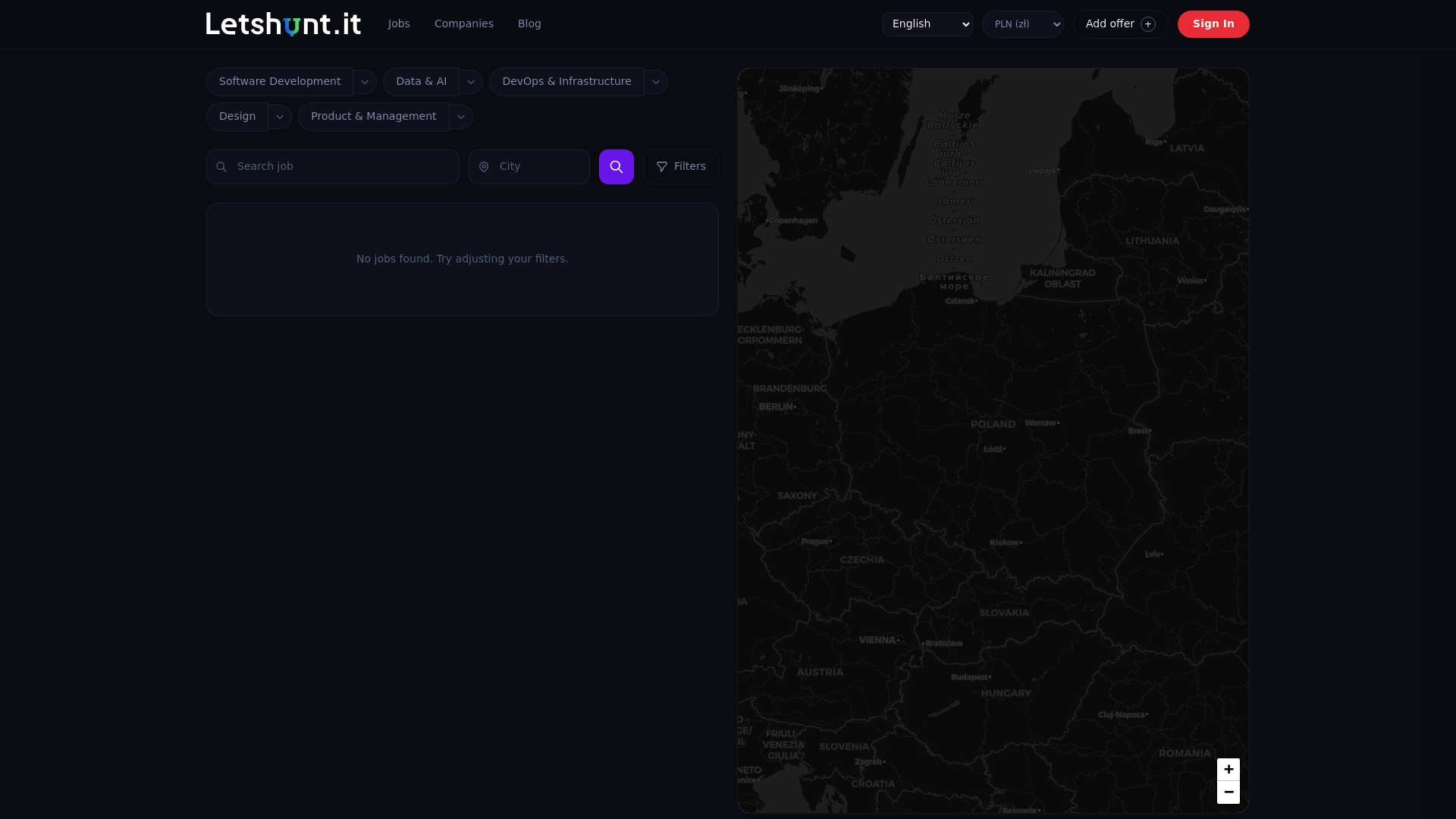
When you browse IT jobs on LetsHunt.it, you can see how top companies structure their postings in real time, giving you concrete benchmarks for your own listings. The platform supports remote, hybrid, and on-site roles across multiple regions and currencies, making it easier to reach the right candidates wherever they are. If you're ready to move faster and hire smarter, LetsHunt.it gives your team the tools to do exactly that.
Frequently asked questions
What details should absolutely be in an IT job posting?
Every IT posting should include essential skills, tech stack and salary range, and at least one real-world problem the candidate will solve. These elements filter for fit and signal that the role is well-defined.
How do inclusive postings affect candidate response rates?
Inclusive postings with clear requirements and neutral language can drive a 15 to 25% response rate improvement by attracting a wider and more diverse applicant pool. Shorter, focused requirement lists play a major role in this lift.
Is salary transparency mandatory everywhere?
No, but many U.S. states require salary ranges in postings, including California, New York, Colorado, and Washington. International requirements vary, with more countries moving toward mandatory disclosure in 2026.
What's the risk of posting too many requirements?
Excess requirements discourage qualified candidates and particularly deter underrepresented groups from applying, shrinking your pool before the process even begins. Focus on true must-haves to keep your funnel healthy.
How often should IT job postings be updated?
Review and update postings frequently as technology evolves, ideally on a quarterly cycle or whenever team priorities or the tech stack changes significantly.