
Not all design jobs are the same, and knowing the differences can reshape your career path. Many professionals enter the tech industry assuming design roles overlap significantly, only to discover vast distinctions in daily responsibilities, required skills, and strategic impact. Understanding whether you're suited for UX research, visual interface work, or end-to-end product strategy can accelerate your growth and job satisfaction. This guide clarifies the landscape of design job openings in technology, breaking down role definitions, career progression stages, core methodologies, compensation data, and actionable strategies to help you navigate and advance in this dynamic field.
Table of Contents
- Key Takeaways
- Understanding key design jobs in tech
- Design job levels and career progression
- Core design methodologies and tools in tech careers
- Compensation insights and career opportunities in tech design
- Explore design jobs and advance your tech career
- Frequently asked questions
Key Takeaways
| Point | Details |
|---|---|
| Role variety in tech | The article outlines distinct duties and impact for UX researchers, UI designers, product designers, and related roles. |
| Career progression ladder | Career progression moves from junior scope work to lead level strategic influence as experience grows. |
| Role specific skills | Each role requires a distinct set of core skills such as user research for UX, visual design for UI, and strategic thinking for product design. |
| Essential design tools | Proficiency in tools like Figma and other collaborative platforms accelerates effectiveness across design roles. |
| Salaries by level | Salaries vary by role and experience, with senior positions typically commanding about 170k to 220k. |
Understanding key design jobs in tech
The technology sector offers diverse design positions, each with specialized focus areas and skill requirements. Recognizing these distinctions helps you target roles aligned with your strengths and interests.
UX designers concentrate on understanding user needs through research, creating personas, mapping user flows, and conducting usability testing. Their work ensures products solve real problems efficiently. UI designers handle the visual layer, crafting aesthetically pleasing interfaces with attention to typography, color theory, spacing, and interactive elements. Product designers manage the complete product lifecycle, balancing user experience with business objectives and technical constraints. This role requires strategic thinking alongside design execution. Web and Digital designers specialize in website functionality and digital media, optimizing for performance and accessibility across devices.
Key design jobs in tech include distinct focuses that require different skill sets and tools. Understanding these differences helps you choose the right career path or identify skills to develop.
Core skills by role:
- UX Designer: user research methods, persona development, journey mapping, wireframing, usability testing, information architecture
- UI Designer: visual design principles, typography, color theory, iconography, design systems, animation principles
- Product Designer: strategic thinking, business metrics analysis, cross-functional collaboration, full-stack design, roadmap planning
- Web Designer: HTML/CSS understanding, responsive design, web accessibility standards, SEO basics, CMS platforms
- Digital Designer: motion graphics, digital advertising formats, brand guidelines, multi-channel campaign design
| Role | Primary Focus | Key Responsibilities | Essential Tools |
|---|---|---|---|
| UX Designer | User research and experience | Personas, flows, testing, research synthesis | Figma, Miro, UserTesting, Optimal Workshop |
| UI Designer | Visual interface aesthetics | Mockups, style guides, component libraries | Figma, Sketch, Adobe XD, Principle |
| Product Designer | End-to-end product strategy | Feature definition, metrics, stakeholder alignment | Figma, analytics platforms, prototyping tools |
| Web Designer | Website design and function | Layouts, responsive grids, web optimization | Figma, Webflow, WordPress, browser DevTools |
| Digital Designer | Digital media and campaigns | Ad creatives, email templates, social assets | Adobe Creative Suite, Figma, After Effects |
Mastering the tools specific to your chosen role accelerates your effectiveness. Most positions require proficiency in Figma or similar collaborative design platforms, but specialization determines which additional skills matter most for your career trajectory.
Design job levels and career progression
Design careers in tech follow predictable progression patterns, with responsibilities and autonomy expanding as experience accumulates. Understanding these levels helps you set realistic goals and recognize when you're ready to advance.
Responsibilities vary significantly across career stages. Junior designers with under two years of experience typically handle scoped tasks under close supervision, focusing on execution rather than strategy. Mid-level designers with two to five years work independently on features, making design decisions within established frameworks. Senior designers with five to eight years lead projects, mentor others, and influence product direction. Lead designers with eight or more years drive organization-wide initiatives, establish design culture, and shape strategic vision.

Each level demands different competencies beyond pure design skill. Junior roles emphasize learning tools, following design systems, and delivering quality work on time. Mid-level positions require understanding business context, collaborating across teams, and solving ambiguous problems. Senior roles involve teaching others, making architectural decisions, and balancing competing priorities. Lead positions focus on organizational impact, hiring, and setting standards that scale.
Progression steps to advance your design career:
- Master core tools and deliver consistent quality work that meets specifications and timelines
- Take ownership of complete features rather than isolated tasks, demonstrating end-to-end thinking
- Initiate improvements to team processes, design systems, or collaboration workflows
- Mentor junior teammates through reviews, pairing sessions, and documentation
- Influence product strategy by connecting design decisions to business metrics and user outcomes
- Lead cross-functional initiatives that require coordination across engineering, product, and business teams
- Shape organizational design culture through hiring, standards-setting, and thought leadership
Pro Tip: To accelerate advancement, actively seek projects slightly beyond your current level and document your impact with metrics. Demonstrating how your design work improved conversion rates, reduced support tickets, or increased engagement provides concrete evidence of readiness for promotion.
Design systems mastery and growth experimentation separate senior practitioners from mid-level designers. Building scalable component libraries that reduce inconsistencies and speed development shows strategic thinking. Running controlled experiments to validate design hypotheses demonstrates data literacy valued in design career progression at leading tech companies.
Core design methodologies and tools in tech careers
Effective designers rely on proven methodologies that transform user needs into successful products. These processes apply across experience levels, though execution sophistication increases with seniority.
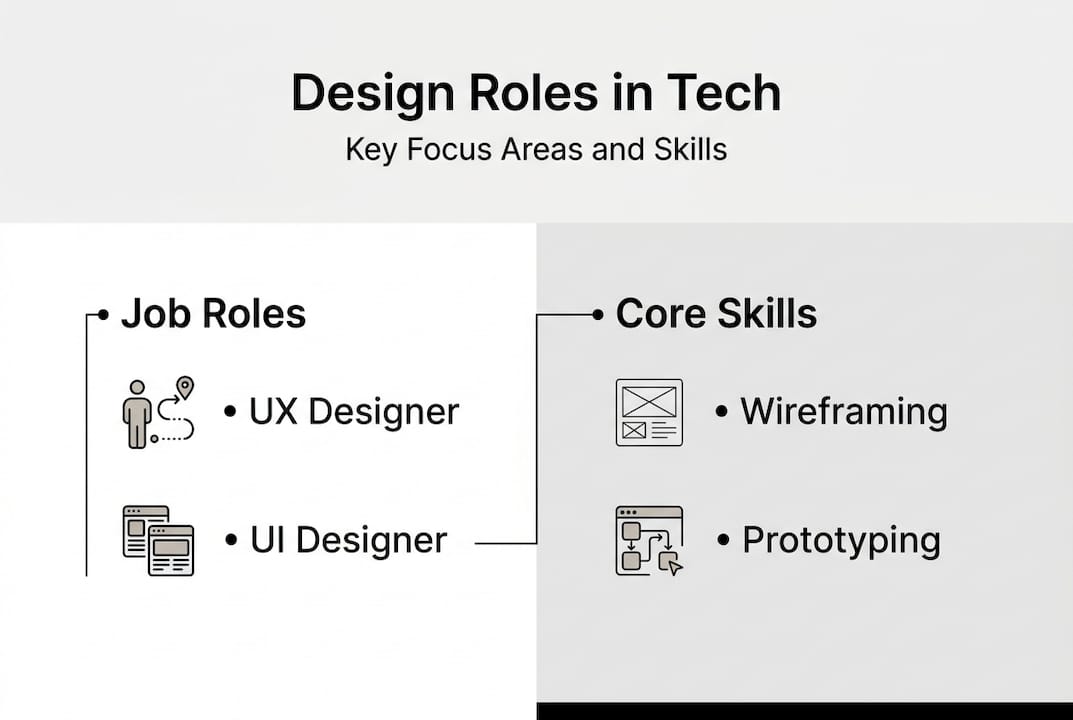
User research, wireframing, and prototyping form the foundation of modern design practice. User interviews uncover pain points and motivations that quantitative data misses. Usability testing validates assumptions before expensive development begins. Wireframing establishes information hierarchy and flow without visual design distractions. Prototyping with tools like Figma enables stakeholder alignment and user testing of interactions.
Design systems provide shared component libraries, patterns, and guidelines that ensure consistency across products. Teams using mature design systems report 90% fewer visual bugs and significantly faster feature delivery. These systems encode design decisions once, eliminating repeated discussions about spacing, colors, or interaction patterns.
Backend-first design approaches where designers understand technical constraints early can shorten time to market by 50%. Collaborating with engineers during architecture discussions prevents unrealistic designs that require costly revisions. This methodology particularly benefits product designers managing complex systems.
Popular tools across design workflows:
- Collaboration and design: Figma, Sketch, Adobe XD, InVision
- Prototyping and interaction: Principle, Framer, ProtoPie, Origami Studio
- User research: UserTesting, Lookback, Optimal Workshop, Maze
- Handoff and specs: Zeplin, Avocode, Figma Dev Mode
- Design systems: Storybook, Zeroheight, Supernova
- Analytics and testing: Amplitude, Mixpanel, Google Optimize, VWO
Pro Tip: Iterative testing with both qualitative feedback and quantitative metrics produces superior outcomes compared to relying on either alone. Combine user interviews to understand why behaviors occur with A/B testing to measure which solutions perform better at scale.
Emerging challenges like AI product UX require new approaches. Designing for probabilistic outputs rather than deterministic results demands different patterns for managing user expectations, handling errors gracefully, and building trust. Expertise in these areas positions designers for high-impact roles as AI integration accelerates across products. Understanding design techniques and tools for these emerging domains differentiates candidates in competitive markets.
Compensation insights and career opportunities in tech design
Design roles in technology offer competitive compensation that scales with experience and specialization. Understanding market rates helps you negotiate effectively and plan career moves strategically.
Product designers average $122k in median salary, while Web and Digital designers earn $95k to $98k median. Senior positions command $170k to $220k depending on company size, location, and scope of responsibility. Lead designers at major tech companies frequently exceed $250k when equity compensation is included.
| Role | Entry Level | Mid-Level | Senior | Lead |
|---|---|---|---|---|
| UX Designer | $65k-$85k | $95k-$125k | $140k-$180k | $190k-$240k |
| UI Designer | $60k-$80k | $90k-$120k | $135k-$175k | $185k-$230k |
| Product Designer | $70k-$90k | $100k-$135k | $150k-$195k | $200k-$260k |
| Web Designer | $55k-$75k | $80k-$110k | $120k-$160k | $170k-$210k |
| Digital Designer | $55k-$75k | $85k-$115k | $125k-$165k | $175k-$215k |
Employment growth and in-demand skills shape opportunity landscapes. The Bureau of Labor Statistics projects steady growth in design-related technology positions through 2030. Specific skills commanding premium compensation include:
- AI and machine learning UX design for conversational interfaces and recommendation systems
- Accessibility expertise ensuring WCAG compliance and inclusive design
- Design systems architecture for scaling consistency across large product portfolios
- Growth design combining experimentation, analytics, and behavioral psychology
- Multi-platform design spanning web, mobile, voice, and emerging interfaces
Business impact justifies designer compensation. Companies implementing strong UX practices see 15% conversion rate increases and 28% churn decreases compared to competitors with weaker design. These improvements translate directly to revenue, making design investment highly profitable.
Regional variations significantly affect compensation. San Francisco, New York, and Seattle offer 30% to 50% higher salaries than smaller markets, though cost of living differences partially offset gains. Remote positions increasingly offer location-adjusted compensation, with some companies moving toward geographic pay bands.
Differentiating yourself in competitive markets requires developing specialized expertise beyond generalist skills. Deep knowledge in emerging areas like spatial computing interfaces, ethical AI design, or design operations creates unique value. Contributing to open-source design systems, speaking at conferences, or publishing case studies builds reputation that opens doors to premium opportunities. Exploring the design job market and salaries through active research keeps your expectations calibrated to current conditions.
Explore design jobs and advance your tech career
Understanding design roles, career paths, and methodologies provides the foundation for strategic career decisions. The next step involves actively exploring opportunities that match your skills and growth objectives.
LetsHunt.it specializes in connecting design professionals with technology companies seeking talent across UX, UI, Product, Web, and Digital design positions. The platform curates listings from startups to enterprise organizations, offering remote, hybrid, and on-site options with competitive compensation. Advanced filters help you find roles matching your experience level, preferred tools, and specialization areas.
Pro Tip: Actively apply to positions and tailor your portfolio to specific job descriptions found on the platform. Highlighting relevant projects and quantifying your impact with metrics significantly improves callback rates. Generic portfolios get overlooked, while customized applications demonstrating understanding of company needs stand out.
Browse current design job listings to discover opportunities aligned with your career stage and interests. The platform's resources section offers additional guidance on portfolio development, interview preparation, and salary negotiation. Whether you're transitioning into design, advancing to senior levels, or exploring specialized domains, targeted job search accelerates your progress. Explore technology design careers to find your next role and take concrete steps toward your professional goals.
Frequently asked questions
What are the main differences between UX and UI designers?
UX designers focus on user research, journey mapping, and overall experience flow, ensuring products solve real problems efficiently. UI designers concentrate on visual interface aesthetics including typography, color, spacing, and interactive elements that make products beautiful and intuitive. While distinct, these roles collaborate closely throughout product development, with UX establishing structure and UI adding visual polish.
How can I progress from a junior to a senior design role?
Gain broad project experience across different product areas and master core design tools used by your team. Take initiative on improvements beyond assigned tasks and actively seek mentorship from senior designers. Leading complete features, mentoring junior teammates, and demonstrating strategic thinking through metrics-driven decisions are key signals of readiness for senior levels.
What design methodologies are most important in tech companies?
User research through interviews and testing, prototyping with collaborative tools like Figma, and iterative refinement based on feedback form the core methodology. Design systems ensuring consistency and A/B testing for data-driven decisions are highly valued. Companies increasingly expect designers to combine qualitative insights with quantitative metrics when making product decisions.
What salary can I expect as a product designer in tech?
Product designers earn approximately $122k median salary, with entry-level positions starting around $70k to $90k. Senior product designers command $150k to $195k, while lead roles reach $200k to $260k depending on company size and location. Specialization in high-demand areas like AI UX or design systems leadership, plus equity compensation at growth-stage companies, can significantly increase total compensation beyond base salary.