
TL;DR:
- Developers prioritize flexibility, impactful work, growth, safety, transparency, and community over salary alone.
- Effective recruitment requires clear policies, authentic community engagement, and seamless application processes.
- Continuous measurement and honest employer reputation are key to attracting top software engineering talent.
Filling a software developer role has never been harder. Global demand for skilled engineers keeps outpacing supply, and candidates now hold more leverage than ever before. The average time to hire a senior developer stretches well beyond 40 days at many companies, and a poor candidate experience can send top talent straight to your competitors. This guide cuts through the noise and gives you research-backed, field-tested strategies to attract software developers whether you are hiring for remote, hybrid, or on-site positions. You will learn how to shape work policies, pick the right channels, and build a hiring process that developers actually respect.
Table of Contents
- Understand what developers value most
- Craft compelling and developer-centric work policies
- Leverage the right channels and trusted communities
- Remove friction from the developer application experience
- Verify and iterate: Measuring what works and adapting fast
- Rethinking developer attraction: Lessons recruiters rarely hear
- Attract top developers with Let's Hunt
- Frequently asked questions
Key Takeaways
| Point | Details |
|---|---|
| Developers prioritize flexibility | Flexible hybrid work is proven to increase satisfaction and efficiency in developer roles. |
| Trusted channels work best | Job boards and community platforms like Stack Overflow are the top places to attract software developers. |
| Streamlined applications matter | A fast, clear, and developer-friendly hiring process keeps candidates engaged. |
| Iterate based on results | Regularly measure and adapt your approach to keep attracting top talent. |
Understand what developers value most
With the high stakes set, let's dig into what makes software developers say yes to an opportunity.
Salary matters, but it rarely closes the deal alone. Today's developers weigh a much broader set of factors before they commit. Think about it from their perspective: they have options. Strong engineers receive multiple outreach messages every week. What separates a role they pursue from one they ignore is almost never the base pay number.
Here is what developers consistently rank as top priorities:
- Flexibility and autonomy over when and where they work
- Meaningful, impactful work that challenges them technically
- Clear growth paths in software development careers
- Psychological safety to experiment and make mistakes
- Honest, transparent communication from leadership
- Peer community and collaborative team culture
One of the most actionable findings from recent research is the concept of a hybrid work "sweet spot." Hybrid work policies with flexibility boost perceived efficiency and lower stress for developers, with 6 to 10 office days per month emerging as the range where most developers feel productive without feeling constrained. That is a specific number you can build policy around.
AI tools are reshaping daily developer work, but they have not replaced the human need for peer validation. Developers still turn to colleagues and trusted communities when they face hard problems. That means your team culture and knowledge-sharing norms are part of your attraction strategy, not just your retention plan. Reviewing global software career trends can help you stay ahead of what candidates expect from employers in 2026.
Building trust starts before the first interview. Transparent job descriptions, realistic timelines, and honest answers to candidate questions signal that your organization respects developers as professionals.
Pro Tip: Survey your current developer team quarterly. Ask them what they value most about working there and what they would change. Their answers will sharpen every job posting and recruiter conversation you have.
Craft compelling and developer-centric work policies
Once you know what developers value, the next step is translating that into clear and effective work policies.

Hybrid and remote options are no longer perks you advertise to stand out. They are baseline expectations. Candidates who see "flexible work" buried in a bullet point at the bottom of a job description are not impressed. They want specifics.
Here is a side-by-side comparison of the three main work models and how developers perceive them:
| Work model | Developer perception | Efficiency impact | Stress level |
|---|---|---|---|
| Fully remote | High autonomy, potential isolation | Moderate to high | Variable |
| Hybrid (6 to 10 days/month in office) | Balanced, collaborative | Highest | Lowest |
| Fully on-site | Structured, less flexible | Lower | Higher |
The hybrid sweet spot of 6 to 10 office days per month maximizes perceived efficiency, and that data point belongs in your internal policy discussions, not just your recruiting pitch.
To optimize tech recruitment workflow and align your policies with developer expectations, follow these steps:
- Audit your current policy. Write down exactly what flexibility you currently offer and where the gaps are.
- Benchmark against competitors. Look at what similar companies in your sector advertise.
- Close the management perception gap. Ensure middle managers understand and support the flexibility you promise publicly.
- Codify your policy in writing. Vague promises erode trust. Put specifics in your employee handbook and job postings.
- Communicate autonomy explicitly. Use phrases like "you choose your core hours" or "async-first team" in job descriptions.
The management perception gap deserves special attention. Many companies promise flexibility at the recruiter level but have managers who quietly expect full office presence. Developers talk to each other. That contradiction spreads fast and damages your employer reputation.
Leverage the right channels and trusted communities
A flexible policy is essential, but you also need to reach developers where they actually spend time.
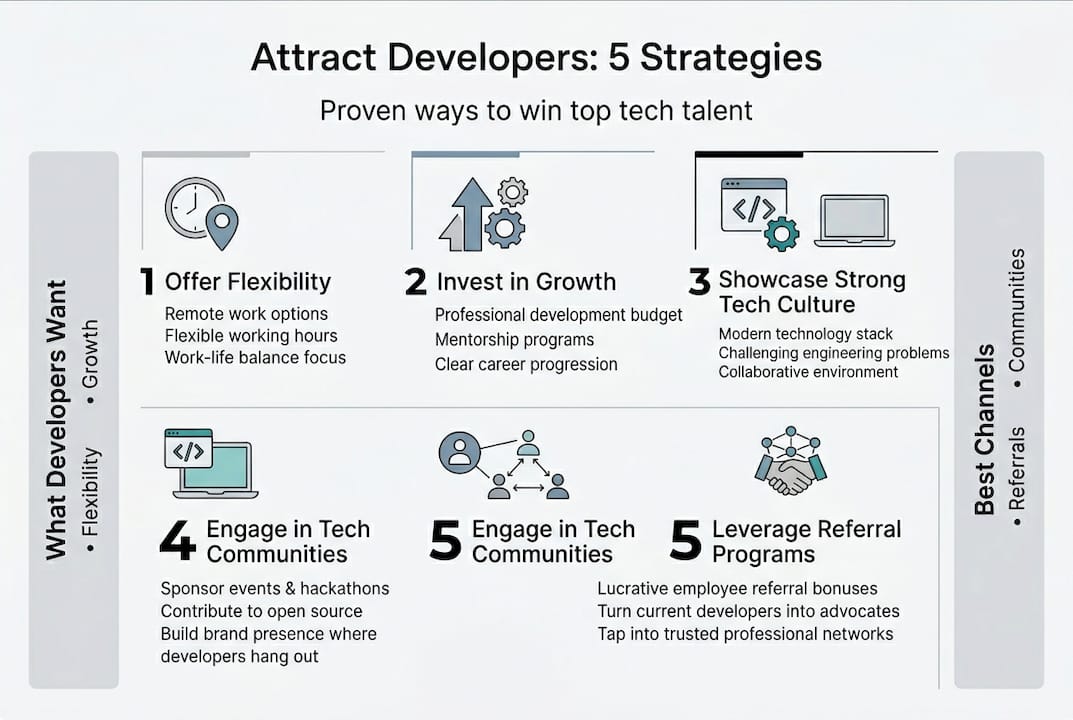
Posting on a generic job board and waiting is not a strategy. Developers discover opportunities through communities they already trust, not through banner ads or cold LinkedIn messages from strangers.
Here is a snapshot of the top channels and their developer reach:
| Platform | Primary use | Developer trust level |
|---|---|---|
| Stack Overflow Jobs | Job search and Q&A | Very high |
| GitHub | Open-source and portfolio | Very high |
| Specialized IT job boards | Targeted tech roles | High |
| Professional networking | Moderate | |
| Generic job boards | Broad reach | Low to moderate |
Even as AI grows in recruiting workflows, developers trust community knowledge sources like Stack Overflow and GitHub for job leads and peer recommendations. That trust is hard-earned and not easily replicated by automated outreach.
Effective channel strategy looks like this:
- Post on specialized IT job boards where candidates are already in job-search mode. Understanding using IT job boards correctly separates companies that attract strong applicants from those that get ignored.
- Engage in developer communities authentically, not just to post openings. Answer questions, share knowledge, and build a presence before you need to hire.
- Use GitHub strategically. If your team contributes to open-source projects, that visibility attracts engineers who care about craft.
- Understand the tech job board benefits that niche platforms offer over general sites, including better candidate filtering and higher intent applicants.
AI recruiting tools can help you move faster on sourcing and screening. Pair them with authentic community engagement so your outreach feels human, not automated.
Pro Tip: Before posting a role, check where your best current developers say they found their last job. That channel is likely your highest-ROI starting point.
Remove friction from the developer application experience
Now that you have reached the right talent, keep them engaged by making it easy, fast, and transparent to apply.
A long, confusing application process is one of the fastest ways to lose strong candidates. Developers are busy and have options. If your process feels disrespectful of their time, they will simply move on.
If top candidates abandon mid-process, you are losing the best talent. The people with the most options are the first ones to drop off when friction appears.
Follow these steps to streamline your application experience:
- Cut unnecessary fields. If you do not use a data point in your decision, remove it from the form.
- Set clear expectations upfront. Tell candidates how many stages there are and how long each takes.
- Acknowledge every application within 48 hours. Silence reads as disrespect.
- Give feedback at every stage. Even a brief note after a rejection builds your reputation.
- Make technical assessments relevant and time-boxed. A four-hour take-home test for a first-round screen will cost you candidates.
Understanding IT recruitment explained in depth helps you see where your process may have hidden friction points that feel normal internally but frustrate candidates externally.
Common mistakes to avoid:
- Requiring account creation before viewing a job description
- Asking for salary history in regions where it is restricted
- Scheduling interviews with less than 24 hours notice
- Ghosting candidates after final-round interviews
Developers seek efficiency and transparency throughout the hiring process, and companies that deliver both earn a reputation that spreads through developer communities. Use IT job search tips to understand what candidates experience from the other side of the process.
Verify and iterate: Measuring what works and adapting fast
Attraction is not a one-time fix. Let's see how to verify what works and keep getting better.
Most recruiting teams track time-to-fill and offer acceptance rate. Those are lagging indicators. By the time those numbers look bad, you have already lost months of strong candidates. You need leading indicators that tell you what is breaking before it costs you hires.
Follow these steps to build a measurement and iteration loop:
- Track application drop-off by stage. If candidates disappear after the technical screen, that screen needs redesigning.
- Send a short candidate experience survey to everyone who completes an interview, hired or not.
- Review job posting performance monthly. Which postings get clicks but no applications? That signals a messaging problem.
- Hold quarterly retrospectives with your hiring team to review what changed in the developer market.
- Monitor your employer brand on developer forums and review sites like Glassdoor and Blind.
Regularly reviewing policy outcomes and developer satisfaction leads to better long-term hiring results, and the companies that treat recruiting as a product to iterate on consistently outperform those that treat it as a fixed process. Use insights from your recruitment workflow optimization to close gaps faster.
Here is a quick reference table of key metrics and what they signal:
| Metric | What it tells you | Action if poor |
|---|---|---|
| Application completion rate | Friction in your form | Simplify the process |
| Interview-to-offer ratio | Quality of sourcing | Refine channel targeting |
| Offer acceptance rate | Competitiveness of offer | Review comp and flexibility |
| 90-day retention | Quality of hire and onboarding | Improve candidate experience |
Rethinking developer attraction: Lessons recruiters rarely hear
With metrics and iteration in place, here is what most guides will not tell you about truly standing out.
The uncomfortable truth is that many companies chase developer talent with the wrong tools. They increase the signing bonus. They add a ping-pong table. They write a press release about their new remote policy. And then they wonder why their pipeline still feels weak.
Developers are skeptical by training. They debug systems for a living. They will see through a polished employer brand that does not match what their peers say about working there. Community reputation, the kind built through honest interactions and real peer feedback, outweighs any marketing campaign you can run.
The best recruiters we have seen act as honest brokers. They tell candidates what the team is actually like, including the rough edges. They connect candidates with future teammates before an offer is made. They advocate internally for the candidate's needs, not just the company's timeline.
Overemphasizing salary or wild perks often signals that the actual work environment is not compelling enough to stand on its own. Developers notice that. Roles in AI jobs and emerging tech attract strong candidates not because of perks but because of the quality of the problems being solved.
Pro Tip: Become the employer that actual developers talk about after work in a good way. That word-of-mouth is worth more than any job board placement.
Attract top developers with Let's Hunt
Ready to put these strategies into practice? Here is how to take the next step.
Every strategy in this guide works better when you have the right platform behind you. Let's Hunt is built specifically for the technology hiring market, giving recruiters direct access to developers actively seeking remote, hybrid, and on-site roles across software development, DevOps, data, and more.
When you post developer jobs on Let's Hunt, your listings reach candidates who are already filtered by skill, location preference, and role type. No noise. No irrelevant applicants. You can discover hiring solutions designed for tech recruiters who need results, not just reach. Start attracting the developers your team actually needs.
Frequently asked questions
What are the most attractive benefits for software developers in 2026?
The most attractive benefits are flexible hybrid work arrangements, clear professional growth opportunities, and genuine autonomy in how work gets done. Developers value hybrid flexibility and efficiency far more than salary alone or novelty perks.
Which platforms are best for recruiting software developers?
Top platforms include Stack Overflow, GitHub, and specialized IT job boards where developers actively network and look for roles. Developers trust Stack Overflow and GitHub for community knowledge and job leads more than generic job sites.
How can I make my developer job application process stand out?
Streamline the number of steps, communicate timelines clearly, and give feedback at every stage. Designing the process with the developer's time and experience in mind is what separates companies that attract strong applicants from those that lose them mid-funnel.
How often should I update my recruitment strategies for developers?
Review your hiring practices at least quarterly and adjust based on candidate feedback, drop-off data, and shifts in the developer job market. Regular review and iteration consistently improve hiring outcomes over time.