
TL;DR:
- Effective tech job searching in 2026 requires clear goals, tailored materials, and strategic sourcing.
- Networking, referrals, and personal branding significantly outperform mass applications due to AI screening.
- Focused outreach, open source contributions, and reputation-building are key to landing top IT roles today.
You've sent out 40 applications, tailored a handful of resumes, and refreshed your inbox every morning for three weeks. Nothing. This is the reality for thousands of IT professionals right now, and it's not because they lack skills. It's because the modern tech job search demands a different playbook. Mass applying to every opening on a job board is the least effective strategy in 2026, yet it's what most people default to. This guide gives you a structured, evidence-based framework to find software development, data science, DevOps, and related IT roles, whether remote or on-site, and actually land interviews.
Table of Contents
- Assess your goals and get job search–ready
- Strategically source IT jobs on top tech platforms
- Apply smart: Tailor your applications for ATS, AI, and humans
- Follow through: Network, track, and maximize interview offers
- What most tech job seekers miss in 2026
- Ready for your next IT job? Start your search now
- Frequently asked questions
Key Takeaways
| Point | Details |
|---|---|
| Narrow your focus | Target a specific list of tech companies and roles for more effective applications. |
| Prioritize referrals | Networking and recommendations lead to far higher interview rates than cold applying. |
| Custom-tailor applications | Use keywords from the job description and showcase tech projects to stand out with AI resume screeners. |
| Be proactive | Track your job search, follow up after applying, and keep building your network weekly. |
Assess your goals and get job search–ready
Before you open a single job listing, you need clarity. What role are you targeting? What technology stack do you want to work with? Are you open to remote, hybrid, or strictly on-site positions? These aren't soft questions. Vague answers lead to scattered applications, inconsistent messaging, and a profile that signals nothing to recruiters.
Start by mapping your target role against your current skills. If you're a backend developer, decide whether you're pursuing senior engineering roles, staff-level positions, or a shift into platform engineering. If you're in data, clarify whether you're targeting ML engineering, analytics, or data platform work. This matters because your resume, your LinkedIn summary, and even your GitHub pinned repositories should all tell the same story.
Understanding your preferred work model matters too. Remote roles typically require stronger async communication skills and a documented home setup. Hybrid roles depend heavily on geography. On-site roles open the door to relocation packages but narrow your options. Knowing what you want upfront saves weeks of wasted effort.
Here's a quick comparison of the three models:
| Work model | Key advantage | Main challenge |
|---|---|---|
| Remote | Global salary access | Requires strong async skills |
| Hybrid | Work-life balance | Location-dependent |
| On-site | Team culture, mentorship | Commute, geography limits |
Once you know your direction, assemble your materials before you start applying. That means:
- A tailored resume for each role category (not one generic version)
- A LinkedIn profile with a clear headline, featured section, and recent activity
- A GitHub or portfolio link with pinned, documented projects
- A shortlist of 15 to 50 target companies you genuinely want to work for
Exploring software career paths before you finalize your target role can help you spot adjacent opportunities you might not have considered.
Pro Tip: Prioritizing company career pages and referrals yields higher ROI than mass applying on job boards. Build your target company list first, then apply directly and work your network into those organizations.
Strategically source IT jobs on top tech platforms
With your goals and materials ready, it's time to find the right openings. The challenge isn't a shortage of job listings. It's signal versus noise. Thousands of postings go live every day, and not all of them are real, current, or worth your time.
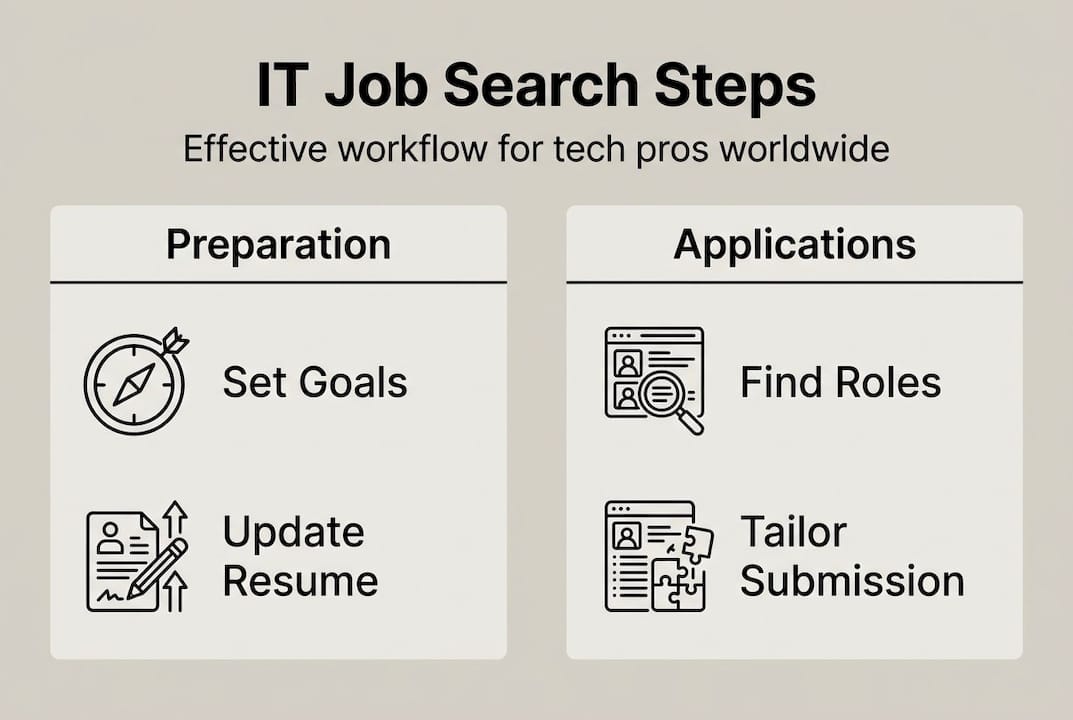
Primary job boards for IT roles include LinkedIn, Indeed, Glassdoor, Wellfound, We Work Remotely, Dice, Otta, Remote OK, Stack Overflow Jobs, Himalayas, Turing, and Toptal. Each serves a different niche.
| Platform | Best for | Role types |
|---|---|---|
| Networking + applying | All IT roles | |
| Wellfound | Startups | Engineering, product |
| We Work Remotely | Remote-first | Dev, design, DevOps |
| Dice | US tech market | Engineering, data |
| Turing | Remote contract | Full-stack, ML |
| Himalayas | Global remote | All IT roles |
For understanding IT job boards more deeply, it helps to know which platforms index the same listings and which have exclusive postings. Avoid spending equal time on every platform. Pick two or three that align with your role type and go deep.
Use advanced filters and saved searches. Set up email alerts for specific job titles, tech stacks, and salary ranges. Check DevOps job types if you're in infrastructure, as the titles vary widely and you may be missing relevant postings.
Watch for these red flags on job postings:
- No salary range listed (often a time-waster in later stages)
- Posted more than 30 days ago with no update
- Generic job description that could apply to any company
- No named hiring manager or recruiter contact
- Requires unpaid trial projects as part of the application
Pro Tip: Bookmark platforms dedicated to remote and contract work separately from your main job board rotation. Job board alternatives like Himalayas and Remote OK surface roles that never appear on LinkedIn or Indeed.
Networking and referrals consistently outperform cold applications. A warm introduction to a hiring manager is worth more than 50 applications sent into a black hole.
Apply smart: Tailor your applications for ATS, AI, and humans
Once you've sourced top job openings, you'll need to make your application stand out. Most companies now use automated systems to filter resumes before a human ever sees them. ATS stands for applicant tracking system, the software that parses your resume for keywords and ranks candidates before a recruiter reviews the pile.

83% of companies use AI for resume screening, and tailoring your resume to each job description doubles your interview rate. That's not a marginal improvement. It's the difference between getting calls and getting silence.
Here's how to tailor your application effectively:
- Copy the job description into a text editor and highlight the top 10 technical and soft skill keywords.
- Mirror those exact terms in your resume, especially in your skills section and bullet points.
- Quantify every achievement you can: "Reduced deployment time by 40%" beats "Improved CI/CD pipeline."
- Add a remote skills section if applying to remote roles: async communication, documentation, self-management.
- Link directly to your GitHub, Kaggle profile, or live project in your resume header.
- Save a separate version of your resume for each role category you're targeting.
Tailoring resumes to job descriptions while focusing on quantifiable achievements and project portfolios significantly increases interview likelihood. This is especially true for strategies for remote IT resumes, where hiring managers can't rely on in-person impressions.
Pro Tip: Never submit the same resume twice without reviewing it against the new job description. Template fatigue is real, and AI screening tools are getting better at spotting low-effort, recycled applications. Using job boards smartly means applying fewer times, but with much higher precision.
Follow through: Network, track, and maximize interview offers
Sending your applications is only half the journey. The professionals who land offers fastest are the ones who stay visible and actively work their network in parallel with applying.
Networking and referrals account for 70 to 85% of job placements, and following up 48 to 72 hours after applying doubles your response chances. These numbers should change how you allocate your time. If you're spending 90% of your effort on applications and 10% on networking, flip the ratio.
Here's a practical follow-up sequence:
- Apply to the role and note the date in a tracking spreadsheet.
- Find the hiring manager or recruiter on LinkedIn within 24 hours.
- Send a short, specific connection request referencing the role and one genuine reason you're excited about the company.
- Follow up via email or LinkedIn message 48 to 72 hours after applying, keeping it to three sentences.
- If no response after 7 days, send one final brief follow-up and then move on.
Consistent LinkedIn activity including content posting and community engagement brings more inbound opportunities than outbound applications in competitive markets. This is a long game, but it compounds fast.
Networking tactics that actually work:
- Request 20-minute informational interviews with engineers at target companies
- Join Slack and Telegram communities specific to your tech stack or role
- Comment meaningfully on posts from engineers and hiring managers at companies you want to join
- Contribute to open source projects used by your target companies
- Share your own work publicly: write-ups, side projects, lessons learned
Use a simple spreadsheet or tool to track every application: company, role, date applied, follow-up date, and current status. Review it weekly. If a batch of applications isn't generating responses after two weeks, revisit your resume and messaging. For more structured IT job search tips and ways to filter IT jobs more efficiently, refining your criteria regularly keeps your pipeline fresh.
Referrals and warm introductions are not just a nice bonus. In a market flooded with AI-generated applications, they are the primary differentiator for serious candidates.
What most tech job seekers miss in 2026
Here's the uncomfortable truth: the job search advice most people follow was written for a different era. Sending 100 applications a month used to be a numbers game you could win. Today, hiring AI flags repeat low-effort patterns, and recruiters are drowning in volume. More applications don't mean more interviews. They often mean fewer.
The real edge in 2026 is reputation. A visible GitHub profile with well-documented projects, a LinkedIn presence that shows you actually think about your field, and two or three genuine relationships inside target companies will outperform 200 cold applications every time.
Open source contributions are underrated. Contributing to a project used by your target company is essentially a working interview. It shows technical judgment, collaboration skills, and initiative in one move.
The professionals landing the best roles right now are not the ones applying the most. They're the ones who have made themselves findable. Recruiters are searching for candidates, not just reviewing inbound stacks. Remote career advice consistently points to the same conclusion: fewer, higher-quality applications with intentional outreach win in a competitive, AI-powered market.
Ready for your next IT job? Start your search now
You now have the full framework: clarity on your goals, a smarter approach to sourcing, a tailored application process, and a networking strategy that actually moves the needle. The next step is putting it into practice on a platform built for IT professionals.
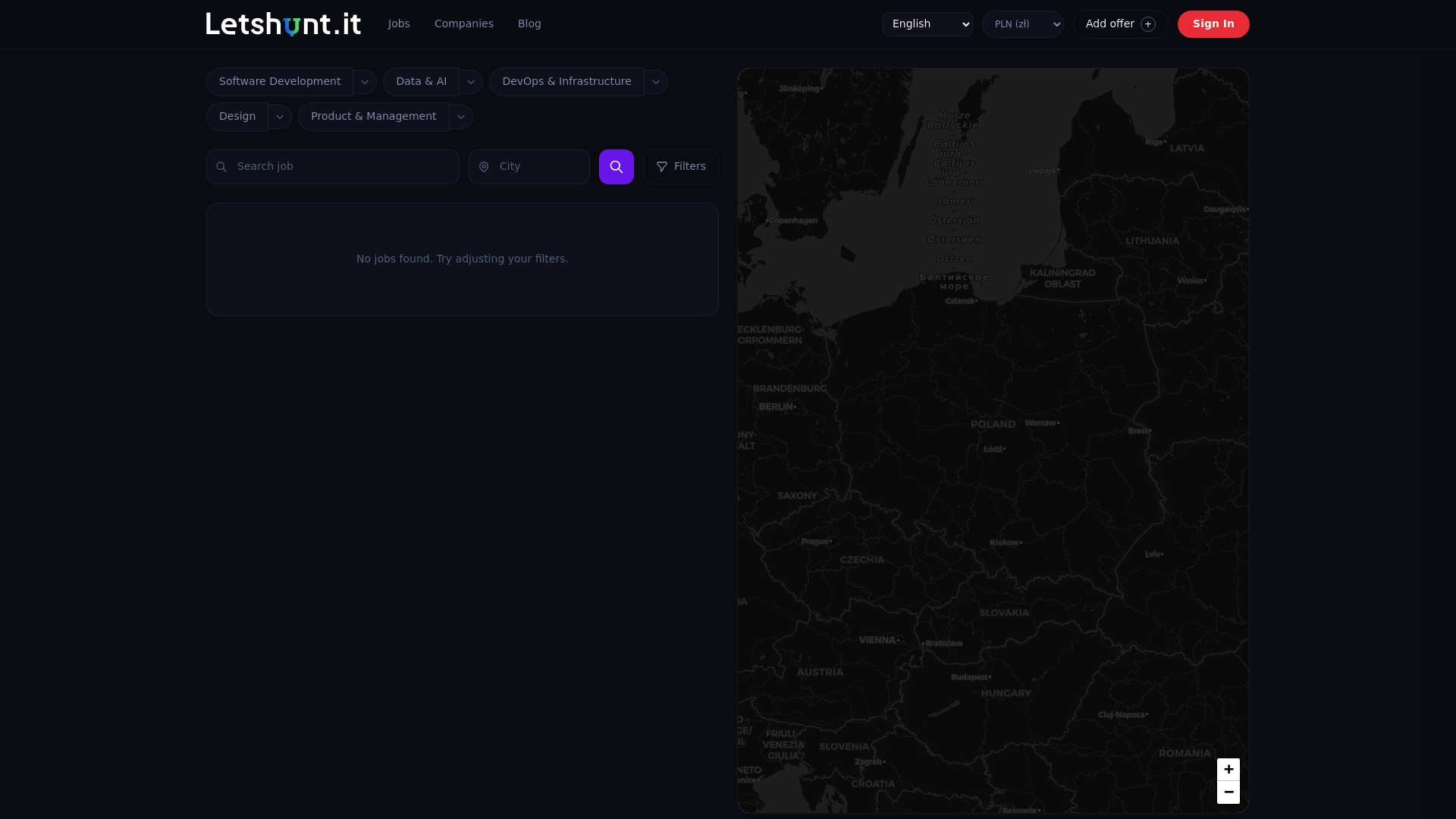
LetsHunt.it offers curated, up-to-date tech job listings across software development, data science, DevOps, infrastructure, design, and product management. Whether you're looking for remote, hybrid, or on-site roles, the platform's filters let you zero in on what fits your skills and location. Stop scrolling through irrelevant postings and browse top IT jobs matched to your field. Your next role is out there. Now you know exactly how to find it.
Frequently asked questions
What are the best platforms to find remote tech jobs?
Top platforms for remote IT jobs include We Work Remotely, Remote OK, Turing, Wellfound, and Stack Overflow Jobs. Each specializes in different role types, so matching the platform to your specific niche saves significant time.
How long does it take to land an IT job offer after applying?
The median time to first interview is 6 to 22 days, with most tech offers finalized between 44 and 83 days after applying. Networking and early applications can shorten this window considerably.
Do referrals really help more than direct applications?
Yes. Referred candidates are significantly more likely to get hired than those applying cold, with networking and referrals accounting for 70 to 85% of all job placements. A single warm introduction often outweighs dozens of cold applications.
What can I do to increase my response rate on tech job applications?
Tailoring your resume and following up 48 to 72 hours after submitting doubles your response chances. Applying within the first 24 to 48 hours of a posting going live also gives you a measurable advantage over later applicants.