
TL;DR:
- US tech sector jobs are growing steadily in AI, cybersecurity, and cloud infrastructure.
- Specialized, high-skill roles are expanding while legacy support positions decline due to automation.
- Adaptability, AI proficiency, and practical project experience are crucial for long-term success.
The US tech sector is adding 185,000 net new jobs in 2026, yet many IT professionals feel more uncertain about their career path than ever before. That gap between raw opportunity and personal clarity is exactly what this guide addresses. Not every role is growing at the same pace, and not every skill will protect you from disruption. Here, we map out which IT jobs are surging, which skills employers are actually hiring for, how team structures are shifting, and what practical steps you can take right now to position yourself for long-term success in the evolving tech landscape.
Table of Contents
- The big picture: IT job market outlook for 2026
- Emerging IT roles: Where jobs are booming
- The top IT skills for 2026 and beyond
- Shifting teams and hiring: The new IT organization
- What most IT career guides miss about 2026 trends
- Advance your IT career with the right job connections
- Frequently asked questions
Key Takeaways
| Point | Details |
|---|---|
| IT workforce is growing | US tech jobs are projected to rise by 1.9% in 2026, signaling new opportunities. |
| AI is reshaping roles | Emerging jobs like AI Engineer and Data Scientist are in highest demand across industries. |
| Skills gaps are critical | Mastering AI, big data, and systems thinking is essential to avoid being left behind. |
| Certifications matter | AI proficiency certifications are becoming key to getting hired in IT by 2026. |
The big picture: IT job market outlook for 2026
The headline numbers are genuinely encouraging. The US tech workforce is on track for 1.9% workforce growth in 2026, and the momentum behind that figure is being driven by three powerful forces: enterprise AI investment, cloud infrastructure expansion, and a cybersecurity threat landscape that shows no signs of slowing down.
At the macro level, global ICT spending hits $4T in 2026, a 10% year-over-year increase fueled almost entirely by AI platforms and the digital transformation budgets of large enterprises. That money flows directly into hiring. Companies need engineers to build the systems, analysts to interpret the data, and security professionals to protect everything in between.
| Sector | Job growth trend | Key driver |
|---|---|---|
| AI and machine learning | Rapid expansion | Enterprise AI adoption |
| Cybersecurity | Strong growth | Rising threat complexity |
| Cloud infrastructure | Steady growth | Digital transformation |
| Legacy IT support | Declining | Automation and consolidation |
| General help desk | Flat to declining | AI-assisted tools |
The picture is not uniformly rosy, though. Legacy IT support roles and general help desk positions are being squeezed by automation. Entry-level generalist roles face real pressure. The growth is concentrated in specialized, higher-skill areas, which means the opportunity is real but targeted.
Here is what you need to understand about the current hiring landscape:
- AI and big data roles are growing faster than any other IT segment
- Cybersecurity professionals remain critically short in supply globally
- Cloud architects and engineers are in sustained demand across industries
- Generalist IT roles are consolidating and shrinking in many organizations
- Mid-level and senior specialists are the primary beneficiaries of current growth
"The tech job market in 2026 rewards depth over breadth. Professionals who own a specialized skill set and can apply it in AI-augmented environments are the ones companies are competing to hire."
For those actively finding IT jobs in 2026, understanding this concentration of growth is the first step toward targeting your search effectively rather than applying broadly and hoping for the best.
Emerging IT roles: Where jobs are booming
The fastest-growing IT roles right now are not the ones that existed five years ago. AI has already created 1.3 million new jobs globally, including entirely new position categories that most hiring managers had never written a job description for before 2023.

The World Economic Forum projects that AI/ML Specialists will see 81% net growth by 2030, with Data Analysts and Scientists close behind at 85% net growth. These are not incremental improvements over existing roles. They represent a structural shift in what technology teams actually do.
Here is a comparison of traditional IT roles versus the emerging positions taking their place:
| Traditional role | Emerging equivalent | Core shift |
|---|---|---|
| Software developer | AI Engineer | Builds and fine-tunes AI models |
| Data analyst | Data Scientist | Predictive modeling, not just reporting |
| IT project manager | AI Operations Manager | Oversees AI system performance |
| Systems administrator | Cloud Infrastructure Engineer | Cloud-native environment management |
| QA tester | Forward-Deployed Engineer | Embeds with clients to solve AI integration problems |
Let's break down the roles seeing the most recruiter attention right now:
- AI Engineers design, train, and deploy machine learning models for production environments
- Data Scientists build predictive systems that inform business decisions at scale
- Forward-Deployed Engineers work directly with enterprise clients to implement and customize AI tools
- AI Operations Managers monitor and optimize AI system performance across an organization
- Big Data Specialists architect the pipelines that make large-scale data usable
For a deeper look at what these positions actually involve day to day, the AI roles explained guide breaks down responsibilities, compensation ranges, and realistic growth paths.
Pro Tip: Recruiters sourcing for AI and data roles are heavily active on LinkedIn and specialized tech job boards. A profile that clearly lists specific tools like PyTorch, TensorFlow, or Snowflake will outperform a generic "data professional" description every time.
The top IT skills for 2026 and beyond
Knowing which jobs are growing is only half the equation. The other half is understanding exactly which skills get you hired into those roles. Employers are not just looking for credentials. They want evidence that you can operate effectively in an AI-augmented environment.
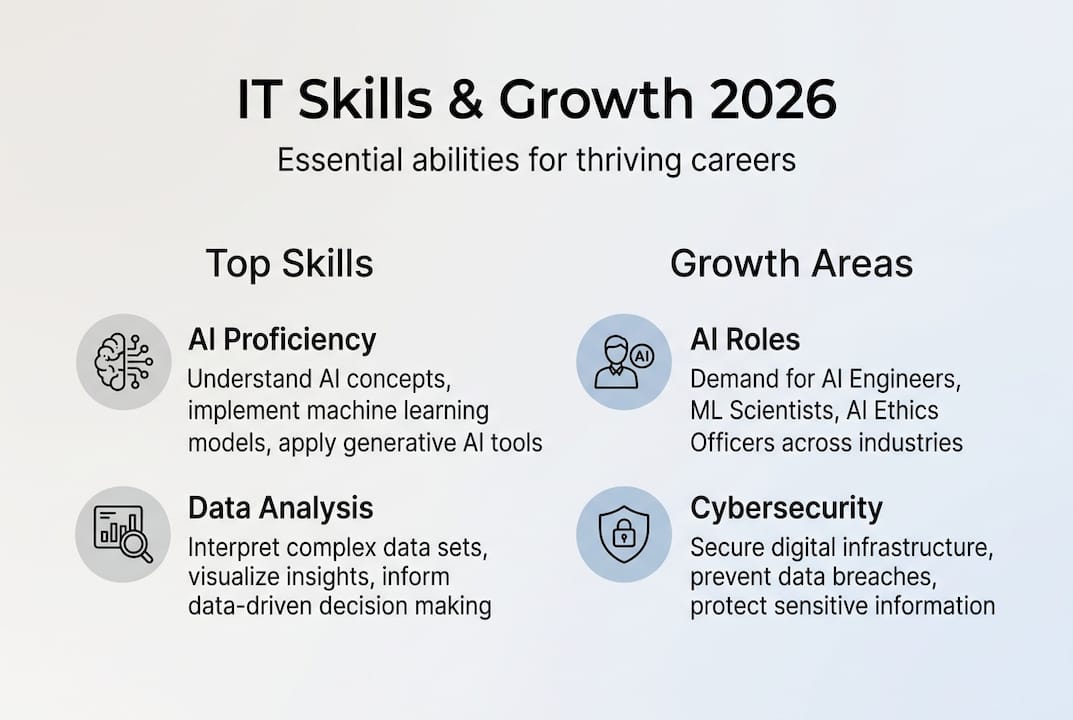
The World Economic Forum identifies AI, big data, and cybersecurity as the top skill clusters employers are prioritizing. And the stakes are rising fast: 75% of IT hiring will require or strongly prefer AI proficiency certifications by 2027, according to Gartner.
Here are the five skills that matter most right now, and why each one carries real weight:
- AI fluency — Understanding how to work with, prompt, fine-tune, and evaluate AI tools is now a baseline expectation in most technical roles, not a bonus
- Cloud architecture — AWS, Azure, and Google Cloud certifications signal that you can build and manage the infrastructure modern applications run on
- Cybersecurity fundamentals — With threat surfaces expanding, every technical role benefits from security awareness, and dedicated security professionals are in short supply
- Big data engineering — The ability to build and maintain data pipelines using tools like Apache Spark or dbt separates junior from senior data professionals
- Systems thinking — The soft skill that ties everything together: understanding how changes in one part of a system ripple through others is what makes senior engineers irreplaceable
Adaptability is the skill underneath all the other skills. The specific tools will change. Professionals who can learn new stacks quickly, apply foundational knowledge to new contexts, and collaborate effectively with AI-assisted teammates will stay relevant regardless of what shifts next.
For practical guidance on positioning yourself in the job market, the IT job search strategies guide covers how to present these skills to employers. If remote work is your goal, remote IT job strategies offers targeted advice for landing distributed roles.
Pro Tip: Certifications matter, but demonstrated projects matter more. A GitHub repo or portfolio showing a working AI integration will move you past the screening stage faster than a certification alone.
Shifting teams and hiring: The new IT organization
The way IT teams are built is changing just as fast as the roles themselves. AI is not just automating tasks. It is redrawing the organizational chart. 80% of organizations are expected to evolve large software development teams into smaller, AI-augmented units by 2030.
This shift has direct implications for job seekers. Smaller teams mean fewer seats, but it also means each team member carries more responsibility and commands higher compensation. The generalist who used to fill a support role in a large team has fewer places to land. The specialist who can own a domain end-to-end is more valuable than ever.
Key changes reshaping IT workplaces right now:
- Teams are shrinking in headcount but expanding in scope and impact
- Cross-functional skills are increasingly expected alongside deep specialization
- AI tools are handling routine coding, testing, and monitoring tasks
- New roles like AI Operations Manager are appearing in org charts that did not exist two years ago
- Hiring timelines are getting longer as companies screen more carefully for AI competency
"The AI skills gap is the single biggest barrier to hiring in tech right now. Companies know what they need. They just cannot find enough people who have it."
That gap is the AI skills barrier Deloitte identifies as the primary hiring roadblock across enterprises. Understanding how tech hiring works gives you a clearer picture of how to navigate screening processes designed to surface exactly those skills.
For job seekers, this means being strategic about where you look. General job boards surface volume. Specialized platforms that focus on tech roles, like those covered in finding tech jobs, surface relevance. If you are exploring software job career paths, understanding how these structural shifts affect your specific track is essential before you commit to a direction.
What most IT career guides miss about 2026 trends
Most career content focuses on job quantity: how many roles are opening, which titles are trending, what the salary ranges look like. That information is useful, but it misses the more important question: are you adaptable enough to stay relevant when the next shift happens?
The real risk in 2026 is not a shortage of IT jobs. It is a skills mismatch so significant that qualified-on-paper candidates are failing to clear AI-focused screening processes. We see this pattern repeatedly in tech hiring: professionals who accumulated certifications without building genuine adaptability hit a wall when the role requires them to actually work alongside AI systems, not just list familiarity with them.
Chasing certifications without foundational adaptation is like memorizing a map without learning to navigate. The credential gets you in the door. What happens next depends on whether you have genuinely internalized how to work in AI-augmented environments.
The professionals who thrive through every market shift share one trait: they invest in understanding why tools work, not just how to use them. That depth is what makes you resilient. Exploring AI job growth factors is a good starting point for building that kind of foundational understanding.
Pro Tip: Build one real AI-integrated project every quarter. It forces genuine learning, gives you something concrete to discuss in interviews, and compounds into a portfolio that no certification can replicate.
Advance your IT career with the right job connections
Understanding the trends is only valuable if you act on them. The next step is putting yourself in front of the employers who are actively hiring for the roles and skills we have covered here.

LetsHunt.it is built specifically for IT professionals who want to cut through the noise and find roles that match their actual skill set. Whether you are targeting AI engineering positions, cybersecurity roles, or cloud infrastructure opportunities, the platform connects you with employers who are hiring for exactly these specializations. Browse the latest IT jobs to see what is open right now, or discover more career opportunities across software development, data and AI, DevOps, and beyond. Your 2026 career move starts with finding the right match.
Frequently asked questions
What IT jobs will be most in demand in 2026?
AI Engineers, Data Scientists, and cybersecurity professionals are seeing the fastest growth. The WEF projects 81-85% net growth for AI/ML Specialists and Data Scientists by 2030, making these the clearest high-demand targets for job seekers.
Do I need an AI certification to get hired for IT jobs in 2026?
Increasingly, yes. 75% of IT hiring will require or prefer AI proficiency certifications by 2027 according to Gartner, so building that credential now puts you ahead of the curve.
What soft skills matter most for IT professionals in 2026?
Systems thinking, adaptability, and the ability to collaborate effectively in AI-augmented teams are the most valued. The WEF identifies technological literacy alongside AI and cybersecurity skills as the top priorities for employers.
How is AI changing IT job structures and teams?
Teams are getting smaller and more specialized, with AI handling routine tasks. 80% of organizations are expected to shift to smaller, AI-augmented development teams by 2030, raising the bar for every remaining team member.