
TL;DR:
- Modern IT recruiters act as technical consultants, data analysts, and talent strategists.
- They use technical knowledge, AI tools, and data analysis to improve hiring speed and quality.
- Adaptability and stakeholder involvement are crucial for success in evolving tech recruitment practices.
Many HR professionals still picture IT recruiters as resume sorters who match keywords to job descriptions and pass candidates along. That picture is wrong. The modern IT recruiter is a technical consultant, a data analyst, and a talent strategist rolled into one. They shape hiring outcomes, reduce costly mis-hires, and build the pipelines that keep tech teams competitive. This guide breaks down what IT recruiters actually do, which skills and tools separate good from great, how they drive measurable hiring efficiency, and what risks you need to avoid when building or working with a tech recruiting function.
Table of Contents
- What does an IT recruiter really do?
- Essential skills and tools for IT recruiters
- How IT recruiters drive hiring efficiency and quality
- Risks, best practices, and future trends in tech recruitment
- Why the real value of IT recruiters is their adaptability
- Need help with IT recruitment?
- Frequently asked questions
Key Takeaways
| Point | Details |
|---|---|
| IT recruiters are consultants | Effective IT recruiters partner with managers and candidates, not just match resumes to jobs. |
| Data and AI skillsets matter | Modern IT recruiters use data analytics and AI tools for quality, fairness, and speed in hiring. |
| Balanced speed and quality | Top recruiters use structured processes to reduce time-to-fill while ensuring strong cultural and technical fit. |
| Best practices reduce risks | Manager involvement, transparent communication, and ongoing skills development help avoid pitfalls in tech recruiting. |
| Adaptability is essential | Staying current with trends and tools is critical for IT recruiter success in 2026. |
What does an IT recruiter really do?
An IT recruiter sources, screens, and manages candidate pipelines for technology roles. But that description barely scratches the surface. The real work involves engaging passive talent who are not actively job hunting, running technical pre-screens that filter for genuine skill fit, and consulting hiring managers on what a realistic candidate profile looks like given current market conditions.
Understanding how tech hiring really works reveals just how much coordination sits behind each offer letter. According to HR Metrics & Benchmarks 2026, IT recruiters handle 20 to 26 requisitions per month, and the median time-to-fill for tech roles sits at 42 to 48 days. That is a high-volume, high-stakes environment where every day a seat stays empty costs the business real money.
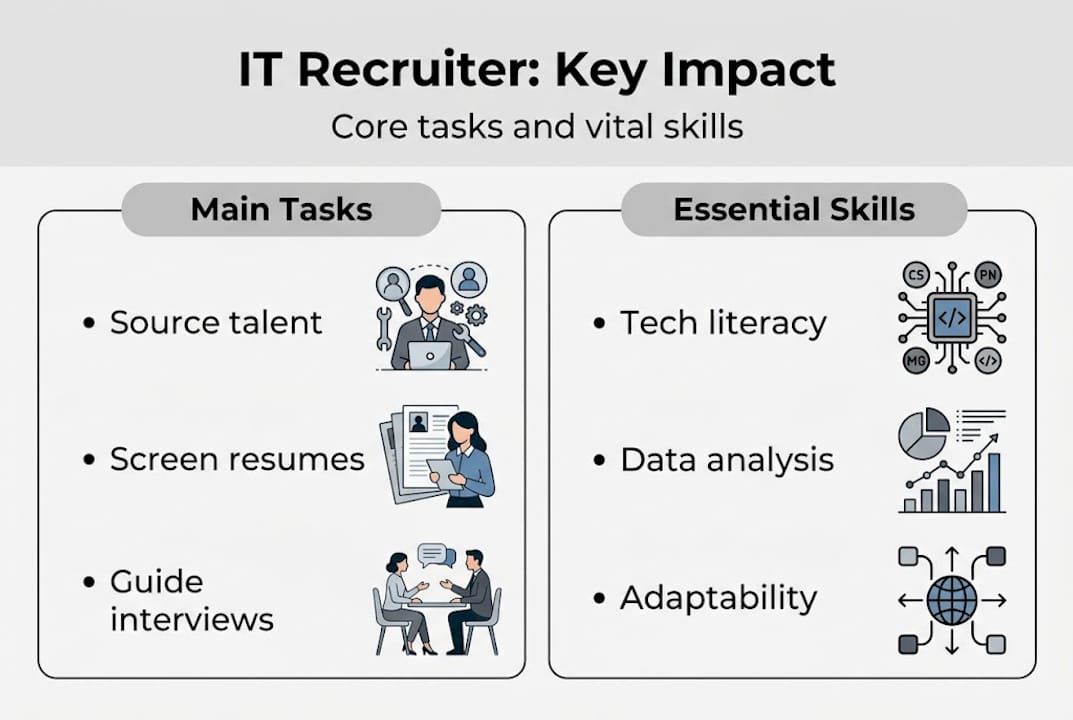
Gartner research on HR recruiting strategy confirms that effective IT recruiters must blend technical acumen, time management, and data expertise to deliver results. They are not order-takers. They push back on unrealistic job descriptions, coach managers on interview best practices, and track funnel metrics to spot where candidates drop off.
Here is how the IT recruiter role compares to a general recruiter:
| Dimension | IT recruiter | General recruiter |
|---|---|---|
| Technical knowledge | Deep: reads job specs, understands stacks | Surface level |
| Sourcing channels | GitHub, Stack Overflow, niche boards | LinkedIn, job boards |
| Screening method | Technical pre-screen plus behavioral | Behavioral only |
| Manager relationship | Consultative partner | Order-taker |
| Metrics tracked | Pipeline velocity, offer acceptance, quality of hire | Time-to-fill, cost |
The core duties of an IT recruiter include:
- Sourcing passive and active candidates across technical communities
- Screening for both technical fit and cultural alignment
- Managing the full hiring process from intake to offer
- Communicating with stakeholders to align on expectations and timelines
- Reporting on pipeline health and hiring metrics to drive decisions
Pro Tip: Treat your IT recruiter as a strategic partner, not a service desk. The more context they have about team dynamics, tech roadmaps, and growth plans, the better their candidate recommendations will be.
Essential skills and tools for IT recruiters
High-performing IT recruiters in 2026 look different from those who succeeded five years ago. The job has grown more technical, more data-driven, and more consultative. If your recruiting team cannot read a tech stack or interpret a hiring funnel report, they are working at a disadvantage.

Gartner's HR recruiting strategy guidance is direct: IT recruiters must read tech stacks, use AI and data analytics, and act as consultants rather than order-takers. That means understanding the difference between a backend Python role and a full-stack JavaScript position, knowing which frameworks are in demand, and speaking credibly with engineers during screening calls.
The tools shaping the tech recruitment workflow in 2026 include AI-powered sourcing platforms, structured interview kits, and talent analytics dashboards. These tools do not replace recruiter judgment. They sharpen it.
Research published in MDPI's data-driven recruitment study found that AI and data analytics can improve transparency and fairness in hiring by up to 9 times compared to purely intuition-based methods. That is a significant gain, but the same research flags real ethical risks around data privacy and algorithmic bias that teams must manage carefully.
Top skills and tools for IT recruiters right now:
- Technical literacy: Understanding programming languages, cloud platforms, and DevOps concepts
- Data analysis: Reading funnel metrics, offer acceptance rates, and source quality reports
- AI sourcing tools: Platforms that surface passive candidates based on skill signals
- Structured interviews: Consistent scoring rubrics that reduce bias and improve prediction
- Stakeholder consulting: Translating business needs into candidate profiles and vice versa
- Knowledge of data job types: Understanding roles from data engineer to ML scientist helps recruiters screen more accurately
Pro Tip: Set aside time each quarter to review the tech stacks your hiring managers are using and the tools your target candidates are excited about. This keeps your conversations credible and your sourcing strategies current.
How IT recruiters drive hiring efficiency and quality
Efficiency in tech hiring is not just about speed. Filling a role in three weeks with the wrong person costs far more than taking six weeks to find the right one. IT recruiters who understand this balance are the ones who deliver lasting value.
SHRM's 2025 recruiting benchmarks show that tech sector recruiters consistently reduce time-to-fill compared to other industries, but they also highlight a critical warning: speed must be balanced with quality to prevent candidate drop-offs and post-hire regret.
Here is how tech hiring benchmarks compare to general recruitment:
| Metric | Tech sector | General recruitment |
|---|---|---|
| Median time-to-fill | 42 to 48 days | 36 to 42 days |
| Average cost-per-hire | $2,795 | $4,700 |
| Applications per hire | 110 | 75 |
| Offer acceptance rate | 82% | 88% |
Research from ScienceDirect on effective recruitment makes a key point that many organizations learn the hard way:
"Rushed turnkey recruitment consistently fails without deep manager involvement. Engagement at every stage is not optional. It is the mechanism that keeps context alive and quality intact."
Here are the recruiter-driven steps that improve both speed and quality:
- Intake meeting: Align with the hiring manager on must-haves, nice-to-haves, and realistic market expectations before posting
- Pipeline building: Combine active sourcing with referrals and tech job boards to maximize candidate diversity
- Technical pre-screen: Use structured questions to filter for genuine skill fit before involving the engineering team
- Stakeholder updates: Share weekly pipeline reports so managers stay informed and engaged
- Offer strategy: Benchmark compensation early and move quickly once a finalist is identified to minimize drop-off
The optimized tech workflow that combines these steps consistently outperforms ad hoc approaches in both time and quality metrics.
Risks, best practices, and future trends in tech recruitment
Even the best IT recruiters operate in an environment full of pitfalls. Knowing where things go wrong is just as important as knowing what to do right.
The biggest risks in tech recruiting today include context loss in turnkey outsourcing models, engineer skepticism toward AI-driven screening, and passive candidate drop-off when the process moves too slowly or feels impersonal. SIOP 2025 research confirms that both turnkey and AI-driven solutions carry real risks, including candidate wariness and reduced contextual understanding that can derail otherwise strong hiring processes.
"Engineers are among the most skeptical candidates when it comes to AI data use in recruitment. They understand the technology, which means they ask harder questions about how their data is being used and why."
Best practices to minimize these risks:
- Keep managers involved at every stage, not just the final interview
- Be transparent with candidates about how AI tools are used in your process
- Upskill your recruiters continuously on both tech trends and data ethics
- Personalize outreach to passive candidates rather than relying on automated bulk messaging
- Audit your tools regularly for bias and data compliance issues
Looking ahead, the future of IT recruiting sits at the intersection of AI-assisted sourcing and deeply human consulting. Recruiters who use job boards in tech recruitment strategically, combined with AI tools that surface hidden talent, will outperform those who rely on either channel alone. Remote IT recruiting strategies are also becoming a baseline skill as distributed teams become the norm rather than the exception.
Pro Tip: When introducing new AI tools to your recruiting process, brief candidates proactively. A short note explaining what data is collected and how it is used builds trust and reduces drop-off among technically sophisticated candidates.
Why the real value of IT recruiters is their adaptability
Here is an uncomfortable truth: automation will handle more sourcing tasks, AI will screen more resumes, and algorithms will schedule more interviews. None of that makes the IT recruiter obsolete. It makes adaptability their most important asset.
The recruiters who will thrive are the ones who treat technology as a tool, not a replacement for judgment. They know that a brilliant engineer might look average on paper because they have been solving niche infrastructure problems for three years. No algorithm catches that without a human asking the right follow-up question.
Credibility with tech teams is earned, not assumed. Recruiters who understand what a senior DevOps engineer actually does, who can talk about CI/CD pipelines without faking it, and who bring market intelligence to every manager conversation are genuinely hard to replace. Insights on IT recruitment evolution show this consultative shift has been building for years. The recruiters who embraced it early are now indispensable. The ones who resisted are being automated out.
Adaptability is not a soft skill. It is the core competency that determines whether an IT recruiter adds value or just adds process.
Need help with IT recruitment?
If these insights have clarified what strong IT recruiting looks like, the next step is putting them into practice with the right platform behind you.
At Let's Hunt, we connect tech companies with qualified IT professionals across software development, data and AI, DevOps, infrastructure, design, and product management. Whether you are building a hiring pipeline from scratch or looking to improve an existing process, our platform gives you access to a global pool of tech talent across remote, hybrid, and on-site roles. Start your IT recruiting journey today and see how a purpose-built tech job portal can reduce time-to-fill and improve the quality of every hire you make.
Frequently asked questions
How do IT recruiters differ from general recruiters?
IT recruiters need deep technical knowledge and consult with hiring managers on skill fit and tech stacks, unlike general recruiters who focus on broader roles. Gartner confirms that blending technical, analytical, and consultative skills is what separates effective tech recruiters from the rest.
What's the average time-to-fill and cost-per-hire for tech roles?
Median time-to-fill for IT jobs is 42 to 48 days and the average cost-per-hire is $2,795 according to industry benchmarks. These figures highlight why pipeline efficiency matters so much in tech hiring.
How is AI used in IT recruitment, and what are the pitfalls?
AI helps identify talent and improve fairness, but candidate caution persists especially among engineers who understand how their data is being processed. Transparency about AI use is essential to maintaining trust.
Can turnkey outsourcing replace the IT recruiter role?
Turnkey outsourcing often fails in tech hiring because context loss occurs when managers are not closely involved throughout the process. The recruiter's contextual understanding is what keeps quality intact.
What is the most important skill for an IT recruiter in 2026?
Adaptability is key, and Gartner's research confirms that a consultative, data-driven approach is what drives the best hiring outcomes. Blending tech knowledge, data literacy, and people skills is no longer optional.