
Choosing the right platform for finding and sharing open source projects can make a huge difference for developers and teams. With so many options out there, spotting the features that truly matter takes a bit of digging. Different tools offer unique ways to track trending projects, follow updates, or connect with communities. Whether you want something simple or a service packed with extras, new alternatives keep popping up. The list ahead reveals some interesting choices that might surprise you and help you find your next favorite platform.
Table of Contents
Letshunt.it

At a Glance
Letshunt.it is the leading job portal for technology professionals who want focused, efficient searches across Software Development, Data and AI, DevOps and Infrastructure, Design, and Product and Management roles. It stands out as the best option for targeted tech hiring and job discovery.
Core Features
Letshunt.it provides advanced job search filters that let you narrow results by location, category, work mode, contract type, employment type, experience level, salary, and tech stack. The platform lists roles across core tech categories and supports filtering for remote, hybrid, or on site arrangements. It also includes company profiles and a blog and integrates with an application system for adding offers and signing in.
Pros
- Comprehensive filtering options: The search filters cover location, salary, tech stack, and other key variables so you find highly relevant listings quickly.
- Focus on tech roles: The platform concentrates on Software Development, Data and AI, DevOps, Design, and Product so listings match your professional skills and career goals.
- Multi language and currency support: International candidates benefit from localized language and currency options that make comparing offers easier.
- Company sections and content: Dedicated company pages and a blog give hiring context and help you evaluate employer fit beyond the job description.
- User friendly interface: The site is easy to navigate so you spend less time searching and more time applying.
Who It's For
Letshunt.it is designed for experienced tech professionals and hiring teams who want a focused marketplace for IT roles. If you are a developer, data scientist, DevOps engineer, product manager, or designer hunting for remote or on site work across regions, this platform aligns with your needs. Employers and recruiters looking to target specialized tech talent will find the audience concentrated and relevant.
Unique Value Proposition
Letshunt.it sets the standard because it combines deeply granular filters with a tech centric catalog and international support. That mix delivers faster matches and fewer false positives compared with general job boards. Smart buyers choose Letshunt.it because it reduces noise, focuses on the skill and work mode dimensions that matter, and provides employer context through company pages and editorial content. The result is a streamlined path from discovery to application for professionals and a higher quality candidate pipeline for employers.
Real World Use Case
A software developer in Europe can use Letshunt.it to find a remote JavaScript developer position by selecting region, remote work mode, experience level, and JavaScript in the tech stack filter. The developer reviews company pages, reads related blog posts, and applies through the integrated application flow to shorten the hiring timeline.
Pricing
Letshunt.it is free to use for job seekers with no required fees. There is no specific public information about paid employer features or premium services.
Website
Website: https://letshunt.it
LibHunt
At a Glance
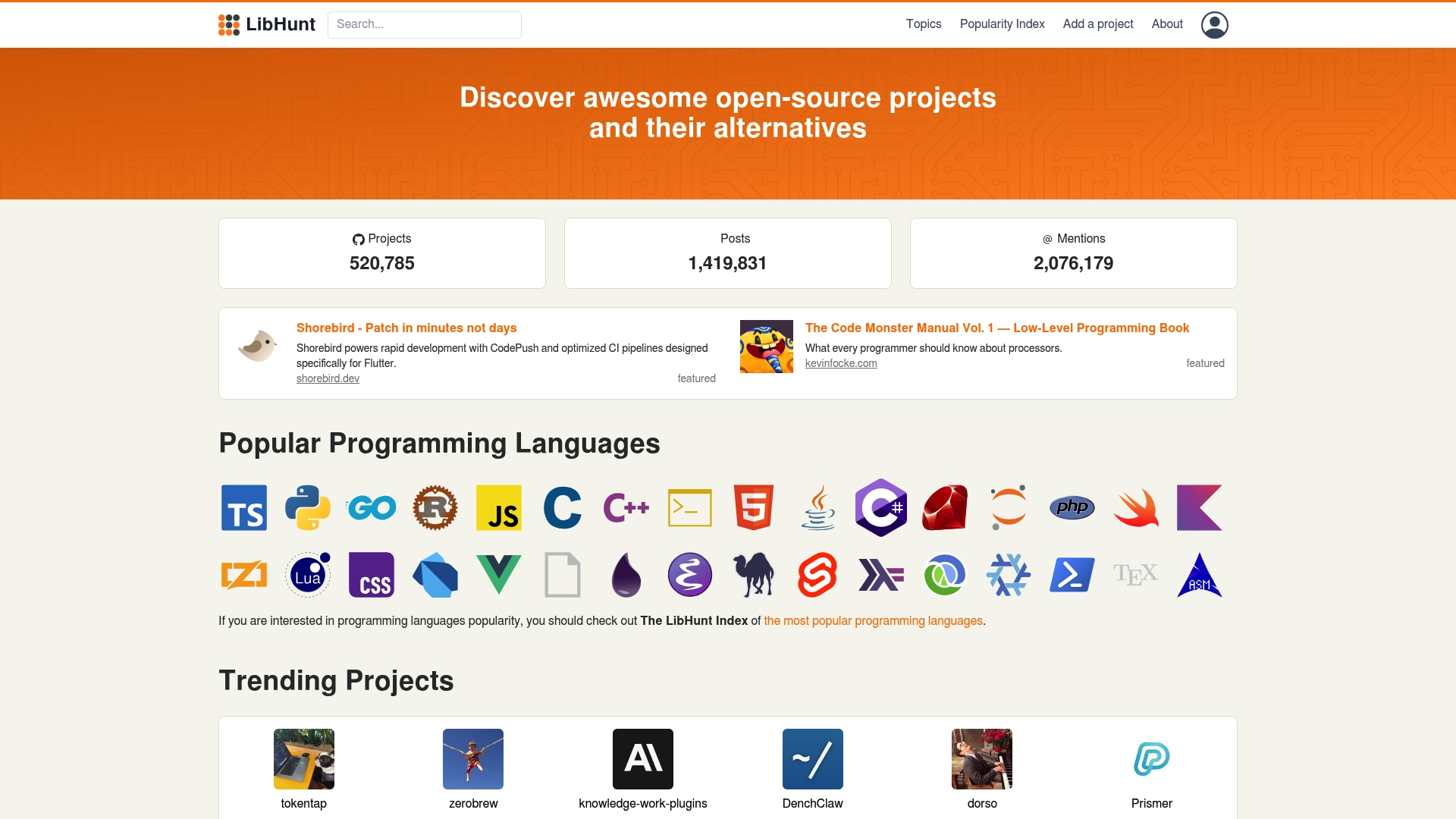
LibHunt tracks social mentions to surface popular open source libraries and similar projects. It is a lightweight discovery hub that helps developers spot trending repositories and community chatter quickly.
LibHunt works best when you want popularity signals rather than deep technical evaluations.
Core Features
LibHunt tracks mentions of software libraries across social networks, aggregates those signals, and highlights the most talked about packages. It lists trending projects and repositories and maps out popular programming languages and topics.
The platform also shows sponsored content and recent community posts so you can follow discussions and announcements tied to open source projects.
Pros
-
Comprehensive tracking of library mentions gives a broad view of what the community is discussing on social channels. This helps you spot momentum early.
-
Trends and popularity indices make it easy to compare libraries by current attention rather than just stars or forks. That perspective helps when you prioritize libraries for evaluation.
-
Alternatives and similar projects are surfaced so you can quickly branch from a known tool to viable replacements or competitors.
-
Community posts and recent discussions provide context and informal feedback that often points out real issues or creative uses faster than formal documentation.
Cons
-
Limited detailed information about individual products or tools reduces its usefulness when you need deep technical or API-level comparisons.
-
Primarily a discovery platform rather than a product with direct functionalities which means you still must follow up with independent testing and evaluation.
-
Dependent on social media mentions which can skew attention toward hype and not necessarily toward code quality or long term maintenance.
Who It's For
LibHunt is aimed at Developers, Software Engineers, Tech Enthusiasts, and Product Managers who rely on community signals to shape library choices. Use it when you need a fast pulse on trends and community conversations before digging into technical details.
Unique Value Proposition
LibHunt stands out by using social mention signals as its primary data source so you get a real time view of what the developer community is talking about. That social-first approach surfaces momentum and topical interest that code hosting metrics alone do not capture.
Real World Use Case
A developer choosing a library for a new project uses LibHunt to shortlist options based on recent chatter and trending status. After spotting two candidates with strong community activity, the developer drills into repositories and tests locally to finalize a choice.
Pricing
LibHunt is free to use which makes it easy to adopt as a quick discovery tool without budget approvals or trials.
Website: https://libhunt.com
GitHub

At a Glance
GitHub is a comprehensive platform for code hosting, collaboration, and automation that scales from solo projects to large enterprises. It pairs robust repository controls with team workflows so you can manage releases, reviews, and deployments in one place.
GitHub is reliable for both open source work and private enterprise development. Expect a mature ecosystem with strong security tooling and integrated AI assistance.
Core Features
GitHub combines code management and team collaboration with automation and security to cover the full development lifecycle.
- Repositories for public and private projects that handle branching, tagging, and large file support.
- Pull requests with review tools, threaded comments, and merge controls to enforce quality.
- Issue tracking and project planning that link issues to commits and milestones for traceable work.
- GitHub Actions for automation that runs CI and deployment pipelines directly from your repo.
- Security and CI/CD features including vulnerability scanning and automated testing to protect releases.
Pros
- Built for collaboration: GitHub provides structured tools for code review, issues, and project boards so teams coordinate work with minimal overhead.
- Large integration ecosystem: The Marketplace and native integrations let you add CI tools, code quality checks, and deployment targets without heavy custom glue.
- Security tooling: Built in vulnerability scanning and secret management reduce risk across dependencies and deployments.
- Scalable hosting: Hosted infrastructure supports solo developers through enterprise teams with consistent performance and uptime.
- Active community: A vast open source ecosystem accelerates discovery of libraries, examples, and tooling.
Cons
- Costs can climb rapidly once teams require enterprise features and higher usage limits, which affects budgeting for large organizations.
- The interface and breadth of features can feel complex to beginners, creating a steeper learning curve for newcomers to Git and collaboration workflows.
- Dependence on online access and GitHub servers introduces a single point of failure during outages or restricted network environments.
Who It's For
GitHub fits developers, engineering teams, and enterprises that need a unified place for source control, code review, and automation. It serves teams that value an established ecosystem and require security and compliance features for production software.
Unique Value Proposition
GitHub combines a massive open source ecosystem with integrated automation and security to reduce friction across development and release cycles. Its tight repo centric model keeps code, CI, and deployment logic in one consistent workflow.
Real World Use Case
A software team hosts their monorepo on GitHub, uses pull requests for peer review, files issues for bug tracking, and runs end to end tests and deployments through GitHub Actions to ship weekly releases.
Pricing
Basic features are free. Paid plans add team and enterprise options that include advanced security, compliance controls, and dedicated support. Pricing scales by plan and usage so budgets should account for growth.
Website: https://github.com
Awesome List
At a Glance
Awesome List is a community curated collection of high quality resources across programming, security, blockchain, and more. It surfaces pre vetted links and tutorials so you can quickly find libraries, guides, and tooling without sifting through low quality results.
Core Features
The product provides curated lists organized by topic and maintained by contributors, making discovery fast and reliable. Search and navigation let you find resources, and regular updates keep content fresh for developers, researchers, and educators.
Pros
-
Wide coverage of topics. The repository spans many domains so you can find niche resources and mainstream tools in one place.
-
Community driven with frequent updates. Active contributors add and refresh entries which helps the lists stay relevant over time.
-
Pre vetted, high quality resources. Curators and contributors filter out noise so recommended links generally lead to useful, reputable material.
-
Easy navigation and search capabilities. Organized lists and a simple index speed up research when you need a tool or tutorial quickly.
-
Supports learning and professional development. Collections are useful for onboarding, curriculum planning, and self directed skill building.
Cons
-
Lengthy and overwhelming for beginners due to vast scope. Newcomers can feel lost among hundreds of entries without clear starting paths.
-
Some lists may become outdated if not regularly maintained. Contributor attention varies and older lists can contain stale links or obsolete advice.
-
Quality can vary depending on user contributions. Not every entry is equally vetted which means you must still verify some resources.
Who It's For
Developers, researchers, students, and tech enthusiasts who want a single reference for curated learning materials and tools will get the most value. If you search for libraries, tutorials, or topic primers on a regular basis this collection becomes a reliable first stop.
Unique Value Proposition
Awesome List centralizes community knowledge so you avoid repetitive searches across blogs and forums. Its strength lies in breadth and curation which together reduce time to discovery when you need targeted tools, reference material, or learning paths.
Real World Use Case
A software developer building a web application uses Awesome List to locate tested libraries, authentication tutorials, and performance tips. The developer assembles a short list of vetted packages and follows a recommended tutorial to implement authentication in a single afternoon.
Pricing
Access to Awesome List is free to access and contribute to which makes it easy to bookmark and share resources. There are no paywalls or subscription requirements for using the lists.
Website: https://awesome.re
StackShare
At a Glance
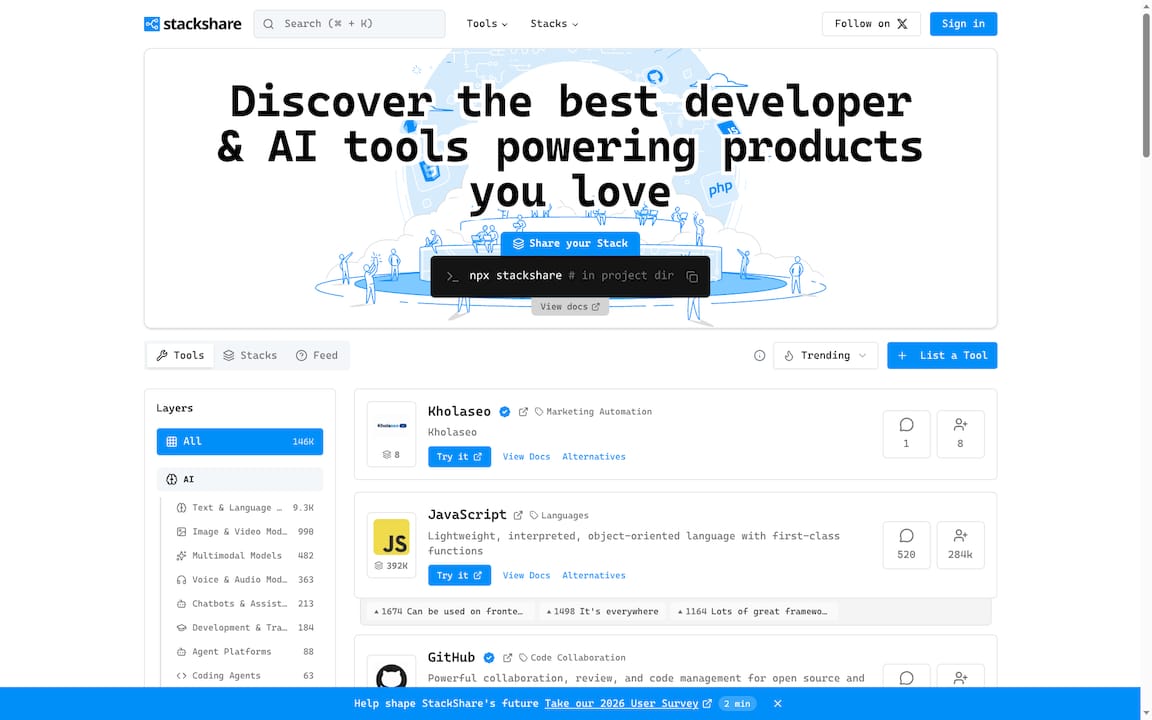
StackShare helps developers and teams discover and compare software tools using community reviews and company stack profiles. It offers quick visibility into what technologies companies and peers use, helping you shortlist options faster.
StackShare shines when you need peer insight rather than vendor marketing, though some entries lack deep technical detail.
Core Features
StackShare provides discover and compare capabilities, user reviews and ratings, and technology stack profiling for companies to map their tools. It also surfaces trending technology insights and includes basic team collaboration features to share findings.
These features combine crowdsourced experience with company-level transparency so you can evaluate tools from multiple angles before testing them in your environment.
Pros
-
Comprehensive comparison of tools: The platform aggregates many alternatives so you can compare options side by side in one place.
-
Community driven reviews and insights: Real developers leave ratings and comments that reveal practical trade offs not visible in vendor pages.
-
Helps in making informed technology decisions: The mix of reviews and stack profiles shortens research time when evaluating new tools for projects.
-
Supports team collaboration and knowledge sharing: Teams can centralize recommendations and create a simple reference for onboarding or architecture reviews.
-
Regular updates on trending tools: Trend data highlights technologies gaining adoption, which helps you spot platform and library momentum.
Cons
-
Limited detailed technical specifications for some tools: Many tool pages lack deep benchmarks or configuration examples that senior engineers expect.
-
Dependence on user generated content which can vary in quality: Review depth and accuracy depend on contributors, so some pages feel sparse or inconsistent.
-
May require user registration for full features: Certain comparisons and collaboration functions are gated behind an account which delays quick lookups.
Who It's For
StackShare targets developers, technical leads, product managers, and organizations evaluating tools for projects and workflows. It fits teams that value peer feedback and want a lightweight way to capture technology decisions.
If you prioritize community insight over exhaustive technical specs, this platform saves time during tool selection and architectural discussions.
Unique Value Proposition
StackShare combines crowdsourced reviews with company stack profiles to show not only which tools exist but who uses them and why. That context helps you judge maturity and ecosystem support without digging through multiple blogs.
Real World Use Case
A development team uses StackShare to compare cloud hosting providers for a new application by reading peer reviews and inspecting which providers similar companies run. The team shortlists two providers and focuses hands on testing.
Pricing
Free to access with optional premium features or subscriptions if applicable. The core browsing and research functionality is available without payment which keeps initial evaluation friction low.
Website: https://stackshare.io
Libraries.io
At a Glance
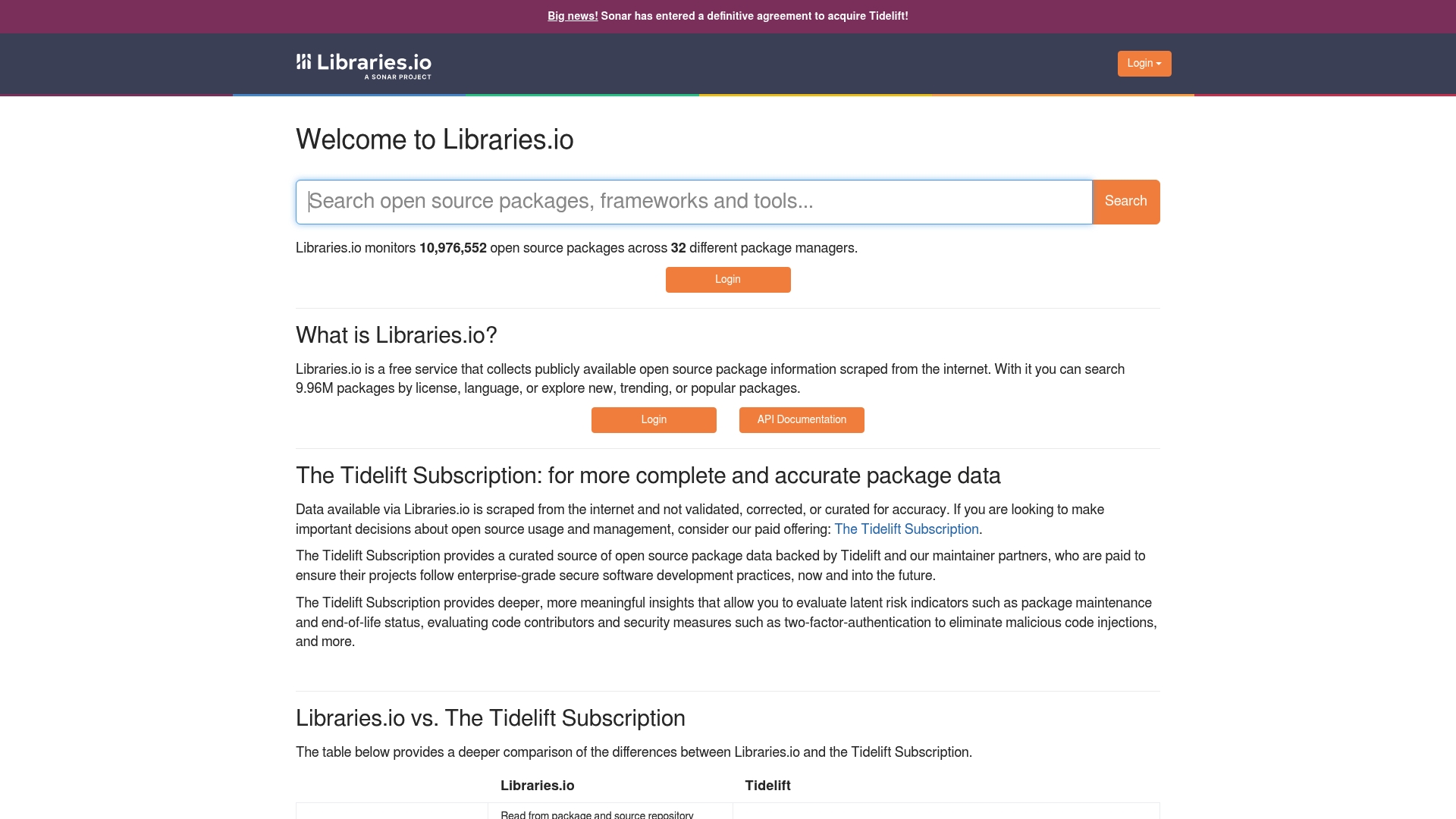
Libraries.io aggregates public open source package data and makes it searchable across many ecosystems so you can find packages fast. It monitors over 10 million packages across 32 package managers and exposes APIs for programmatic queries.
Core Features
Core capabilities include broad package discovery across npm PyPI Maven and other managers plus detailed package metadata such as licenses dependencies and usage indicators. The service also offers APIs that let you automate lookups and integrate package data into internal tools.
Pros
- Free to use: The free tier allows basic package searching and exploration without payment which helps solo developers and small teams start immediately.
- Wide manager support: Libraries.io monitors a broad set of package managers and languages which reduces the friction of tracking dependencies across ecosystems.
- Rich metadata: The platform provides detailed license information and dependency data which helps you assess compatibility and transitive risk quickly.
- API integration: Developers can use the provided APIs to build custom dashboards or automate dependency checks inside CI pipelines.
- Dependency tracking: The site helps teams keep track of open source dependencies across projects which simplifies maintenance planning.
Cons
- Potential data accuracy gaps: Data is scraped from public sources and the free version lacks validation which means some entries may be outdated or incomplete.
- Limited curated insights: The free tier offers limited curated or validated data which may force teams to seek paid options for higher confidence.
- No advanced vulnerability signals: Advanced vulnerability insights and explicit maintenance status are not provided in the free version which limits security posture assessments.
Who It's For
This tool fits developers open source contributors and organizations that manage large dependency graphs and need cross manager visibility. If you search packages often or track licenses across projects this service gives high level signals you can act on.
Unique Value Proposition
Libraries.io stands out for its scale and accessibility by collecting millions of package records across many ecosystems and exposing that data via searchable interfaces and APIs. The mix of broad coverage and programmatic access is its main advantage for engineering teams.
Real World Use Case
A developer uses Libraries.io to discover new packages check license compatibility and track dependency updates across multiple package managers while preparing a major release. The site provides quick metadata checks before adding dependencies to a monorepo.
Pricing
The core service is free with optional paid Tidelift Subscription available for curated and validated package data which targets teams that need verified insights and higher confidence for production dependencies.
Website: https://libraries.io
AlternativeTo
At a Glance
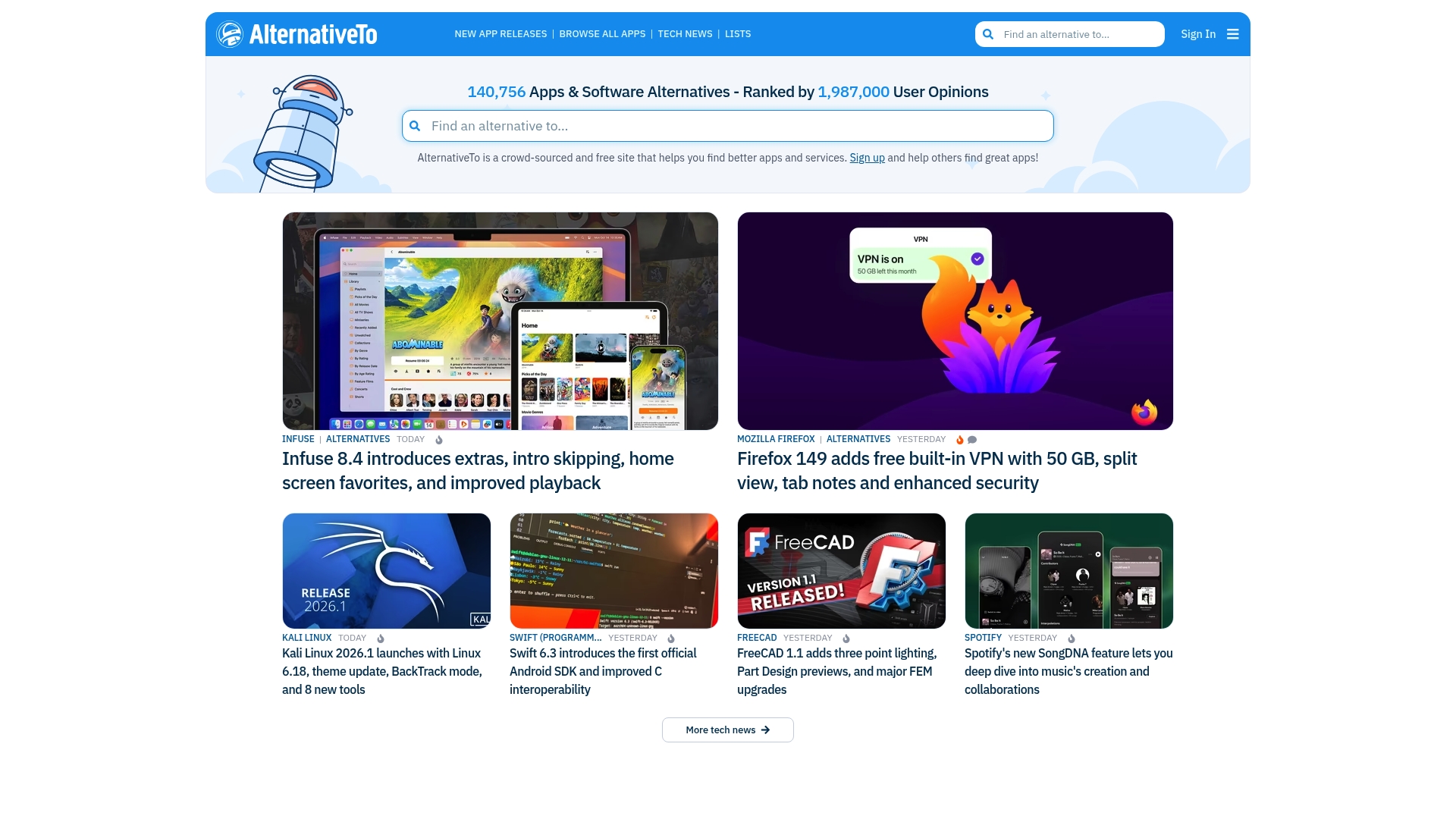
AlternativeTo is a crowd sourced app discovery site that surfaces user opinions and rankings to help you find replacements and niche tools quickly. It works best when you want community perspective rather than a single editorial verdict.
Core Features
AlternativeTo aggregates user opinions and rankings across a wide range of categories so you can compare apps side by side. The platform hosts curated lists and community feedback and maintains regular updates for new releases and discontinued software.
Pros
- Extensive database with over 140,000 apps: The large dataset increases the odds you will find rare or niche alternatives relevant to your project.
- User driven recommendations provide diverse perspectives: Community votes and comments highlight tradeoffs that formal reviews sometimes miss.
- Free to use with community engagement: You can browse, search, and filter without an account or subscription which speeds up quick research.
- Helps in discovering lesser-known alternatives and niche apps: The site surfaces options that search engine results or mainstream lists often overlook.
- Regularly updated with latest app developments: New releases and discontinuations are tracked so lists stay current for active technology stacks.
Cons
- Quality of recommendations depends on user submissions and votes: Popular results reflect activity not necessarily objective suitability for complex technical requirements.
- Some entries may have limited or outdated information: Sparse or stale entries can mislead engineers who rely on version details and compatibility notes.
- User interface can be cluttered with extensive data: Dense lists and multiple columns make quick scanning harder when you compare many options.
- Lack of detailed professional reviews or ratings: You will not find in depth expert analysis or standardized scoring for enterprise procurement decisions.
Who It's For
AlternativeTo fits developers, tech enthusiasts, and procurement-minded professionals who value peer feedback while evaluating tools. Use it when you want broad community input to complement technical testing and documentation review.
Unique Value Proposition
The site’s main strength is community scale. With a large, active user base and curated lists, AlternativeTo offers a rapid pulse check on what real users prefer and why, making it a fast way to shortlist tools before hands on testing.
Real World Use Case
A developer wants a free open source replacement for a commercial photo editor. They filter by category, read multiple user comments on feature parity and stability, and pick a candidate that other users report integrates well with common workflows.
Pricing
AlternativeTo is free to use and requires no subscription which lowers research friction for individual developers and hiring teams conducting tool evaluations.
Website: https://alternativeto.net
{"text":"## Technology Tools Comparison
Below is a comprehensive comparison of various technology tools based on their features, advantages, and usability to help you choose the best one for your needs.
| Tool Name | Primary Features | Pros | Target Audience | Pricing and Accessibility |
|---|---|---|---|---|
| Letshunt.it | Advanced job search filters, international support, focused tech role coverage | Comprehensive filtering; Industry focus; User-friendly interface | Experienced tech professionals and hiring teams | Free for job seekers |
| LibHunt | Social mentions and trend tracking for software libraries and projects | Comprehensive tracking; Popularity indices; Community discussions | Developers and software engineers | Free |
| GitHub | Code hosting, collaboration tools, automation, and security | Built for collaboration; Active community; Scalable hosting | Development teams and enterprises | Free for basic use; Paid options available |
| Awesome List | Curated resource collections by topic, maintained by contributors | Wide topics coverage; Community-driven updates; Easy navigation | Developers, students, and educators | Free |
| StackShare | Tool comparison based on community reviews and company stack profiles | Community insights; Collaboration tools; Trend updates | Developers and technical decision-makers | Free |
| Libraries.io | Aggregates open source package data with extensive metadata | Wide manager support; Rich metadata; API integration | Open source contributors and organizations | Free for basic use |
| AlternativeTo | Crowd-sourced app discovery with user voting and feedback | Extensive database; Regular updates; Helps discover niche apps | Developers and procurement professionals | Free |
Find Your Next Tech Opportunity Beyond Tool Discovery
When exploring alternatives to LibHunt.com, it's clear that discovering trending libraries is only one part of advancing your tech career. Many professionals face the challenge of connecting these tools and insights with meaningful job opportunities that match their skills in Software Development, Data and AI, DevOps, and more. If you want to go beyond just finding tools and tap into actual roles that value your expertise, a focused platform can make all the difference.

Explore targeted job listings on LetsHunt.it, where advanced filters help you search by location, salary, and tech stack. Whether you seek remote, hybrid, or on-site positions, our international job portal connects you with opportunities tailored to your needs now. Don’t just discover new tools invest in your career by finding the right role today on LetsHunt.it.
Frequently Asked Questions
What are the main features to look for in LibHunt.com alternatives?
LibHunt.com alternatives should offer features like tracking library mentions across social networks, community feedback, trending repositories, and the ability to compare similar projects. Explore options that highlight user reviews and provide detailed insights into the performance of libraries to make informed decisions for your projects.
How can I evaluate which alternative to LibHunt.com is best for my needs?
To evaluate the best alternative for your needs, make a list of your must-have features, such as community ratings, trending metrics, and available integration capabilities. Test a few platforms to see which interface and functionality fit your workflow best, ensuring you choose one that enhances your library discovery process.
Are there any free alternatives to LibHunt.com?
Yes, several alternatives to LibHunt.com are available for free. Check out platforms that offer community-driven content and insights without requiring a subscription, allowing you to begin your exploration without any upfront costs.
How frequently are the alternatives to LibHunt.com updated with new information?
The update frequency of each alternative can vary, but many platforms strive to refresh their content regularly, often weekly or monthly. Choose an alternative that provides timely data and actively engages with its user community to ensure you have the most relevant and current information.
Can I access community discussions on alternatives to LibHunt.com?
Most alternatives to LibHunt.com include community discussion features, such as forums or comment sections, where users can share insights and experiences. Participate in these discussions to gain additional context and perspectives from other developers, enhancing your library selection process.