
Product management roles in tech can feel like a maze. Job titles overlap, responsibilities blur, and every company seems to define positions differently. If you're a tech professional exploring PM opportunities or planning a career shift, this confusion can stall your progress. Understanding the distinct roles, their expectations, and how they fit into different organizations is essential for making informed decisions and landing the right position. This guide breaks down the key product management roles, clarifies their responsibilities, and shows you how to navigate your path into this dynamic field.
Table of Contents
- Key Takeaways
- Overview of product management roles
- Detailed roles and responsibilities in product management
- How product management roles differ by company and industry
- Practical steps to transition into product management roles
- Explore product management jobs with Letshunt
- FAQ
Key Takeaways
| Point | Details |
|---|---|
| Role variety and confusion | PM titles overlap and responsibilities vary by company, making it essential to clarify what a role entails before applying. |
| Differences by level | Associate to Senior PMs differ in scope from learning to leading strategic initiatives. |
| Startup versus enterprise | Startups often require wearing multiple hats while enterprises specialize in focused domains with dedicated research and analytics resources. |
| Sector influences success metrics | B2B SaaS, consumer apps, and hardware each emphasize different success metrics and development timelines. |
Overview of product management roles
Product management serves as the strategic bridge connecting customer needs, business objectives, and technical execution. In tech companies, product managers drive the vision, roadmap, and success metrics for digital products, ensuring teams build solutions that deliver real value. The discipline requires balancing market research, user feedback, competitive analysis, and cross-functional collaboration to guide products from concept through launch and beyond.
Common core roles in product management include:
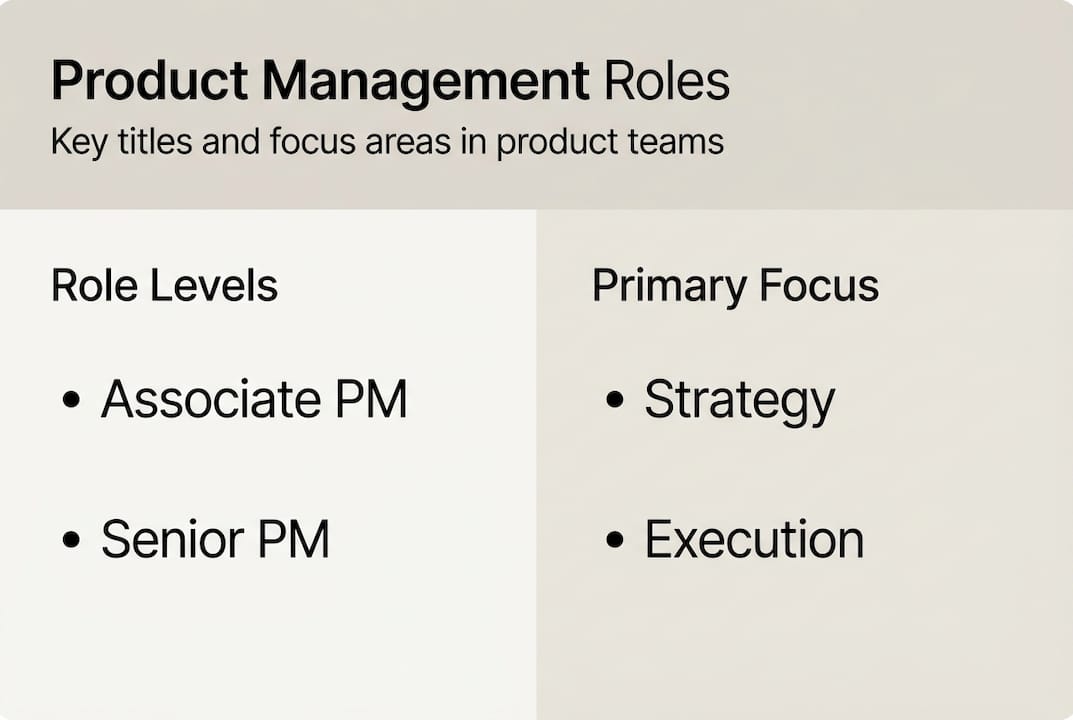
- Associate Product Manager: Entry-level position focused on learning the craft, supporting senior team members, and handling specific features or smaller product areas
- Product Manager: Mid-level role with ownership of product areas, responsible for roadmap execution, stakeholder alignment, and driving measurable outcomes
- Senior Product Manager: Advanced position managing complex products or multiple product lines, leading strategic initiatives, and mentoring junior team members
- Product Owner: Role emphasizing backlog management, sprint planning, and day-to-day coordination with development teams in agile environments
These product management role variations depend heavily on factors like company size, product complexity, and organizational structure. A startup PM might wear multiple hats, handling everything from customer interviews to sprint planning, while an enterprise PM often specializes in specific product domains with dedicated resources for research, design, and analytics. Understanding these contextual differences helps you identify which environments match your skills and career goals.
Regardless of specific title, most product management roles share common responsibilities. You'll define product vision and strategy, prioritize features based on impact and feasibility, collaborate with engineering and design teams, analyze user data and market trends, and communicate progress to stakeholders. The depth and breadth of these responsibilities scale with seniority, but the core function remains consistent: ensuring the right product gets built for the right users at the right time.
Company sector also influences role definition. B2B SaaS companies emphasize enterprise sales cycles and customer success metrics, consumer mobile apps prioritize user engagement and retention, and hardware-focused organizations require deeper technical knowledge and longer development timelines. Recognizing these sector-specific nuances helps you prepare for interviews and understand what success looks like in different contexts.
Detailed roles and responsibilities in product management
Each product management level carries distinct expectations and requires different skill combinations. The table below compares key aspects across major roles:
| Role | Primary Focus | Key Responsibilities | Required Skills | Stakeholder Scope |
|---|---|---|---|---|
| Associate PM | Learning and execution | Feature specification, user research support, data analysis | Analytical thinking, communication, basic technical literacy | Internal teams, limited external |
| Product Manager | Ownership and delivery | Roadmap management, cross-functional leadership, metrics tracking | Strategic thinking, prioritization, stakeholder management | Cross-functional teams, customers |
| Senior PM | Strategy and mentorship | Product vision, complex problem-solving, team development | Leadership, business acumen, advanced technical knowledge | Executive level, key partners |
| Product Owner | Backlog and sprints | Story writing, sprint planning, acceptance criteria | Agile methodology, technical detail, team coordination | Development team, scrum master |
Associate Product Managers typically enter the field fresh from university or after 1-2 years in related roles like business analysis or project management. You'll spend significant time learning how products get built, understanding user needs through research, and supporting more experienced PMs with specific deliverables. Expect to write detailed feature specifications, analyze user behavior data, and participate in sprint ceremonies. Success at this level means demonstrating curiosity, attention to detail, and the ability to translate ambiguous requirements into clear documentation.
Product Managers own outcomes for specific product areas or features. You'll define what gets built and why, balancing user needs against business constraints and technical feasibility. This role demands strong skills for product management roles including the ability to say no to good ideas in favor of great ones, facilitating alignment across engineering, design, marketing, and sales teams, and using data to validate assumptions and measure impact. Your day involves strategic planning sessions, user interviews, roadmap reviews, and constant communication to keep everyone moving toward shared goals.

Senior Product Managers handle greater complexity and ambiguity. You might oversee multiple product lines, lead major strategic initiatives, or tackle problems without clear solutions. At this level, you're expected to influence company direction, mentor junior team members, and navigate organizational politics effectively. Technical depth increases, requiring you to engage in architecture discussions, evaluate build-versus-buy decisions, and understand technical debt implications. Your stakeholder interactions expand to executives, key customers, and strategic partners.
Product Owners focus heavily on the tactical execution within agile frameworks. While Product Managers define the what and why, Product Owners translate that into actionable user stories, acceptance criteria, and sprint goals. You'll work closely with development teams, attending daily standups, refining backlogs, and making real-time decisions about scope and priority. This role requires deep understanding of technical constraints and excellent communication skills to bridge business needs with engineering realities.
Pro Tip: Develop your communication and prioritization skills early in your product career, regardless of your starting role. The ability to articulate complex ideas simply and make tough tradeoff decisions separates good PMs from great ones across all levels.
How product management roles differ by company and industry
Organizational context dramatically shapes what product management looks like day-to-day. Company impact on product roles manifests in scope, resources, processes, and success metrics. Understanding these differences helps you find environments where you'll thrive and avoid mismatches that lead to frustration.
In startup environments, product managers often function as generalists. You might conduct customer development interviews in the morning, write user stories after lunch, and help with go-to-market strategy before dinner. Resources are limited, so scrappiness and adaptability matter more than specialized expertise. Decision-making happens quickly with minimal process, and you'll likely have direct access to founders and executives. The tradeoff: less mentorship, more ambiguity, and higher risk of product failure.
Large enterprises offer specialization and structure. Product managers focus on specific domains with dedicated support from researchers, analysts, designers, and technical writers. Processes are well-defined, with stage gates, approval chains, and formal review cycles. You'll navigate complex stakeholder landscapes and align multiple teams toward common objectives. The benefits include mentorship opportunities, established career paths, and greater resources. The challenges: slower decision-making, bureaucracy, and potentially less direct impact visibility.
Industry-specific nuances further differentiate roles:
- SaaS companies emphasize subscription metrics, customer retention, and feature adoption, requiring strong analytical skills and understanding of recurring revenue models
- Mobile app organizations prioritize user acquisition, engagement loops, and app store optimization, demanding expertise in consumer behavior and platform-specific guidelines
- Hardware-focused companies involve longer development cycles, supply chain considerations, and regulatory compliance, necessitating technical depth and patience with extended timelines
- Marketplace platforms balance multi-sided networks, liquidity challenges, and complex incentive structures, requiring systems thinking and economic modeling capabilities
"Success in product management depends not just on your skills, but on finding organizational contexts that align with your working style, values, and career goals. Company size and industry create fundamentally different environments that shape your daily experience and growth trajectory."
Company culture influences role boundaries and expectations. Some organizations maintain strict separation between Product Managers and Product Owners, while others use the titles interchangeably. Certain companies expect PMs to have engineering backgrounds, while others value business or design expertise equally. Before pursuing opportunities, research how the company defines product roles, what skills they prioritize, and how product teams interact with other functions. This due diligence prevents surprises and helps you assess cultural fit.
Practical steps to transition into product management roles
Breaking into product management requires strategic preparation, especially for career changers. Follow these steps to increase your success rate:
- Research role requirements thoroughly by analyzing job descriptions for positions you're targeting, identifying common skills and qualifications, and understanding what different companies value in candidates
- Assess your transferable skills honestly, mapping your current experience to product management competencies like problem-solving, communication, analytical thinking, and customer empathy
- Fill knowledge gaps through targeted learning, taking online courses in product management fundamentals, agile methodologies, and data analysis, while reading industry blogs and books
- Gain practical experience by volunteering for product-related projects in your current role, building side projects to demonstrate product thinking, or offering to help startups with product challenges
- Build your network by attending product management meetups and conferences, connecting with PMs on LinkedIn for informational interviews, and joining online communities where product professionals gather
- Create a compelling narrative that explains your transition motivation clearly, highlights relevant achievements from your background, and demonstrates genuine passion for product work
- Tailor applications meticulously by customizing resumes to emphasize product-relevant experience, writing cover letters that address specific company challenges, and preparing concrete examples for behavioral interviews
- Practice product thinking by staying current on tech trends and product launches, analyzing products you use daily with a critical eye, and preparing for case interviews with structured frameworks
Pro Tip: Leverage transferable skills from your current field rather than starting from zero. Engineers bring technical credibility, designers understand user-centered thinking, marketers excel at positioning and messaging, and consultants master stakeholder management. Identify your unique angle and emphasize how your background adds value to product teams.
Entering product management successfully often requires patience and persistence. Many career changers start with associate or junior positions, accepting initial salary adjustments to gain experience. Others transition internally by moving into product roles within their current companies where they already have credibility and context. Some pursue MBA programs or formal product management training to build credentials and networks.
Tailoring your approach to specific roles matters enormously. When applying for Product Owner positions, emphasize agile experience and technical collaboration skills. For Product Manager roles, highlight strategic thinking and cross-functional leadership. Senior positions require demonstrating measurable impact, mentorship experience, and the ability to navigate complexity. Study each job description carefully and adjust your materials accordingly.
Continuous learning separates successful product professionals from those who plateau. Technology evolves rapidly, user expectations shift constantly, and new methodologies emerge regularly. Commit to staying current through reading, experimentation, and feedback-seeking. Build relationships with other PMs who can share insights and challenge your thinking. Embrace failure as learning opportunities rather than setbacks. The most effective product managers maintain beginner's mindset while developing deep expertise, remaining curious and adaptable throughout their careers.
Explore product management jobs with Letshunt
Ready to put your product management knowledge into action? Letshunt connects tech professionals with current opportunities across all product management levels and specializations. Whether you're seeking your first associate role or a senior position leading strategic initiatives, the platform offers comprehensive listings from startups to enterprises.

Search roles by experience level, industry focus, and company size to find positions matching your skills and career goals. Filter for remote, hybrid, or on-site opportunities across global markets. Each listing includes detailed role descriptions, required qualifications, and company information to help you make informed decisions. The platform updates continuously, ensuring you access the latest openings in product management. Take the next step in your product career by exploring product management job listings today and connecting with companies seeking talented product professionals like you.
FAQ
What qualifications do I need for different product management roles?
Qualifications vary significantly by level and company. Entry-level associate positions often accept candidates with relevant degrees in business, computer science, or design, plus internships or related experience. Mid-level product manager roles typically require 3-5 years of product experience or equivalent work in adjacent fields like consulting, engineering, or project management. Senior positions expect 7+ years with proven track records of successful product launches, team leadership, and strategic impact.
How do product management roles differ from product owner roles?
Product managers focus on strategic vision, market positioning, and long-term roadmap planning, spending significant time on user research, competitive analysis, and stakeholder alignment. Product owners concentrate on tactical execution within agile frameworks, managing backlogs, writing user stories, and coordinating daily with development teams. While overlap exists, product managers typically own the what and why, while product owners handle the how and when of delivery.
Can I transition into product management without a technical background?
Absolutely. Many successful product managers come from non-technical backgrounds in marketing, design, business operations, or customer success. Focus on developing strong analytical skills, learning basic technical concepts, and emphasizing your unique perspective. Communication abilities, business acumen, and customer empathy often matter more than coding skills. Supplement gaps through online courses, shadowing technical teams, and asking lots of questions to build technical literacy over time.
How long does it take to move from associate to senior product manager?
Timelines vary widely based on individual performance, company growth, and learning opportunities. Typical progression from associate to product manager takes 2-3 years, then another 3-5 years to reach senior level. However, fast-growing startups may accelerate advancement, while large enterprises often have more structured timelines. Focus on delivering measurable impact, seeking increasing responsibility, and developing leadership skills rather than fixating on titles or timelines.