
TL;DR:
- Software jobs are expected to grow 15 to 36% through 2033, creating new opportunities.
- Remote and hybrid work environments dominate modern software roles, emphasizing collaboration skills.
- AI is increasing productivity and shifting roles toward validation, oversight, and specialized AI applications.
Despite widespread fears that AI is eliminating tech roles, software developer jobs are projected to grow 15 to 25% through 2033, with data scientist roles expanding at 36%, far faster than most other professions. That means hundreds of thousands of new positions are opening up, not disappearing. But the landscape has shifted dramatically. Software jobs in 2026 cover far more ground than writing code in a cubicle. This guide breaks down the real categories, working environments, essential skills, and how AI is reshaping every layer of the field so you can navigate your next move with clarity.
Table of Contents
- What are software jobs? Categories and opportunities
- Modern software job environments: Remote, hybrid, and global
- Key skills and methodologies in software jobs
- AI's impact on software job roles and career growth
- How to advance or transition your software career
- What most guides miss about thriving in software jobs
- Find your next software job with Let's Hunt
- Frequently asked questions
Key Takeaways
| Point | Details |
|---|---|
| Growing demand | Software jobs are surging with over 129,000 new roles projected in the next decade. |
| New career paths | Roles like forward deployed engineer and MLOps are emerging thanks to AI and cloud expansions. |
| Remote is the norm | Most software professionals now work remotely or in hybrid teams using global tech stacks. |
| Valuable skills | Agile, AI proficiency, and excellent collaboration matter as much as core coding abilities. |
What are software jobs? Categories and opportunities
Software jobs are roles focused on building, testing, deploying, and maintaining software applications and systems. That definition sounds simple, but the range of work underneath it is enormous. A software job might mean writing Python pipelines for a machine learning model, configuring cloud infrastructure, or running user research to inform product decisions.
The main categories you will encounter include:
- Software developer / engineer: Builds and maintains applications across web, mobile, and backend systems
- Data scientist: Extracts insights from data using statistical modeling and machine learning
- QA engineer: Tests software to catch bugs and ensure quality before release
- DevOps engineer: Bridges development and operations, automating deployments and managing infrastructure
- Product manager: Defines what gets built and why, coordinating between technical and business teams
Beyond these core roles, the AI era has created a new layer of specializations. Machine learning engineers, MLOps specialists, UI/UX developers, and forward deployed engineers (professionals embedded with clients to implement AI solutions) are all growing fast. These software career roles reflect a market that rewards breadth as much as depth.
| Role | Primary focus | Growth outlook |
|---|---|---|
| Software developer | Application building | 15 to 25% by 2033 |
| Data scientist | Data modeling and AI | 36% by 2033 |
| DevOps engineer | Automation and infrastructure | Strong, above average |
| ML engineer | AI model development | Rapidly expanding |
The data job types alone have multiplied significantly, with roles splitting into analytics, engineering, and AI-specific tracks. Understanding which category fits your strengths is the first step to targeting the right opportunities.
Modern software job environments: Remote, hybrid, and global
Now that you know what's out there, let's explore how and where these jobs actually unfold. The shift toward remote and hybrid work has permanently changed how software teams operate. For most tech professionals, the question is no longer whether remote work is possible but how to do it well.

Remote roles offer flexibility and access to global employers. Hybrid roles blend structured office time with independent work. In-person roles still exist, particularly at larger enterprises or in regulated industries, but they are no longer the default. Most software hiring today skews toward remote or hybrid arrangements.
One fact surprises many newcomers: 40 to 50% of time in a typical software role is spent on planning, testing, reviewing, and communicating rather than writing code. That means your ability to collaborate asynchronously, write clear documentation, and run effective standups is just as important as your technical output.
| Environment | Key tools | Main challenge |
|---|---|---|
| Remote | Slack, Jira, GitHub, Zoom | Staying aligned across time zones |
| Hybrid | Office days plus async tools | Balancing two modes of work |
| In-person | Whiteboard sessions, shared IDEs | Less flexibility, higher commute cost |
Modern software teams run on Agile frameworks, meaning short sprints, frequent check-ins, and continuous delivery. Understanding essential teamwork in tech is not optional. Teams that communicate well ship better products, regardless of where they sit.
Pro Tip: Treat remote collaboration as a skill to practice, not a perk to enjoy. Professionals who write clearly, respond quickly, and document decisions consistently stand out in distributed teams.
Key skills and methodologies in software jobs
After understanding the workspaces, success in software jobs hinges on key skills and shared practices. The technical foundation matters, but methodology is what ties individual skills into team output.
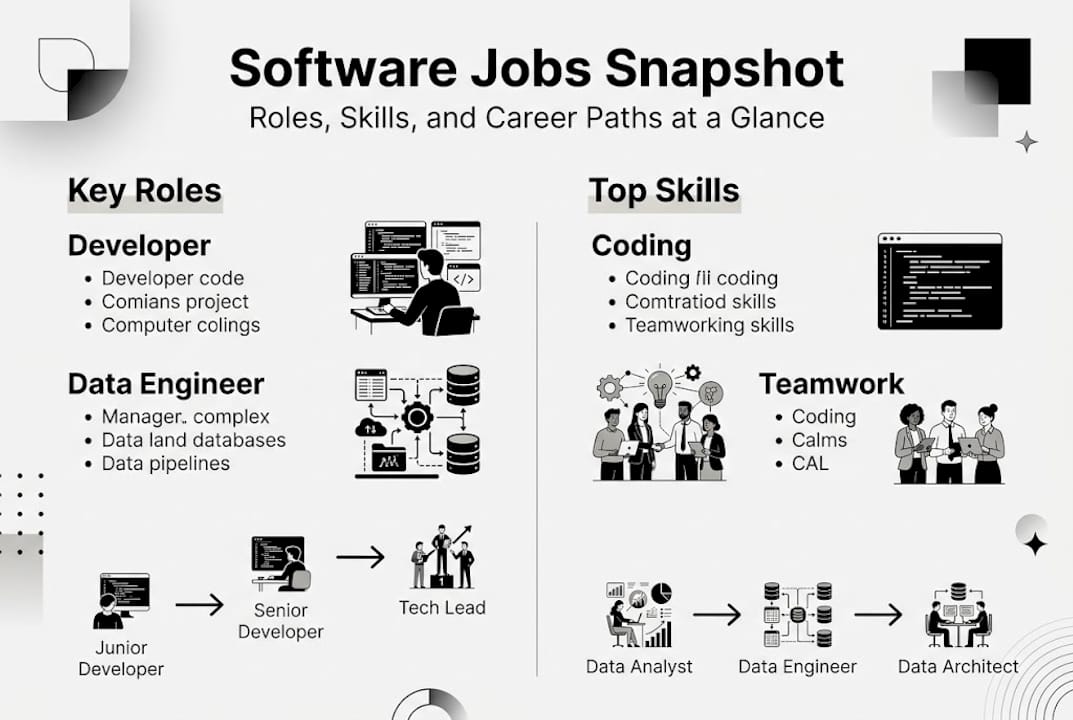
On the technical side, you need at least one strong programming language (Python, JavaScript, Java, and Go are among the most in demand), a working knowledge of system design, and familiarity with cloud platforms like AWS, Azure, or Google Cloud. Soft skills, particularly written communication and the ability to give and receive code reviews, are increasingly weighted in hiring decisions.
The software methodologies explained that dominate the industry today include:
- Agile: Iterative development in short cycles called sprints, with continuous feedback from stakeholders
- DevOps: A culture and set of practices that unify development and operations for faster, more reliable releases
- CI/CD (Continuous Integration / Continuous Delivery): Automated pipelines that test and deploy code frequently, reducing manual errors
- MLOps: Applies DevOps principles to machine learning, managing model training, versioning, and deployment at scale
"Pull requests for code review, iterative addressing of technical debt, and CI/CD pipelines are now standard practice across modern software teams."
Technical debt (the cost of shortcuts taken during development that slow future progress) is a concept every software professional should understand. Teams that ignore it ship slower over time. Teams that address it iteratively stay agile. Exploring DevOps roles gives you a clearer picture of how these practices translate into specific job functions.
Pro Tip: When evaluating a new role, ask how the team handles technical debt. The answer tells you more about engineering culture than any job description will.
AI's impact on software job roles and career growth
With frameworks in place, the latest and perhaps most dramatic change in software jobs comes from AI's rapid adoption. The effect is real, measurable, and more nuanced than most headlines suggest.
AI tools like GitHub Copilot and large language model integrations boost developer productivity by 35% on average. But that productivity gain is not evenly distributed. Junior roles that once involved writing boilerplate code or basic data transformations are increasingly automated. Senior engineers, by contrast, are in higher demand because someone needs to validate AI outputs, catch edge cases, and make architectural decisions that AI cannot reliably handle.
New roles are emerging specifically because of this shift:
- Forward deployed engineer: Works directly with enterprise clients to implement and customize AI systems in real environments
- AI validation specialist: Reviews model outputs for accuracy, bias, and safety before deployment
- Prompt engineer: Designs and tests inputs to AI systems to optimize their performance for specific use cases
| Role type | AI impact | Demand trend |
|---|---|---|
| Junior developer | High automation risk | Declining in some areas |
| Senior engineer | Validation and oversight needed | Increasing |
| ML / AI engineer | Core to new products | Rapidly growing |
| Forward deployed engineer | New role category | Emerging fast |
Understanding AI and tech hiring trends helps you position yourself on the right side of this shift. The professionals winning right now are those who use AI as a tool while building the judgment skills that AI lacks. Browsing IT job boards filtered by AI-related skills reveals just how fast these new categories are scaling.
How to advance or transition your software career
Knowing where tech is headed, here's how you can successfully chart your next career move. The good news is that the market is large. With over 129,000 new software jobs projected at the conservative end of estimates, there is real room to move, whether you are entering the field or pivoting within it.
Here is a practical framework for making your next move:
- Audit your current skills: List your technical skills, tools, and methodologies. Identify gaps relative to roles you want to target.
- Research target roles: Read job descriptions for positions one level above yours. Note the skills and experience patterns that appear repeatedly.
- Upskill strategically: Focus on AI tools, cloud certifications, and collaboration frameworks. These are the areas where demand is outpacing supply fastest.
- Build a visible portfolio: Contribute to open source projects, write technical posts, or build side projects that demonstrate your skills in context.
- Network intentionally: Connect with engineers in roles you want. Ask specific questions about their day-to-day work, not just how they got hired.
For those targeting remote or international roles, finding IT jobs globally requires a slightly different approach. Tailor your resume for asynchronous work habits and highlight any experience with distributed teams.
Pro Tip: Use IT job search tips to set up targeted alerts on job platforms so you hear about relevant openings before they fill. Speed matters in competitive markets.
What most guides miss about thriving in software jobs
Most career guides focus on what skills to learn next. That is useful, but it misses a bigger point. The professionals who build lasting careers in software are not just the fastest coders. They are the ones who understand the full picture: product thinking, design constraints, business context, and team dynamics.
In 2026, agile learners outperform agile developers. The ability to pick up a new framework in two weeks matters more than mastering one framework for ten years. Short-term skills go stale fast. What does not go stale is the habit of learning, the comfort with ambiguity, and the willingness to work across disciplines.
Understanding design in tech careers is a good example of this. Engineers who understand design principles ship better products. Data scientists who understand business strategy build more useful models. Cross-functional fluency is not a soft skill. It is a competitive advantage that compounds over time.
Do not optimize only for your next role. Optimize for the kind of professional you want to be in five years.
Find your next software job with Let's Hunt
You now have a clear map of the software job landscape, from role categories and working environments to the skills and AI-driven shifts shaping hiring in 2026. The next step is putting that knowledge to work.

Let's Hunt is built specifically for tech professionals like you. Browse open software jobs across remote, hybrid, and on-site categories, filtered by role type, location, and salary range. Whether you are a software developer targeting a senior position, a data scientist exploring AI-focused roles, or an engineer ready to go global, Let's Hunt connects you with curated opportunities from employers actively hiring in the tech sector. Set up personalized job alerts and get relevant listings delivered directly to you.
Frequently asked questions
What are the top software jobs in 2026?
Top software jobs include software developer, data scientist, DevOps engineer, and roles managing AI-integrated systems. Software developer roles are projected to grow 15 to 25% through 2033, with data scientists growing at 36%.
How is AI changing software jobs?
AI is boosting productivity by 35% on average while shifting junior roles toward automation and increasing demand for senior engineers who can validate AI outputs and handle complex edge cases.
Do I need to work in an office for a software job?
No. Most software jobs now offer remote or hybrid options. Strong collaboration habits matter more than physical location, since 40 to 50% of work involves planning, reviewing, and communicating rather than coding alone.
What skills matter most for breaking into software jobs?
Core programming in an in-demand language, working knowledge of Agile and DevOps practices, and strong written communication skills are the most consistently required across software job listings today.