
Most tech professionals assume that posting or applying to more jobs on a board automatically leads to better results. The reality is more complicated. Dice holds 25% of the IT recruiting market with 150,000 jobs listed per month, yet only around 43% of actual hires come from job boards. That gap between volume and results confuses both job seekers and recruiters every day. This guide breaks down how IT job boards actually work, which platforms deliver real value, and what strategies help you cut through the noise whether you are hunting for your next role or your next hire.
Table of Contents
- The IT job board landscape: Volume, reach, and main players
- Do job boards work? Effectiveness for job seekers and recruiters
- How to optimize your application for IT job boards and ATS
- Beyond job boards: Alternative strategies for finding tech roles and talent
- Making IT job boards work for you: Strategies for 2026 and beyond
- Kickstart your tech job journey or hire top talent
- Frequently asked questions
Key Takeaways
| Point | Details |
|---|---|
| Niche boards dominate IT hiring | Specialized job boards attract higher-quality candidates and better response rates for tech roles. |
| Optimize for ATS filters | Use standardized resume formats and job matching keywords to pass initial screenings on IT job boards. |
| Broaden your search strategy | Combine job boards with networking, referrals, and direct recruiter outreach for best results. |
| Job boards offer high volume, not selectivity | Expect more applications per job, but know that most hires come from a mix of sources—not boards alone. |
| Adapt to evolving trends | Stay updated on new tools and passive sourcing methods to keep your IT job search competitive. |
The IT job board landscape: Volume, reach, and main players
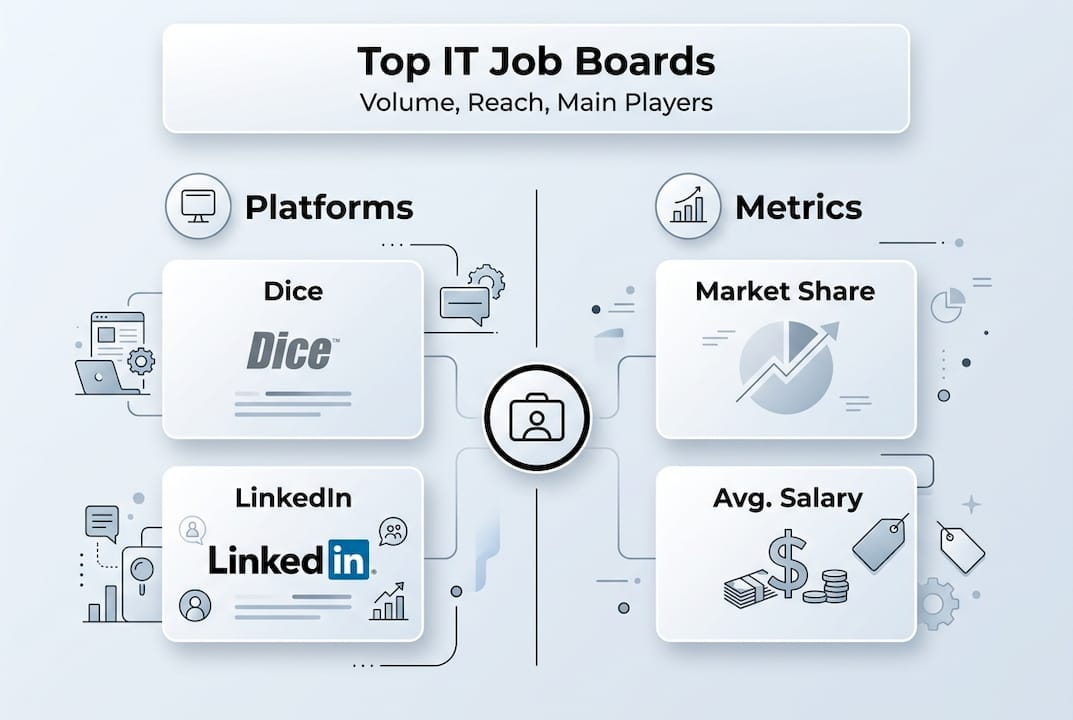
An IT job board is a digital platform where technology companies post open positions and professionals browse, filter, and apply for roles. They serve as the top of the hiring funnel, meaning they generate awareness and initial applications before any human conversation happens. The job board market is valued at $14.2 billion globally, with Dice commanding a 25% market share and listing roughly 150,000 IT jobs per month at an average salary of $120,000.
The major players each serve a slightly different audience. Dice focuses exclusively on technology roles, making it the go-to for specialized IT hiring. LinkedIn blends professional networking with job listings, giving recruiters access to candidate history and endorsements. Indeed casts the widest net across all industries, while Glassdoor adds company reviews and salary transparency to the mix. For roles in DevOps or technology design, niche boards often surface more relevant candidates faster than general platforms.
What job boards offer at a glance:
- Job seekers: searchable listings, salary filters, remote or hybrid options, and one-click applications
- Recruiters: resume databases, sponsored postings, applicant tracking integrations, and analytics
- Both sides: market benchmarking through salary data and job trend reports
"The IT job board market is worth $14.2 billion, and Dice alone lists 150,000 tech jobs per month at an average salary of $120,000, making it the single largest specialized IT recruiting platform in the world."
| Platform | Market share | Jobs per month | Avg. IT salary |
|---|---|---|---|
| Dice | 25% | 150,000 | $120,000 |
| ~22% | 200,000+ (all fields) | $110,000 | |
| Indeed | ~18% | 500,000+ (all fields) | $95,000 |
| Glassdoor | ~10% | 100,000+ | $105,000 |
These numbers show why boards remain the first stop for most hiring teams, but volume alone does not tell the full story.
Do job boards work? Effectiveness for job seekers and recruiters
Here is the number that should reset your expectations: the average IT job posting receives 369 applications. Screening alone takes six to nine days. Yet only 43% of hires actually come from job boards, even though 61% of applicants use them as their primary channel. The math reveals a clear mismatch between effort and outcome.

Response rates vary significantly by platform. Google Jobs leads at 11.29%, while LinkedIn sits at just 3.10%. Niche boards consistently outperform general ones for IT roles because the audience is pre-filtered. A Python developer applying on Dice is already in the right room; the same developer on Indeed is competing with accountants and nurses for recruiter attention.
Typical outcomes for job seekers and recruiters:
- Job seekers: expect a 3 to 11% response rate depending on the platform and role specificity
- Recruiters: plan for high application volume with a low signal-to-noise ratio on general boards
- Niche boards: faster screening, better candidate fit, and lower cost per qualified applicant
- Both sides: boards work best for active candidates, not passive ones
The biggest misconception is that more applications equal more hires. Boards supplement your strategy; they do not replace it. Passive candidates make up 70 to 75% of the workforce and rarely use job boards at all. If you are a recruiter chasing senior engineers or specialized data scientists, boards will show you only a fraction of the available talent pool. Explore niche tech job boards and find tech jobs on platforms built specifically for IT professionals to improve your odds.
How to optimize your application for IT job boards and ATS
An ATS, or Applicant Tracking System, is software that parses your resume before a human ever reads it. Most large tech companies and staffing agencies use ATS to filter hundreds of applications down to a manageable shortlist. If your resume is not formatted correctly, it gets rejected automatically, regardless of your actual qualifications.
ATS parsing requires standardized formatting: use MM/YYYY date formats, a dedicated skills section, strong action verbs, and keyword alignment with the job description. Python appears in 84% of software engineering job postings, making it the single most important skill keyword to include if it applies to your background.
Step-by-step guide to optimizing your IT resume for job boards:
- Use a clean, single-column layout with no graphics or tables that confuse parsers
- Format all dates as MM/YYYY (e.g., 03/2023 to 11/2025)
- Add a dedicated skills section near the top listing tools, languages, and frameworks
- Mirror exact keywords from the job description, especially for required skills
- Lead each bullet point with a strong action verb: built, deployed, reduced, automated
- Quantify results wherever possible (e.g., reduced deployment time by 40%)
- Save and submit as a .docx or .pdf depending on the platform's stated preference
Most-requested IT skills in 2026:
- Python (84% of software engineering postings)
- SQL (core requirement across data and backend roles)
- Cloud platforms: AWS, Azure, Google Cloud
- Docker and Kubernetes for DevOps and infrastructure roles
- React and TypeScript for frontend positions
Pro Tip: Copy the exact phrasing from the job description into your skills section. ATS systems often match on exact strings, not synonyms. "Machine learning" and "ML" may not score the same.
For recruiters, the flip side is real: overly rigid ATS filters eliminate strong candidates who use slightly different terminology. Review your filter settings regularly and consider ATS resume optimization practices to avoid losing qualified applicants to formatting technicalities.
Beyond job boards: Alternative strategies for finding tech roles and talent
Job boards are a starting point, not the whole map. Because up to 75% of top tech talent consists of passive candidates who are not actively searching, recruiters who rely solely on board postings are fishing in a very small pond. The best hires often come from channels that require more effort but deliver far better signal.
Alternative sourcing channels worth your time:
- LinkedIn search: filter by skills, location, and current employer to find passive candidates
- GitHub: review public repositories to assess real coding ability before outreach
- Tech communities: Slack groups, Discord servers, and forums like Stack Overflow
- Industry events: conferences, hackathons, and local meetups build genuine relationships
- Agency networks: specialized IT recruiters maintain warm pipelines of pre-vetted talent
- Employee referrals: referrals and networks yield higher hire rates than job boards alone
For passive tech recruitment, the approach shifts from broadcasting to targeting. Instead of posting and waiting, you identify specific people, study their work, and reach out with a personalized message that speaks to their interests and career goals.
Pro Tip: Contribute to open-source projects or write technical posts on LinkedIn. Recruiters actively search for candidates who demonstrate expertise publicly. Visibility in the right communities creates inbound interest without a single job application.
For job seekers, the hidden job market is real. Many roles are filled before they ever appear on a board. Staying active in professional communities, attending virtual events, and maintaining relationships with former colleagues puts you in the conversation early.
Making IT job boards work for you: Strategies for 2026 and beyond
The smartest approach treats job boards as one layer of a broader strategy, not the entire plan. Time-to-hire for IT roles averages 16 to 23 days, offer acceptance rates run between 75 and 81%, and the average cost per hire in IT sits at $2,795. These benchmarks matter because they set realistic expectations for both sides of the hiring equation.
When to use job boards vs. other approaches:
- Use boards for: entry to mid-level roles, high-volume hiring, roles with clear skill requirements
- Use networks for: senior or executive positions, niche specializations, passive candidate outreach
- Use both for: building employer brand, benchmarking salaries, and staying visible in the market
| Key insight | Data point |
|---|---|
| IT job board market size | $14.2 billion globally |
| Average applications per posting | 369 |
| Hires from job boards | 43% |
| Passive candidates in tech | 70 to 75% of workforce |
| Average time-to-hire (IT) | 16 to 23 days |
| Cost per hire (IT) | $2,795 |
In 2026, AI-driven matching is reshaping how boards surface candidates. Platforms now use behavioral signals, not just keyword matches, to rank applicants. This means your activity on the platform, how often you update your profile, which jobs you click, and how quickly you respond, all feed into your visibility score. Staying active matters as much as having the right keywords.
For recruiters, the winning formula combines a well-written job post on a niche board with a parallel outreach campaign on LinkedIn or GitHub. Use the improve recruitment workflow strategies to reduce time-to-hire and improve offer acceptance rates by keeping candidates engaged throughout the process.
Kickstart your tech job journey or hire top talent
You now have a clear picture of where job boards fit, where they fall short, and how to use them strategically. The next step is putting that knowledge to work on a platform built specifically for the tech industry.
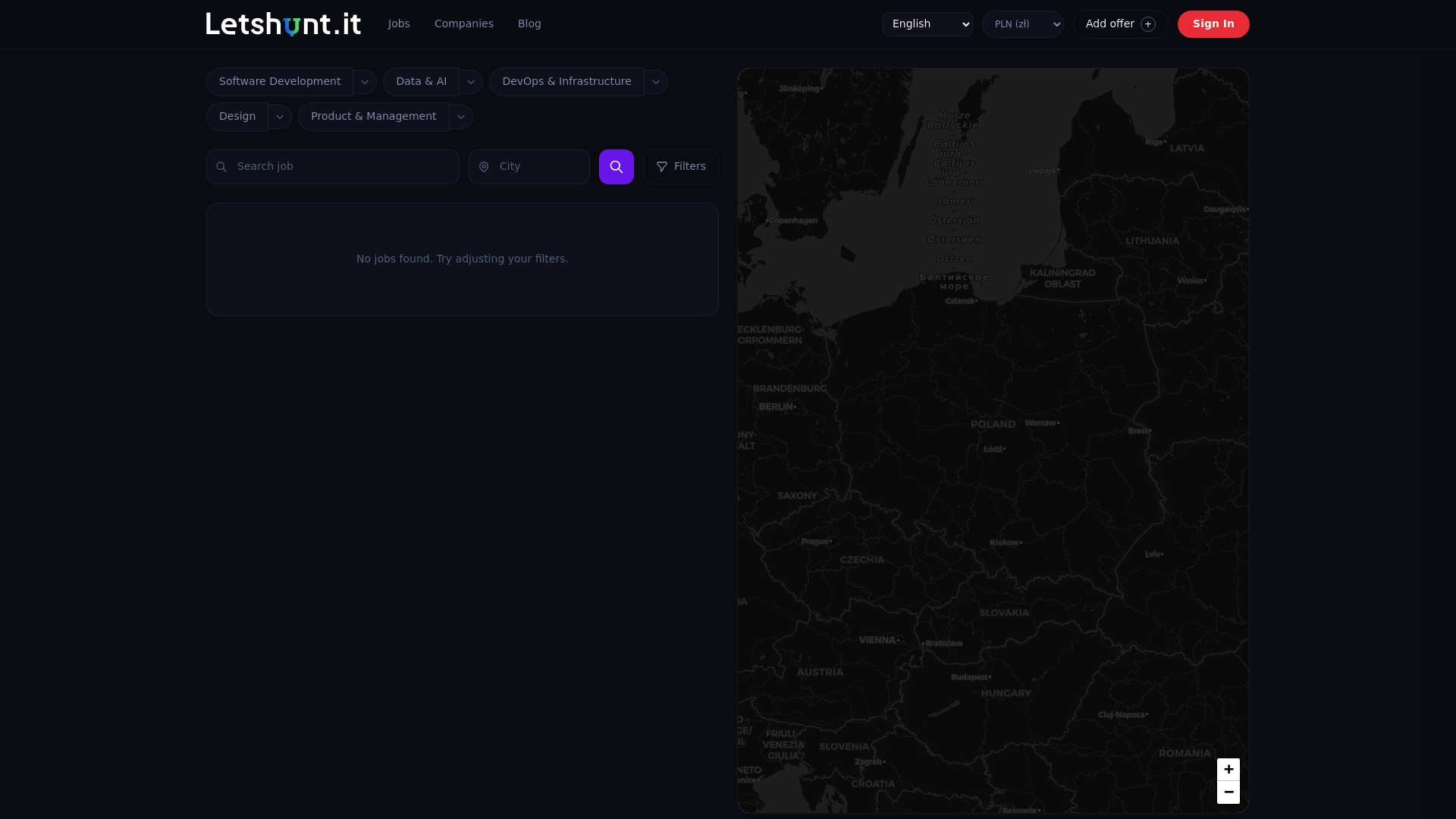
LetsHunt.it connects IT professionals with remote, hybrid, and on-site roles across software development, data and AI, DevOps, infrastructure, design, and product management. Whether you are a developer ready to explore your next move or a recruiter looking to fill a specialized role, the platform's filters, salary data, and global reach give you a real advantage. Browse active listings or post your open position today and start connecting with the right people faster.
Frequently asked questions
Which IT job board has the highest response rate in 2026?
Google Jobs leads with an 11.29% response rate for IT roles, outperforming both niche and general boards in raw response volume.
What resume format helps me get noticed by IT recruiters on job boards?
Use MM/YYYY date formatting, a dedicated skills section, and embed exact keywords from the job description. Python appears in 84% of software engineering postings, making it a critical keyword to include if relevant.
Do job boards work for executive or highly specialized IT roles?
Rarely. Most senior and specialized positions are filled through networks, referrals, or direct outreach because passive candidates make up 75% of top tech talent and do not actively use job boards.
What is the average time-to-hire for IT roles through job boards?
Time-to-hire averages 16 to 23 days for IT roles sourced through job boards, with offer acceptance rates between 75 and 81%.
How do niche IT job boards compare to general job boards for hiring?
Niche boards like Dice deliver higher response and hire rates for IT roles because the candidate pool is already filtered by industry. Niche boards outperform general platforms like Indeed or LinkedIn for specialized tech hiring.