
TL;DR:
- DevOps is a collaborative culture integrating development and operations, not just a toolset.
- High-performing teams focus on CALMS principles and measurable outcomes throughout the lifecycle.
- Skills like Kubernetes, CI/CD, IaC, and understanding DORA metrics are essential for career advancement.
Most IT professionals assume DevOps is a toolbox: grab Jenkins, add Docker, call it done. That framing misses the point entirely. DevOps is fundamentally a collaborative methodology that bridges development and operations teams, not just a stack of automation scripts. The gap between "I know the tools" and "I practice DevOps" is exactly where careers stall or accelerate. This article breaks down what DevOps actually means, which methodologies drive high-performing teams, what skills employers pay a premium for, and how you can position yourself to land the roles that matter in 2026.
Table of Contents
- DevOps defined: Beyond tools to culture and collaboration
- Key methodologies and the DevOps lifecycle explained
- Core practices: CI/CD, IaC, and automation in action
- Performance and pitfalls: Metrics, benchmarks, and common mistakes
- DevOps skills for career growth: What top employers seek
- A fresh perspective: DevOps for real-world IT career advantage
- Ready for your next step? Launch your DevOps career
- Frequently asked questions
Key Takeaways
| Point | Details |
|---|---|
| DevOps is culture-first | True DevOps blends collaboration and culture with technical practices for better results. |
| Automation accelerates delivery | CI/CD, IaC, and containerization streamline build, deploy, and operate phases. |
| DORA metrics guide improvement | Top teams use metrics like deployment frequency and lead time to benchmark performance. |
| Practical skills boost careers | Mastering real-world DevOps tools and culture makes job candidates stand out. |
DevOps defined: Beyond tools to culture and collaboration
At its core, DevOps integrates development and operations into a unified, continuous workflow aimed at delivering software faster and with higher quality. But the definition that sticks is simpler: DevOps is what happens when the people who build software and the people who run it actually work together, share goals, and own outcomes jointly.
Collaboration and continuous feedback are not soft extras. They are the engine. Automation handles repetitive work, but it cannot replace the alignment that comes from shared responsibility. A team that automates everything but blames ops when deployments fail is not doing DevOps, regardless of the tools in place.
The CALMS framework gives DevOps a practical structure:
- Culture: Shared ownership, psychological safety, and blameless postmortems
- Automation: Eliminating manual toil from integration, testing, and deployment
- Lean: Reducing waste, shortening feedback loops, optimizing flow
- Measurement: Using data to drive decisions and track improvement
- Sharing: Transparent knowledge flow across teams, not siloed expertise
Each element of CALMS reinforces the others. You cannot sustain strong measurement without a culture that welcomes honest reporting. You cannot share effectively without lean processes that free up time to document and communicate.
"The hardest part of DevOps is not the technology. It's getting teams to think and act differently. Cultural shift is cited as the number one challenge by 37% of organizations adopting DevOps."
That statistic matters for your career. If you walk into an interview able to discuss how you influenced team culture, not just which pipeline tool you configured, you immediately separate yourself from candidates who only list tools. Understanding the types of DevOps positions available today shows how wide the spectrum is, from site reliability engineer to platform engineer to DevOps advocate.
The cultural foundation is what makes everything else sustainable. Tools change. Frameworks evolve. Teams that internalize collaboration and ownership adapt. Teams that just follow tool checklists plateau.
Key methodologies and the DevOps lifecycle explained
With the foundation of DevOps as a culture and practice established, it is time to explore the concrete methods and phases that define a DevOps workflow.
Core methodologies include CALMS and DevOps lifecycle phases that map directly to how elite teams organize work. The eight standard phases are:
- Plan: Define features, prioritize backlog, align with business goals
- Code: Write, review, and version-control changes
- Build: Compile code, resolve dependencies, generate artifacts
- Test: Automated and manual validation of quality and security
- Release: Approve and prepare for deployment
- Deploy: Push changes to target environments
- Operate: Manage live infrastructure and ensure stability
- Monitor: Collect metrics, logs, and user feedback to feed back into planning
The loop is intentional. Monitoring data feeds directly into the next planning cycle, creating a continuous improvement engine rather than a linear release process.
| Dimension | Traditional IT | DevOps pipeline |
|---|---|---|
| Release cadence | Months or quarters | Hours to days |
| Team structure | Siloed dev and ops | Cross-functional ownership |
| Feedback loop | Post-release reviews | Real-time monitoring |
| Failure response | Blame and escalation | Blameless postmortems |
| Change management | Heavy approval gates | Automated quality gates |
DORA metrics (Deployment Frequency, Lead Time for Changes, Change Failure Rate, and Time to Restore Service) map directly onto these lifecycle stages. High deployment frequency reflects a healthy Plan-to-Deploy cycle. Low lead time indicates a streamlined Build-to-Release path. These are not abstract scores. They reflect real team behavior.
Building solid software job skills around the lifecycle stages makes you versatile across industries, since every sector from finance to healthcare is adopting this model. Staying aware of software career trends tells you where the market is heading next.
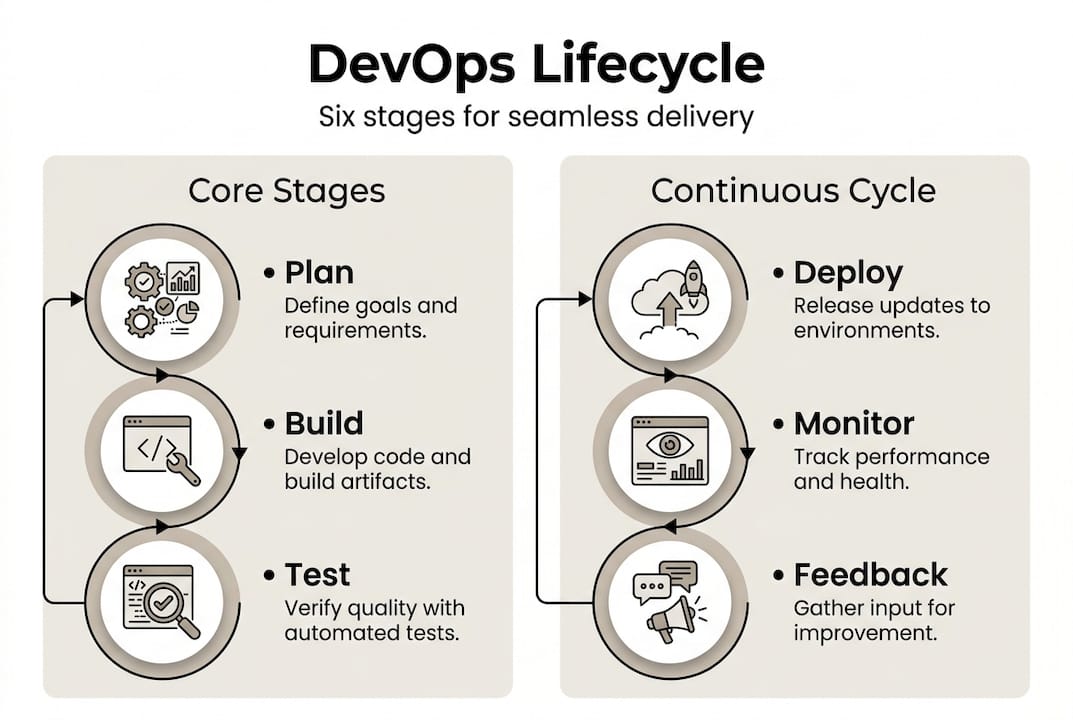
Pro Tip: When reviewing job descriptions, map every listed responsibility to a lifecycle phase. This tells you exactly where the team needs depth and where your experience is a direct match.
Core practices: CI/CD, IaC, and automation in action
Understanding the DevOps lifecycle leads naturally to its core practices. Here is what automation, CI/CD, and IaC look like in real teams.
CI/CD pipelines automate integration, IaC tools like Terraform manage infrastructure declaratively, and containerization with Docker and Kubernetes ensures consistent environments from development to production. These three pillars carry most of the operational load in modern DevOps shops.

CI/CD (Continuous Integration and Continuous Delivery or Deployment) means every code commit triggers an automated pipeline: tests run, security scans fire, artifacts build, and approved changes flow toward production. The practical benefit is that bugs surface in minutes, not weeks.
IaC (Infrastructure as Code) treats servers, networks, and cloud resources like software. Terraform files describe the desired state; the tool reconciles reality to match. Version control applies to your infrastructure the same way it applies to your application code.
| Practice | Core benefit | Popular tools |
|---|---|---|
| Continuous Integration | Catch bugs early, reduce merge conflicts | GitHub Actions, Jenkins, GitLab CI |
| Continuous Delivery | Reliable, repeatable releases | ArgoCD, Spinnaker, CircleCI |
| Infrastructure as Code | Consistent environments, auditability | Terraform, Pulumi, AWS CDK |
| Containerization | Portability, isolation, scalability | Docker, Podman |
| Container orchestration | Automated scaling and self-healing | Kubernetes, Amazon EKS |
AI is now entering DevOps pipelines in a real way. AI accelerates throughput but can destabilize pipelines without strong testing foundations in place. AI-assisted code review, anomaly detection, and predictive scaling add genuine speed. The risk is that teams adopt AI-generated code or automated remediation without understanding what the system is actually doing. Speed without comprehension raises your change failure rate.
For IT infrastructure roles, fluency in IaC is increasingly a baseline requirement rather than a differentiator. If you are not versioning your infrastructure today, start now.
- Master at least one CI/CD platform end to end, not just the basics
- Build and run a Kubernetes cluster outside of tutorials, even a small local one
- Practice Terraform by rebuilding a cloud environment from scratch using only code
- Integrate a security scan (SAST or dependency check) into a personal pipeline
Performance and pitfalls: Metrics, benchmarks, and common mistakes
Having looked at the hands-on tools and practices, it is equally vital to know how DevOps performance is measured and where teams often get stuck.
DORA metrics remain the industry standard for performance benchmarking. Elite performers in 2026 deploy on-demand (multiple times per day), maintain lead times under one hour, hold change failure rates below 5%, and restore service in under 15 minutes. These numbers are achievable, but they require all of the cultural and process foundations described above.
99% of organizations report positive bottom-line impact from DevOps adoption. That figure is striking. It confirms that the methodology works across industries and scales when applied correctly.
However, DORA metrics alone are not enough. Elite teams track developer experience alongside DORA scores. Developer experience (DX) measures cognitive load, tooling friction, and satisfaction. A team hitting great DORA numbers while burning out engineers is not sustainable. Business alignment metrics, like feature-to-revenue correlation, add a second dimension that pure operational data misses.
Common pitfalls to watch for:
- Cultural resistance: Individuals protect silos even when leadership mandates DevOps
- Over-tooling: Accumulating tools faster than the team can master them increases complexity and failure points
- Ignoring DX: Optimizing pipelines without reducing developer friction creates diminishing returns
- Overreliance on AI: Allowing AI to auto-merge or auto-remediate without human checkpoints invites cascading failures
- Under-measuring: Tracking only deployment frequency while ignoring lead time or failure rate gives a false picture of health
Pro Tip: Before your next interview, calculate your team's DORA metrics from memory. Concrete numbers signal real ownership. "We deployed twice a week and recovered from incidents in under 20 minutes" is far more compelling than "we practiced agile delivery."
For professionals targeting AI in DevOps roles, the ability to critically evaluate where AI adds value versus where it introduces risk is a rare and highly paid skill.
DevOps skills for career growth: What top employers seek
Before wrapping up, let's make this actionable: here is what you need to do to leverage DevOps for your career.
Mastering Kubernetes, building a GitHub portfolio, and focusing on DORA metrics are the clearest signals employers look for. DevSecOps, which integrates security into every pipeline stage rather than bolting it on at the end, adds a measurable salary premium in current hiring data.
- Build a hands-on portfolio: Employers want to see working CI/CD pipelines, IaC repositories, and evidence of production cluster management, not just certifications
- Learn DevSecOps basics: Add vulnerability scanning, secret management, and policy-as-code to your toolkit
- Document DORA improvements: Quantify what changed after you implemented a practice. Numbers matter enormously in technical interviews
- Contribute to open-source DevOps projects: Public contributions demonstrate initiative and real-world collaboration skills
- Practice incident postmortems: Being able to articulate what went wrong, why, and how you prevented recurrence signals operational maturity
Interviewers for senior DevOps roles consistently prioritize candidates who can speak to team outcomes and business impact, not just technical configurations. Phrases like "we reduced deployment lead time from three days to four hours" carry more weight than a certification list.
Pro Tip: GitHub is your resume. Keep your repositories clean, well-documented, and active. Treat your own infrastructure projects with the same rigor you would apply to production code.
Exploring IT job search strategies gives you a tactical edge when converting DevOps skills into actual offers.
A fresh perspective: DevOps for real-world IT career advantage
Here is what most DevOps guides get wrong: they treat tooling as the destination. Tool fluency is a prerequisite, not a differentiator. The professionals who consistently land the best DevOps roles are the ones who can talk about failure, not just success.
Owning an outage, driving a postmortem, and shipping the fix that prevents the next one is worth more on your resume than three certifications. Business alignment is the real ceiling-breaker. When you can map a pipeline improvement to a revenue outcome or a reduced customer churn metric, you are speaking the language of leadership.
Contrarian take: chasing the newest tool (today it is AI-assisted everything, yesterday it was GitOps) rarely builds the career you want. Depth in fundamentals, strong culture instincts, and measurable outcomes age far better than trend-chasing. The teams worth joining are looking for people who understand why before how.
This perspective connects directly to optimizing tech hiring from the employer side. Companies that hire well are looking for cultural fit and ownership mindset, not just stack coverage.
Ready for your next step? Launch your DevOps career
You now have a clear picture of what DevOps demands, from cultural foundations to CI/CD pipelines to the metrics that prove impact. The next move is finding the role that lets you apply all of it.
LetsHunt.it connects IT professionals with remote, hybrid, and on-site DevOps opportunities across the global tech market. Whether you are looking to move into a platform engineering role, a site reliability position, or a DevSecOps specialist track, you can find DevOps jobs that match your skills and salary expectations. The DevOps job search platform filters by role type, location, and seniority so you spend less time scrolling and more time interviewing. Your next high-impact DevOps role is already posted. Go find it.
Frequently asked questions
What are the main benefits of adopting DevOps?
DevOps delivers faster, higher-quality outcomes and measurably shortens time-to-market, with organizations reporting up to a 20% reduction in delivery cycles alongside improved software reliability.
Which skills should I prioritize for a DevOps job?
Master Kubernetes, CI/CD, IaC, and DORA metrics first. Adding DevSecOps knowledge distinguishes you from candidates who cover only the automation basics.
How do DevOps and AI interact in modern workflows?
AI increases throughput but can raise change failure rates by 30 to 40% when deployed without strong testing gates and human oversight in place.
What are common pitfalls when starting with DevOps?
Cultural changes are the hardest part; teams also frequently over-automate before establishing stable processes, which introduces new failure modes rather than eliminating old ones.
Why is the CALMS framework important in DevOps?
CALMS is central to effective DevOps because it ensures organizations balance culture, automation, lean thinking, measurement, and sharing rather than focusing exclusively on any single dimension.