
TL;DR:
- IT recruitment takes 48 to 58 days to fill, making it significantly slower than other industries.
- Specialized technical roles require deep evaluation, technical assessments, and understanding of evolving tech stacks.
- AI tools assist in screening but must be combined with human judgment for fair, effective hiring.
The typical tech hire takes 48 days to fill, which is 26% slower than the cross-industry average. If you've ever felt like your job application disappeared into a black hole, you're not imagining things. IT recruitment is genuinely more complex, slower, and more competitive than most people expect. Specialized roles, evolving tech stacks, and multi-stage interview processes all add friction that general hiring doesn't face. This guide breaks down how IT recruitment actually works, what slows it down, and what you can do to navigate it smarter.
Table of Contents
- Defining IT recruitment: What it means and why it matters
- The IT recruitment process: From application to offer
- AI, humans, and the hybrid recruitment model
- Nuances and challenges in IT hiring: Skills, roles, and fraud
- What most guides miss about IT recruitment
- Next steps: Find your tech job or recruit top IT talent
- Frequently asked questions
Key Takeaways
| Point | Details |
|---|---|
| IT hiring is slower | Tech time-to-hire averages almost 50 days, making it more competitive than other fields. |
| Hybrid model works best | Combining AI and human recruiters improves speed and decision quality while reducing bias. |
| Skills gaps drive demand | Specialist roles in AI, data, and DevOps remain highly sought after due to persistent talent shortages. |
| Fraud and drop-off are real risks | Candidate ghosting and misrepresentation are common in tech hiring, requiring layered screening. |
Defining IT recruitment: What it means and why it matters
IT recruitment is the process of identifying, attracting, evaluating, and hiring professionals for technology-focused roles. We're talking about software engineers, DevOps specialists, data scientists, AI/ML researchers, cloud architects, and product managers. It's not just a subset of general hiring. It's a fundamentally different discipline that requires recruiters to understand technical concepts, evaluate code quality, and assess how well a candidate fits into a specific engineering culture.
General recruitment can rely on transferable soft skills and broad experience. IT recruitment can't. A hiring manager for a backend engineering role needs to know whether a candidate's experience with distributed systems is relevant to their specific stack. A recruiter who doesn't understand the difference between Kubernetes and Docker can't meaningfully screen applicants. That gap is why companies invest in technical recruitment insights and specialized talent teams.
Here's what makes IT recruitment distinct from general hiring:
- Role complexity: Tech roles often require proficiency in specific languages, frameworks, or cloud platforms, not just general competency.
- Evaluation depth: Candidates go through technical assessments, coding challenges, system design interviews, and portfolio reviews.
- Market competition: Top engineers are often already employed and not actively job hunting, making sourcing harder.
- Rapid skill evolution: What was cutting-edge two years ago may already be outdated, so role requirements shift constantly.
- Cultural fit in tech teams: Collaboration style, remote work preferences, and agile familiarity matter as much as hard skills.
Software development roles have the slowest time-to-hire at 58 days, which reflects just how thorough the evaluation process tends to be. For IT professionals, this means patience is part of the game. For recruiters, it means every bottleneck in the process has a real cost.
Understanding these dynamics helps you approach job searching or talent acquisition with realistic expectations. If you want to go deeper on improving your approach, exploring resources on optimizing tech recruitment or brushing up on IT job search tips can give you a meaningful edge.
The IT recruitment process: From application to offer
Let's walk through what actually happens between the moment you submit your resume and the moment you get an offer letter. The process isn't linear, and knowing where delays happen gives you more control.
The typical IT recruitment stages:
- Sourcing: Recruiters search job boards, LinkedIn, GitHub, and referral networks to build a candidate pipeline.
- Screening: Resumes and profiles are filtered, often using applicant tracking systems (ATS) before a human ever sees them.
- Technical assessment: Candidates complete coding tests, take-home projects, or platform-based challenges.
- Interviews: Multiple rounds, often including a recruiter call, technical panel, and a final culture or leadership interview.
- Reference and background checks: Verification of past employment, skills, and sometimes security clearance.
- Offer and negotiation: Salary, equity, benefits, and start date discussions before a formal offer is signed.
Here's a quick look at key benchmarks that define the IT hiring landscape:
| Metric | IT industry average |
|---|---|
| Time to hire | 44 to 58 days |
| Applications per hire | ~110 |
| Cost per hire | $2,795 to $20,000+ |
| Offer acceptance rate | ~70% |
Cost per tech hire ranges from $2,795 to over $20,000, with roughly 110 applications submitted per open role. That's a lot of competition. Most applicants drop off at the screening stage, which means your resume and LinkedIn profile are doing more work than you might realize.
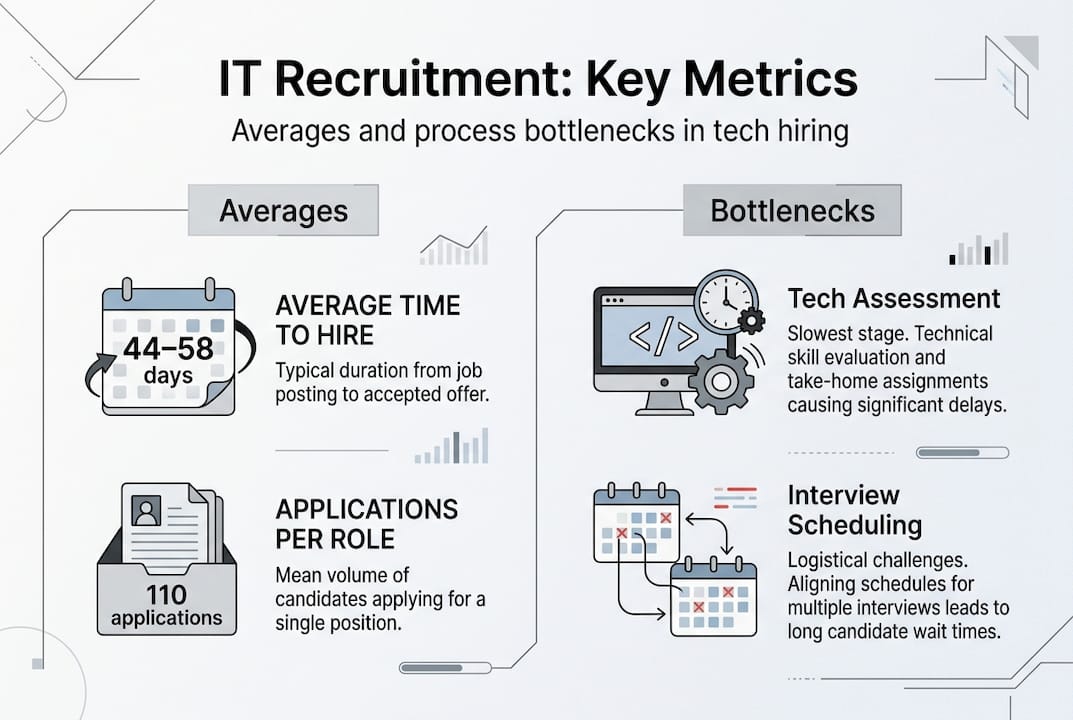
The biggest bottlenecks tend to appear in the technical assessment and interview scheduling phases. Coordinating multiple interviewers across time zones, waiting for assessment results, and managing internal approval chains all add days or weeks to the process. For candidates, this waiting period is often the most frustrating part.

Pro Tip: Customize your resume for each application by mirroring the exact language used in the job description. ATS systems rank candidates based on keyword matching, and even small adjustments can move you from filtered-out to shortlisted. Also, follow up professionally after each interview stage. It signals genuine interest and keeps you top of mind. Exploring resources on optimizing tech recruitment can help you understand what recruiters are actually looking for at each stage.
AI, humans, and the hybrid recruitment model
Recruitment technology has changed fast. AI tools now handle resume parsing, candidate ranking, chatbot-based screening, and even video interview analysis. But the question isn't whether AI belongs in IT recruitment. It's how much of the process it should own.
| Approach | Strengths | Weaknesses |
|---|---|---|
| AI-driven | Fast, scalable, consistent | Risk of bias, misses soft skills |
| Human-led | Contextual, empathetic, nuanced | Slower, subject to personal bias |
| Hybrid | Balanced, efficient, fair | Requires careful design and oversight |
AI enables 5x better performance prediction compared to traditional screening methods, but it carries real risks of encoding bias into hiring decisions if the training data reflects historical inequalities. That's why hybrid IT recruiting models are becoming the standard in serious tech organizations.
Here's what each model contributes in practice:
- AI strengths: Rapid resume filtering, scheduling automation, skills matching, and volume screening at scale.
- Human strengths: Reading between the lines on a career pivot, assessing communication style, evaluating team dynamics fit.
- Hybrid strengths: Using AI to narrow the field and humans to make the final call, combining speed with judgment.
"The risk isn't that AI will replace human recruiters. It's that poorly designed AI will silently filter out great candidates before a human ever sees them."
Pro Tip: If you're navigating AI-driven screening as a candidate, structure your resume with clean formatting, standard section headers, and no tables or graphics. ATS parsers often misread complex layouts. For roles in AI tech job search or DevOps talent gaps, include specific tool names and version-relevant experience to pass automated filters.
Nuances and challenges in IT hiring: Skills, roles, and fraud
Even with better tools and processes, IT recruitment faces persistent challenges that neither AI nor experienced recruiters have fully solved.
The skills shortage is real and growing. 2.1 million US IT jobs went unfilled in 2023, driven by demand outpacing the supply of qualified professionals in AI/ML, DevOps, and data engineering. This isn't just a numbers problem. It's a mismatch problem. Many candidates have adjacent skills but not the exact stack a company needs, and companies often refuse to invest in upskilling.
"The hardest roles to fill aren't always the most technical. Sometimes it's the mid-level engineer with three years of niche framework experience that takes four months to find."
Key challenges shaping IT recruitment today:
- Ghosting: Candidates drop out mid-process without notice, often because they received a competing offer or felt the process was too slow.
- Resume fraud: Misrepresentation of skills, certifications, and employment history is more common in tech than most recruiters admit. Screening reveals both fraud and real skill gaps.
- Over-indexing on portfolios: Some hiring teams reject strong candidates who lack polished GitHub profiles, even when work experience clearly demonstrates competence.
- Soft skill blindspots: Technical interviews often dominate, leaving little room to assess communication, conflict resolution, or leadership potential.
- Evolving requirements: A job description written six months ago may already be outdated by the time the role is filled.
Strategies that actually help include structured behavioral interviews alongside technical ones, realistic job previews to reduce drop-off, and transparent timelines communicated to candidates from day one. Roles like DevOps positions and software development careers have their own unique hiring patterns worth understanding. Staying current on software career trends also helps candidates position themselves for what the market actually needs.
For organizations serious about fairness and accuracy, AI recruiting audits are emerging as a way to check whether automated tools are introducing bias into the pipeline.
What most guides miss about IT recruitment
Here's the uncomfortable truth: most IT recruitment content talks about best practices without acknowledging how far reality falls short. Take skills-based hiring. It's everywhere in recruiting conversations. But only 0.14% of hires are truly skills-based, even though 85% of organizations claim to practice it. Degrees still dominate, and pedigree still opens doors that skills alone don't.
The hybrid model matters not because it's trendy but because it's the only approach that balances efficiency with fairness. AI alone creates blind spots. Humans alone create inconsistency. Neither is acceptable when you're trying to build a high-performing engineering team.
For IT professionals navigating this, the practical advice is to measure your own job search like a recruiter would measure a pipeline. Track where you're dropping off. Are you getting interviews but no offers? That's an interview skills problem. Are you getting no callbacks? That's a resume or visibility problem. Knowing your KPIs (key performance indicators) helps you fix the right thing.
When filtering tech jobs or pursuing remote IT job strategies, the candidates who succeed aren't always the most technically brilliant. They're the ones who understand the process and work it strategically.
Next steps: Find your tech job or recruit top IT talent
You now have a clear picture of how IT recruitment actually works, where it breaks down, and how to navigate it more effectively. The next step is putting that knowledge into action.
Whether you're a developer ready for your next role, a DevOps engineer exploring remote opportunities, or a recruiter building a stronger pipeline, LetsHunt.it connects you with what you need. Browse tech job listings across software development, AI, data engineering, and more. Filter by location, work model, and salary range to find roles that actually match your profile. The market is competitive, but the right opportunity is out there.
Frequently asked questions
What makes IT recruitment different from general hiring?
IT recruitment requires deep knowledge of technical roles, evolving skill sets, and multi-stage screening methods. Tech time-to-hire is significantly slower and job requirements are far more specific than in most other industries.
How long does it take to fill a typical IT role?
Most IT roles take between 44 and 58 days to fill. Tech and software development roles average 48 to 58 days, making the process up to 26% slower than the cross-industry average.
How do AI tools impact tech hiring?
AI speeds up screening and can predict candidate performance at a much higher rate, but it needs human oversight to catch bias and assess soft skills. Hybrid models are recommended for balanced, fair outcomes.
Why are some IT roles so hard to fill?
Rapid changes in required tech stacks, high market demand, and real skill shortages in specialist roles like AI/ML and DevOps mean competition for qualified candidates is intense and ongoing.