
TL;DR:
- Job matching compares IT skills and experience to role requirements for precise job fit.
- Automated systems use ontologies and NLP to match specific technical skills accurately.
- Enhancing resumes with targeted keywords and updating profiles improves matching success.
Sending out 50 applications and hearing nothing back is one of the most frustrating experiences in any IT job search. The assumption that volume equals results is wrong, and most experienced tech professionals already know it. Job matching flips that logic entirely. Instead of casting a wide net, it connects you to roles where your actual skills, experience, and knowledge align with what employers need. This guide explains what job matching means for IT professionals, how automated systems work under the hood, where they fall short, and exactly what you can do to make matching work in your favor.
Table of Contents
- Understanding job matching in IT
- How automated systems match IT skills and roles
- Challenges and edge cases in IT job matching
- How to optimize for job matching as an IT professional
- Why successful job matching requires more than algorithms
- Take the next step with smarter job matching
- Frequently asked questions
Key Takeaways
| Point | Details |
|---|---|
| Job matching defined | Job matching compares your tech skills and experience with open positions to target ideal roles. |
| Automated tech platforms | Advanced job boards use AI and skill ontologies to precisely pair IT professionals with relevant jobs. |
| Optimization essentials | Align your resume with industry frameworks and job keywords to boost your visibility in job matches. |
| Edge cases matter | Human oversight is crucial as AI may miss nuance, motivation, and cultural fit in tech hiring. |
Understanding job matching in IT
Job matching is not a buzzword. It is a structured process that compares what you bring to the table against what a role actually requires. At its core, job matching pairs job seekers with suitable vacancies by comparing skills, knowledge, competences, and experience to job requirements, using automated recruitment systems.
For IT professionals, this matters more than in almost any other field. Tech roles are highly specialized. A backend engineer with five years of Java experience and a frontend developer who knows React are not interchangeable, even if both carry the title "software developer." Traditional job searches treat those two as near-identical. Job matching systems do not.
Here is what a well-designed job matching process evaluates:
- Technical skills: Programming languages, frameworks, cloud platforms, databases
- Experience depth: Years worked, project complexity, team size managed
- Certifications and credentials: AWS, Google Cloud, PMP, and similar qualifications
- Domain knowledge: Fintech, healthtech, SaaS, cybersecurity, and other verticals
- Soft skills indicators: Communication style, leadership signals in resumes
The benefit for you as a candidate is reduced noise. You stop wasting time on roles that will never call back because the fit was never there. For companies, matching cuts screening time dramatically and surfaces qualified candidates faster.
"The goal of job matching is not to find any job, but to find the right job based on a precise comparison of capabilities and requirements."
If you want a broader view of how to approach your search strategically, IT job search strategies are worth reviewing before you start optimizing your profile for matching systems.
Job matching also removes some of the bias that comes with manual screening. When a system evaluates skills objectively, your resume gets evaluated on what you know, not just where you worked.
How automated systems match IT skills and roles
Understanding the mechanics behind matching gives you a real edge. These systems do not just search for keywords. They use structured skills ontologies and machine learning to map your profile against role requirements with surprising precision.
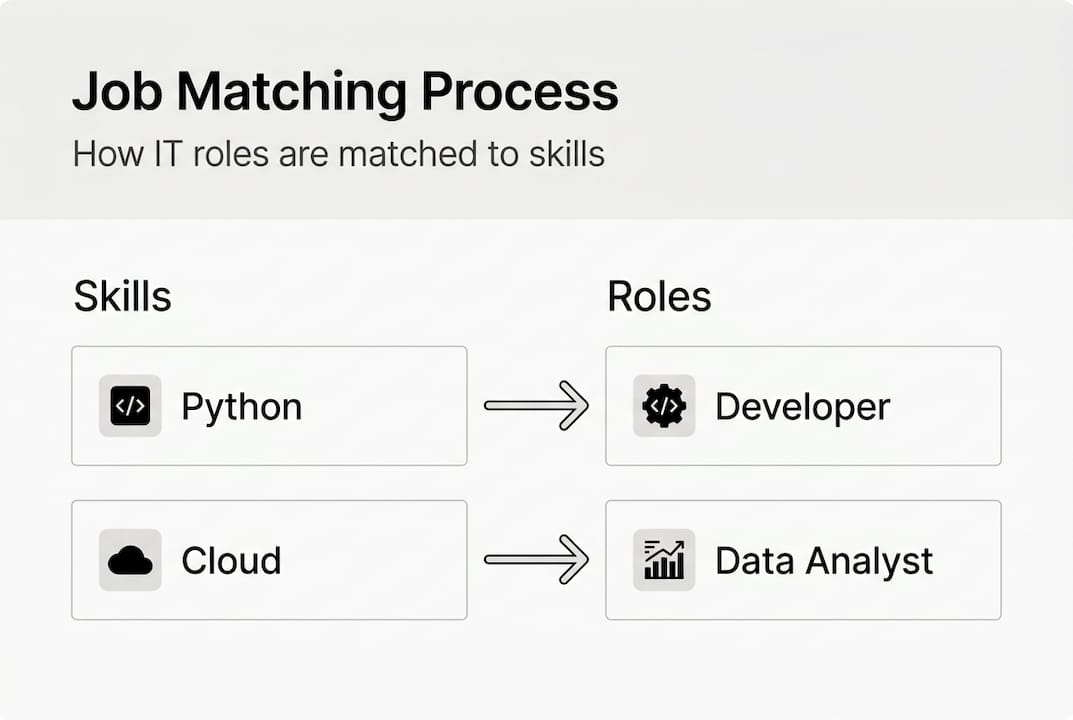
IT platforms leverage ontologies like ESCO or ONET to map skills to tech roles, enabling precise matching in high-skill domains. ESCO (European Skills, Competences, Qualifications and Occupations) and ONET (Occupational Information Network) are essentially giant, structured databases that define what skills belong to which roles, and how those skills relate to each other.
When you upload your resume, the platform's NLP (natural language processing) engine reads it and extracts entities. It identifies "Python" as a programming language, "Kubernetes" as a container orchestration tool, and "CI/CD" as a DevOps practice. It then maps those entities to skill nodes in its ontology and scores your profile against open roles.

Here is a quick look at how common IT skills map to specific roles:
| Skill | Primary Role Match | Secondary Role Match |
|---|---|---|
| Python, TensorFlow | Machine Learning Engineer | Data Scientist |
| React, TypeScript | Frontend Developer | Full-Stack Developer |
| Kubernetes, Terraform | DevOps Engineer | Cloud Architect |
| SQL, dbt, Spark | Data Engineer | Analytics Engineer |
| Penetration Testing | Security Analyst | Red Team Engineer |
Beyond static keyword matching, more advanced platforms use semantic matching. That means "built CI pipelines" and "managed continuous integration workflows" are understood as the same skill, even though the words differ.
Key factors these systems weigh when matching IT profiles:
- Recency of skill use (skills used in the last two years score higher)
- Skill combinations (Python plus AWS plus Docker is weighted more than each alone)
- Role level signals (lead, senior, principal indicate seniority)
- Location and remote preferences
Knowing how IT job boards work helps you understand why some platforms surface better matches than others. Boards built on richer skills taxonomies produce more accurate results. Using tech job filtering tips alongside matching tools gives you even more control over what you see.
Challenges and edge cases in IT job matching
Automation makes job matching scalable, but it introduces real problems that IT professionals need to understand. Knowing where the system fails helps you work around it.
Edge cases include language variability in resumes and job descriptions, taxonomy mismatches such as "Data Scientist" versus "AI Engineer," and curvilinear fit issues that affect retention. That last point is particularly important. If you are significantly overqualified or underqualified for a role, matching algorithms may still surface it as a fit based on skills alone, while missing the satisfaction and retention risk entirely.
Title ambiguity is a genuine problem in tech. "Data Engineer" at one company means writing Spark pipelines. At another, it means managing Excel reports. The same title, wildly different responsibilities. Matching systems that rely heavily on job titles rather than granular skills will produce misleading results.
"An algorithm can confirm you have the skills. It cannot confirm you will care about the work in 18 months."
Here is how human review and AI evaluation compare on key matching factors:
| Evaluation factor | AI matching strength | Human review strength |
|---|---|---|
| Skills accuracy | High | Medium |
| Cultural fit | Low | High |
| Career trajectory | Low | High |
| Speed at scale | Very high | Very low |
| Motivation assessment | None | Medium |
| Salary alignment | Medium | High |
For roles in emerging areas like AI roles and skills, the taxonomy gaps are especially large because job titles and required skills are evolving faster than any ontology can keep up.
Pro Tip: When writing your resume, use the exact skill keywords from the job descriptions you are targeting. If a posting says "Apache Kafka" rather than "event streaming," use that specific term. Systems match on vocabulary, not intent.
How to optimize for job matching as an IT professional
You can actively improve how matching systems see you. This is not about gaming the system. It is about presenting your real skills in a language the system understands.
Use job-specific keywords, align skills with ESCO/O*NET frameworks, and choose platforms with transparent matching to enhance your IT career prospects. Here is a practical sequence to follow:
- Audit your current resume for vague language. Replace "worked on cloud projects" with "deployed microservices on AWS EKS using Helm and Terraform."
- Map your skills to ESCO or O*NET to see which job families you realistically qualify for. This prevents targeting roles two levels above your experience.
- Update your profile quarterly to reflect new skills, tools, and certifications. Matching systems favor recent, active profiles.
- Choose platforms that show matching criteria explicitly. If a platform tells you "You match 78% of this role's requirements," you can identify the gaps and decide whether to apply or upskill.
- Avoid extreme mismatches in either direction. Applying to roles far below your level signals poor judgment. Applying far above creates frustration when match scores are low.
- Use skill-based filters when browsing. Platforms that let you filter IT jobs by skills let you narrow results before the algorithm does it for you.
For those on the hiring side, understanding optimizing tech recruitment workflows shows how employers are using the same matching logic to find candidates like you.
Pro Tip: Review trending IT job descriptions every quarter and add any tools or frameworks you have used recently to your profile. Platforms reward up-to-date profiles with higher match visibility.
Why successful job matching requires more than algorithms
Here is a perspective most job matching articles skip entirely: the algorithm is only as good as the assumptions built into it. And the biggest assumption most platforms make is that skills equal fit. They do not.
Matching is psychologically complex with factors like motivation and trajectory; AI excels at scale but needs human oversight. We have seen this play out consistently. A developer with the perfect skill set for a role accepts an offer and leaves within six months because the team's working style clashed with how they operate. No algorithm caught that.
The smartest IT professionals treat matching platforms as a starting point, not a final answer. They use the match score to identify which roles are worth pursuing, then do their own research into team culture, growth opportunities, and company direction before investing time in the process. Understanding how tech hiring works from the employer's side makes that self-assessment sharper.
Self-awareness is a matching variable that no platform currently measures. Knowing what kind of problems you find genuinely interesting, what size team you work best in, and what your five-year direction looks like makes your job search more precise than any algorithm can. Combine that clarity with strong platform matching and you get results that are both fast and durable.
Take the next step with smarter job matching
Ready to move from theory to action? Job matching works best when the platform behind it is built specifically for tech roles, with filters and matching logic designed for IT skills rather than generic job categories.

LetsHunt.it connects IT professionals with remote, hybrid, and on-site roles across software development, DevOps, data and AI, and more. The platform is built for tech job seekers who want precise results, not a wall of irrelevant listings. Use skill-based filters to surface roles that match your actual experience level, preferred work setup, and target location. Browse explore IT jobs and see how matching on a purpose-built platform changes the quality of opportunities you find.
Frequently asked questions
How is job matching different from traditional job search methods?
Job matching uses AI to compare your skills with job requirements automatically, while traditional methods rely on manual search and broad applications without data-driven filtering. Automated systems match job seekers and roles using structured data comparisons rather than keyword searches alone.
Which skills matter most for IT job matching platforms?
Programming languages, cloud technologies, frameworks, and current industry certifications carry the most weight. Systems use ontologies like ESCO or O*NET to map these skills to specific tech roles for precise matching.
Can job matching help with remote or international IT roles?
Yes, matching systems can filter and connect you to remote or international positions that align with your skill set and preferences. Automated matching facilitates results at scale and across geographic boundaries.
What if my skills don't match a posted IT job exactly?
Optimize your resume with targeted keywords and align your experience with recognized frameworks to close the gap. Resume optimization and alignment with ESCO/O*NET structures measurably improves your matching results on most platforms.