
TL;DR:
- Product management involves defining strategy, roadmap, and success metrics focusing on user problems.
- Key skills include communication, user empathy, data analysis, strategic thinking, and technical literacy.
- Frameworks like Agile, RICE, and OKRs help PMs make decisions and prioritize work effectively.
Product management sits at a confusing intersection, and even experienced engineers often mistake it for project management or assume it's just a more senior technical role. It's neither. Product management is at the crossroads of business, technology, and user experience, and most tech professionals underestimate how different it really is from what they do today. This guide breaks down the actual responsibilities, the skills that matter, the frameworks you'll use daily, and the career realities you should know before making a move. If you're a developer, designer, or data professional thinking about pivoting, this is your starting point.
Table of Contents
- What is product management? Core definition and responsibilities
- Skills and competencies: What makes a great tech product manager?
- Popular frameworks and methodologies in product management
- Success metrics and career realities for product managers
- The real value of product management in tech: Insights for career switchers
- Ready to explore your product management career?
- Frequently asked questions
Key Takeaways
| Point | Details |
|---|---|
| Product management bridges disciplines | Product managers connect business, technology, and user needs to deliver valuable solutions. |
| Career path requires more than technical skill | Strong communication and user/business empathy are essential for tech professionals moving into product management. |
| Frameworks drive product decisions | Popular methods like RICE and Agile help PMs prioritize work and focus on outcomes. |
| Success is measured by impact | Key metrics include user satisfaction, retention, revenue growth, and feature adoption. |
| Challenges and opportunities | PMs face high expectations and role ambiguity but can thrive with strategic thinking and influence. |
What is product management? Core definition and responsibilities
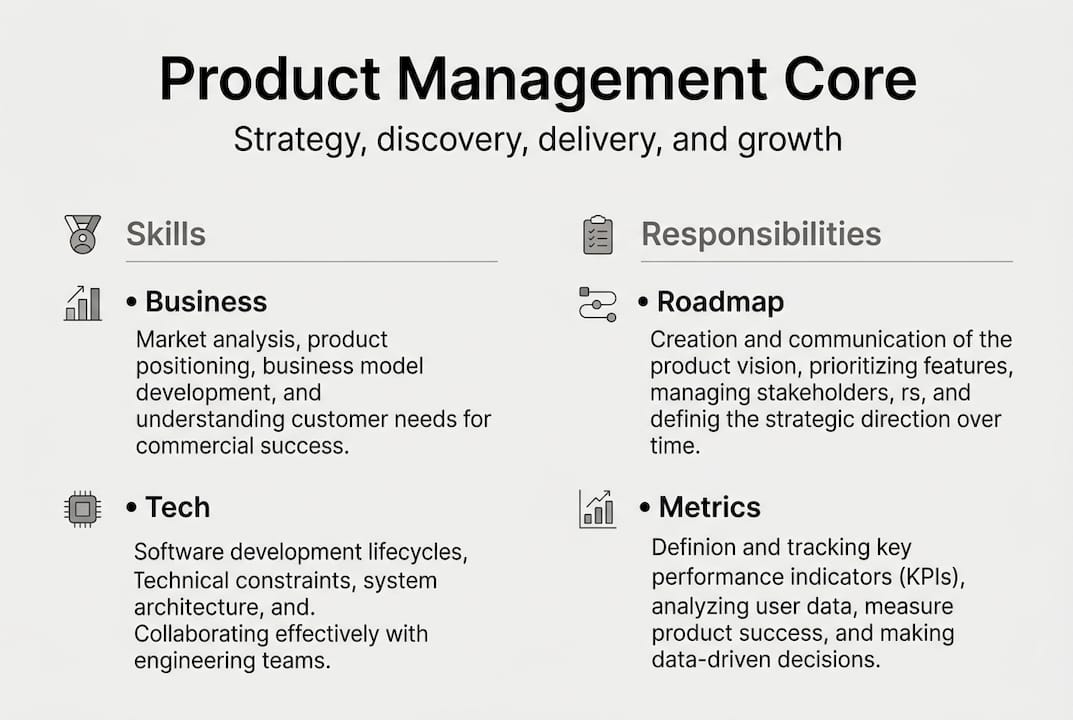
Product management is the practice of defining a product's strategy, roadmap, features, and success metrics. It's not about writing code or managing a project timeline. It's about deciding what gets built, why it gets built, and whether it actually solves a real user problem. That distinction matters enormously when you're choosing a career path.
Core responsibilities span four key areas: strategy, discovery, delivery, and growth. In practice, this means a product manager owns the product vision, aligns stakeholders around a roadmap, defines features with enough clarity for engineers to build them, and tracks whether those features actually move the needle.
Here's how product management compares to adjacent roles you might already know:
| Role | Primary focus | Success measured by |
|---|---|---|
| Product manager | Vision, strategy, user value | Adoption, retention, revenue |
| Project manager | Timelines, tasks, delivery | On-time, on-budget delivery |
| Software engineer | Building and technical quality | Code output, system reliability |
| UX designer | User experience and interface | Usability, satisfaction scores |
The core duties of a product manager typically include:
- Product vision: Setting the long-term direction and communicating it clearly
- User research: Understanding what real users need, not just what they ask for
- Roadmap ownership: Deciding what gets prioritized and when
- Feature definition: Writing specs and requirements that engineering can act on
- Growth analytics: Measuring whether the product is achieving its goals
Product management is the discipline of connecting business objectives, technical capability, and user needs into a single coherent strategy. The PM is the person accountable for whether that strategy works.
Exploring the range of product management roles available in tech will show you just how varied this career can be. From B2B SaaS to consumer apps to platform products, the shape of the role shifts significantly depending on company size and industry. If you're comparing it to other tech job roles you've considered, product management tends to carry more strategic ownership than most. For those mapping out software career paths, PM is one of the few roles that touches every function in the business.
Skills and competencies: What makes a great tech product manager?
Understanding the core responsibilities is just the start. The right skills turn product managers into lynchpins for delivery and growth. And here's what surprises most engineers: the technical skills you've spent years building are only the entry ticket.

Key skills for PMs include communication, strategic thinking, leadership, technical acumen, user empathy, data analysis, and problem-solving. Notice that technical acumen is on the list, but it's one item among seven. The skills that actually separate good PMs from great ones are the softer, harder-to-measure ones.
Here's a practical breakdown of what you need to build:
- Communication and influence: You'll rarely have direct authority over engineers or designers. You lead by persuasion, clarity, and trust.
- User empathy: The ability to represent the user's perspective even when stakeholders push back with opinions and assumptions.
- Data analysis: Reading dashboards, interpreting A/B test results, and making decisions based on evidence rather than gut feel.
- Strategic thinking: Seeing the product not just as a set of features but as a business asset with a market position.
- Technical literacy: Enough understanding of how software is built to have credible conversations with engineering teams.
For engineers considering the switch, the biggest gap is usually commercial awareness. You need to understand how the product makes money, who the buyers are, and what the competitive landscape looks like. That's a different muscle than writing clean code.
Pro Tip: Start writing product requirements documents (PRDs) for features in your current role. You don't need permission. Treat it as practice. This builds the habit of translating user problems into structured specs, which is one of the most valuable PM skills you can demonstrate in interviews.
Common transition paths include software engineer to PM, UX designer to PM, and data analyst to PM. Each brings a different strength. Engineers bring technical credibility, designers bring user focus, and analysts bring data fluency. The gap for all three is the same: business strategy and stakeholder influence. Knowing where your gaps are helps you target your preparation. Reviewing IT job search strategies for PM roles specifically can sharpen your approach. A solid tech job search guide will also help you position your background effectively when applying.
Popular frameworks and methodologies in product management
Once you've built foundational skills, leveraging structured frameworks will guide your work and boost impact. Frameworks are not just jargon. They're the tools that help you make defensible decisions under pressure and communicate your reasoning to stakeholders who want answers fast.
Common methodologies include Agile, Scrum, Kanban, RICE prioritization, the Aha! Framework, OKRs, and Jobs to Be Done. Each serves a different purpose, and most PMs use several in combination.
| Framework | What it does | Best used for |
|---|---|---|
| Agile | Iterative development cycles | Ongoing product delivery |
| Scrum | Sprint-based team coordination | Engineering team alignment |
| RICE | Scores features by impact and effort | Backlog prioritization |
| OKRs | Links team goals to company outcomes | Quarterly planning |
| Jobs to Be Done | Frames features around user motivations | Discovery and positioning |
| Kanban | Visual workflow management | Continuous delivery teams |
Here's how to start applying frameworks in your current workflow:
- Pick one prioritization framework (RICE is a strong start) and apply it to your current project backlog, even informally.
- Attend sprint planning and retrospectives if you're not already involved. Observe how decisions get made.
- Write one OKR for a goal you own or contribute to. Practice connecting output to outcome.
- Map a user journey using Jobs to Be Done language. What is the user trying to accomplish, and what gets in their way?
Pro Tip: Frameworks are your best defense against HiPPO decisions, which stands for the highest paid person's opinion. When a senior leader pushes a feature based on instinct, a RICE score or OKR alignment check gives you a data-backed reason to redirect the conversation. Use frameworks to protect the roadmap, not just organize it.
The RICE framework is the most widely used prioritization method, adopted by 42% of PMs. Understanding software development methodologies will also give you context for how PM frameworks fit into the broader engineering process. AI tools are also reshaping how PMs work, with agentic frameworks now being used for automated discovery, user research synthesis, and roadmap generation.
Success metrics and career realities for product managers
Methods matter, but understanding where your efforts are measured and what the real world looks like is essential before committing to this path.
Salary and market snapshot (2026):
Median PM salaries range from $135K to $165K USD. The average PM-to-engineer ratio is 1:7 to 1:10. Average team size is 6 to 9 people. 73% of PMs now use AI tools in their daily workflow.
The metrics that define PM success on the job are different from what most engineers track. Key success metrics include NPS (Net Promoter Score), CSAT (Customer Satisfaction), retention rates, revenue growth, feature adoption, and TTFV (time to first value). These are business outcomes, not technical outputs.
The everyday challenges that catch new PMs off guard:
- Role ambiguity: In many organizations, the line between PM and project manager is blurry, which creates friction and confusion about ownership.
- Influence without authority: You're accountable for outcomes but don't manage the people who create them. That tension is constant.
- Balancing speed and quality: Shipping an MVP fast versus handling edge cases thoroughly is a daily negotiation.
"The PM role is not dying, but it is evolving. The PMs who struggle are those who over-index on process and under-invest in user understanding and strategic influence." The Death of Product Management
Large organizations often dilute the PM role into coordination and reporting, which frustrates PMs who want strategic ownership. Smaller companies and startups tend to give PMs more latitude but also more ambiguity. Knowing which environment suits you is part of the career decision. The rise of AI jobs in product management is also creating new PM specializations focused on AI product strategy, model evaluation, and responsible deployment.
The real value of product management in tech: Insights for career switchers
Beyond data and frameworks, consider this real-world advice for your own PM journey. Technical expertise gets you in the room. It gives you credibility with engineers and helps you ask better questions during scoping. But it does not make you a great product manager on its own.
The PMs who build lasting careers are the ones who invest in user understanding and business acumen early. For tech pros transitioning, the advice is consistent: use your technical background for credibility, but build user empathy and business acumen as your primary differentiators.
Product management is not disappearing. Some argue the PM role is declining, but what's actually happening is that the bar is rising. Generic coordination is being automated. Strategic influence and user focus are becoming the core of what makes a PM irreplaceable.
Before you commit to a full career switch, experiment. Take on a small PM responsibility in your current role. Own a feature end to end. Write a roadmap. Present a prioritization decision to stakeholders. These experiments will tell you more about fit than any job description. Exploring the full PM role breakdown across different company types will also help you find the right environment for your strengths.
Ready to explore your product management career?
Product management careers are growing fast, and the demand for technically fluent PMs is especially strong in 2026. If you've read this far, you're already thinking seriously about the move.

LetsHunt.it connects technology professionals with tech product management jobs across remote, hybrid, and on-site opportunities worldwide. Whether you're making your first move into PM or looking for a role that matches your seniority, the LetsHunt.it platform gives you access to curated listings with competitive salaries and filters built for tech professionals. Start your search today and find the PM role that fits where you want to go next.
Frequently asked questions
Is product management a good career for software engineers?
Yes. Engineers bring strong technical credibility to the PM role, but success also requires building user empathy and business acumen to complement those technical strengths.
What is the difference between a product manager and a project manager?
Product managers own the vision and user value of a product, while project managers focus on timelines and task delivery. Product management defines strategy and success metrics, not just schedules.
Which frameworks are most important for product managers?
Agile, Scrum, and RICE are the most widely used, with RICE adopted by 42% of PMs for backlog prioritization. OKRs and Jobs to Be Done are also essential for strategy and discovery work.
What metrics show product manager success?
The most important PM metrics are NPS, CSAT, retention, and feature adoption rates. These measure whether the product is delivering real value to users and the business.
Is the PM role at risk in large companies?
In large organizations, the role can lose strategic focus and become coordination-heavy. Strong PMs protect their impact by staying close to users and influencing product strategy directly.