
Software development powers a $824 billion global industry, yet most aspiring developers still misunderstand what the field actually involves day to day. It is not just writing code. It is a structured discipline with defined phases, competing methodologies, and a wide range of specialized roles. Whether you want to build mobile apps, design cloud infrastructure, or lead engineering teams, knowing how software development actually works gives you a serious edge. This guide breaks down the core concepts, the most widely used methodologies, the importance of testing, and the skills and career paths that matter most in 2026.
Table of Contents
- Understanding software development: Core concepts and phases
- Exploring software development methodologies
- Edge cases and robust testing: Ensuring reliability
- Key skills, tools, and career opportunities in software development
- What most aspiring developers miss: Mastering context, not just code
- Explore new software career opportunities with LetsHunt.it
- Frequently asked questions
Key Takeaways
| Point | Details |
|---|---|
| SDLC phases explained | Understanding each phase of the SDLC is foundational for building reliable software. |
| Methodology matters | Agile, Waterfall, Scrum, and DevOps offer different approaches; knowing when to use each is critical. |
| Test for edge cases | Addressing boundary inputs and unusual conditions ensures your code works under real-world scenarios. |
| Skills drive careers | Python, AI, and tool mastery empower you to land top developer roles in a fast-growing job market. |
| Context, not just code | Developers succeed by understanding user needs, requirements, and business impact beyond technical syntax. |
Understanding software development: Core concepts and phases
Software development is the process of designing, creating, testing, and maintaining software applications and systems. It covers everything from a simple mobile app to a complex enterprise platform. The scope is broad, which is exactly why structured frameworks exist to keep teams aligned and projects on track.
At the center of this structure is the Software Development Life Cycle, or SDLC. The SDLC is a repeatable framework that guides teams through every stage of building software, from the first idea to long-term maintenance. Understanding it is foundational for anyone pursuing software development careers.
Here are the core SDLC phases in order:
- Planning — Define the project scope, timeline, and resources.
- Requirements analysis — Gather and document what the software must do.
- System design — Architect the technical structure and database models.
- Implementation (coding) — Write the actual source code.
- Testing — Verify the software works correctly and securely.
- Deployment — Release the software to users or production environments.
- Maintenance — Fix bugs, update features, and monitor performance over time.
Each phase feeds into the next. Skipping or rushing any one of them creates compounding problems later. A poorly defined requirements phase, for example, leads to a design that solves the wrong problem entirely.
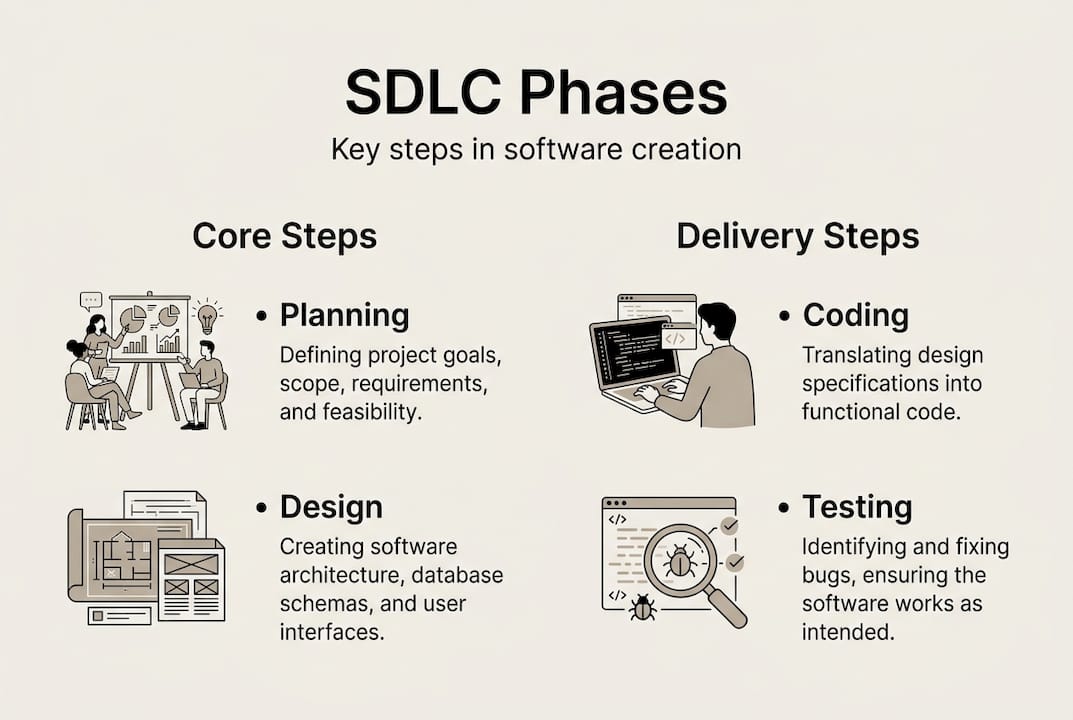
| SDLC Phase | Primary goal | Key output |
|---|---|---|
| Planning | Scope and feasibility | Project plan |
| Requirements | Define user needs | Requirements document |
| Design | Architect the solution | System design spec |
| Coding | Build the product | Working codebase |
| Testing | Validate quality | Test reports |
| Deployment | Release to users | Live software |
| Maintenance | Sustain and improve | Patches and updates |
For aspiring developers, learning the SDLC is not just academic. Employers expect you to speak this language from day one.
Exploring software development methodologies
Once you understand the SDLC phases, the next question is: how do teams actually move through them? That is where methodologies come in. A methodology is the workflow and philosophy a team uses to organize development work.
The most widely used methodologies each have distinct strengths:
- Waterfall — Linear and sequential. Each phase must be completed before the next begins. Best for projects with fixed, well-understood requirements.
- Agile — Iterative and flexible. Work is broken into short cycles called sprints, with continuous feedback from stakeholders.
- Scrum — A specific Agile framework with defined roles (Product Owner, Scrum Master, Development Team) and ceremonies like daily standups and sprint reviews.
- DevOps — Bridges development and operations teams. Focuses on automation, continuous integration, and rapid deployment. Explore DevOps career paths if this approach interests you.
| Methodology | Best for | Key strength | Limitation |
|---|---|---|---|
| Waterfall | Fixed-scope projects | Clear structure | Inflexible to change |
| Agile | Evolving requirements | Fast iteration | Requires strong communication |
| Scrum | Team-based sprints | Accountability | Overhead from ceremonies |
| DevOps | Continuous delivery | Speed and automation | Complex toolchain setup |
Hybrid approaches are trending in 2026. Many teams combine Agile's flexibility with Waterfall's structure for phases like compliance-heavy design or regulated industries like healthcare and finance.

Pro Tip: When choosing a methodology, match it to your project's uncertainty level. High uncertainty means Agile. Low uncertainty with fixed deliverables means Waterfall. When in doubt, start Agile and tighten structure as requirements solidify.
Edge cases and robust testing: Ensuring reliability
Methodologies tell you how to organize work. Testing tells you whether that work actually holds up under pressure. And one of the most overlooked areas of testing is edge case handling.
An edge case is an input or condition that sits at the extreme boundary of what a system is designed to handle. Think of a user entering a negative number in an age field, or uploading a file that is exactly the maximum allowed size. These scenarios are rare, but edge cases cause real failures in production systems.
Why does this matter? Because bugs found in production cost significantly more to fix than bugs caught during development. The key testing strategies that catch edge cases early include:
- Boundary value analysis — Test values at the exact limits of acceptable input ranges.
- Equivalence partitioning — Group inputs into classes and test one value from each class.
- Fuzz testing (fuzzing) — Automatically generate random, unexpected inputs to find crashes or vulnerabilities.
- Regression testing — Re-run previous tests after changes to catch newly introduced bugs.
- Exploratory testing — Testers actively investigate the system without predefined scripts.
Understanding key skills and tools for testing is increasingly valuable as companies shift toward quality-first development cultures.
"Software testing is not about finding bugs. It is about building confidence that the system behaves correctly under every condition a real user might create." — Common principle in quality engineering
Shift-left testing, which means testing earlier in the SDLC rather than only at the end, is now standard practice at high-performing teams. It reduces rework and speeds up delivery without sacrificing reliability.
Key skills, tools, and career opportunities in software development
The software job market is not slowing down. Developer employment is projected to grow 25% through the next decade, far outpacing most other professions. But knowing which skills to build makes the difference between landing a role and getting filtered out.
Technical skills in high demand:
- Python (dominant in AI, data science, and backend development)
- JavaScript and TypeScript (essential for web and full-stack roles)
- Cloud platforms: AWS, Azure, Google Cloud
- Containerization: Docker, Kubernetes
- Version control with Git
- CI/CD pipelines (Continuous Integration and Continuous Delivery)
Soft skills that employers consistently prioritize:
- Clear written and verbal communication
- Ability to break down complex problems
- Collaboration across cross-functional teams
- Adaptability when requirements change
Pro Tip: Do not try to learn everything at once. Pick one programming language, one cloud platform, and one version control tool. Master those three before branching out. Depth beats breadth when you are starting out.
Career paths in software development span far beyond "software engineer." You can specialize in global tech job trends like AI engineering, cloud architecture, or platform engineering. You can also explore remote IT job strategies to access opportunities across borders without relocating.
Salary benchmarks in 2026 remain strong. Mid-level software engineers in the United States earn between $110,000 and $150,000 annually, with senior and specialized roles often exceeding $180,000. Remote roles have expanded access to these salaries globally.
What most aspiring developers miss: Mastering context, not just code
Here is the uncomfortable truth most coding bootcamps will not tell you: the developers who advance fastest are not the ones who memorize the most syntax. They are the ones who understand why a system is being built, who will use it, and what breaks it under real conditions.
We see this pattern repeatedly. Job seekers spend months learning the latest framework, then struggle in interviews because they cannot explain how they would handle a requirements conflict or a production failure. Frameworks change every few years. SDLC fundamentals do not.
The developers who stand out treat edge cases as learning opportunities, not annoyances. They ask questions during the requirements phase instead of waiting until testing. They understand that a hybrid methodology is not a compromise but a sign of mature engineering judgment.
If you want to accelerate your career path, focus on context. Learn how business requirements translate into technical decisions. Practice shift-left testing. Get comfortable with ambiguity. That combination is rarer and more valuable than any single programming language.
Explore new software career opportunities with LetsHunt.it
You now have a solid foundation in software development concepts, methodologies, testing, and the skills that matter most in 2026. The next step is putting that knowledge to work in a real role.
LetsHunt.it connects aspiring and experienced developers with latest tech jobs across software engineering, DevOps, AI, cloud, and more. The platform covers remote, hybrid, and on-site positions worldwide, with filters by role, location, salary, and experience level. Whether you are looking for your first developer role or ready to move into a senior position, LetsHunt.it gives you a focused, efficient way to find opportunities that match where you are in your career right now.
Frequently asked questions
What are the main phases of the Software Development Life Cycle (SDLC)?
The SDLC includes seven phases: planning, requirements analysis, design, coding, testing, deployment, and maintenance. Each phase produces specific outputs that feed into the next.
Which programming languages are most in demand for software developers?
Python leads current language demand due to its dominance in AI and data science, followed by JavaScript for web development and cloud-specific languages tied to AWS and Azure ecosystems.
What's the difference between Agile and Waterfall methodologies?
Agile and Waterfall differ fundamentally in structure: Agile is iterative with continuous feedback loops, while Waterfall is linear with fixed sequential phases that do not overlap.
How do edge cases affect software reliability?
Edge cases expose hidden bugs that standard testing misses. Techniques like boundary value analysis and fuzz testing catch these failures before they reach production users.