
TL;DR:
- Global IT jobs offer high salaries and diverse opportunities due to international talent shortages.
- Remote and hybrid models expand access, enabling geographic arbitrage and faster career growth.
- Success requires adaptability, clear communication, and continuous networking beyond technical skills.
Earning US-level pay while living in Lisbon, Buenos Aires, or Warsaw is not a fantasy reserved for digital nomads. It is a realistic career move that thousands of IT professionals are making right now. Global IT jobs, once limited to those willing to relocate, have opened up dramatically thanks to remote and hybrid work models. If you work in software development, data science, or product management, the gap between your current compensation and what international employers offer might surprise you. This guide breaks down why global IT roles are surging, what motivates professionals to pursue them, and exactly how to position yourself to benefit.
Table of Contents
- What drives the demand for global IT jobs?
- Motivations behind pursuing global IT roles
- Remote and hybrid work: Expanding global opportunities
- Key trends: Skills, compensation, and geographic arbitrage
- Our perspective: What most guides don't say about global IT careers
- Ready to find your next global IT opportunity?
- Frequently asked questions
Key Takeaways
| Point | Details |
|---|---|
| Global IT demand surging | Unprecedented skills shortages mean more international IT jobs are available than ever. |
| Salaries and flexibility | Remote global IT roles can pay up to five times local salaries with flexible work arrangements. |
| Remote and hybrid trends | Hybrid work is increasingly popular for balancing performance, while remote unlocks worldwide access. |
| Skills drive success | Cutting-edge skills in AI, cloud, or data science open the most lucrative global opportunities. |
What drives the demand for global IT jobs?
The numbers behind global IT hiring are hard to ignore. The US BLS projects 15% growth in software developer roles, with approximately 344,000 new vacancies opening annually in the US alone. That kind of demand cannot be filled domestically, which is exactly why companies are casting a wider net across borders.
The financial pressure of leaving roles unfilled is enormous. The global skills shortage is projected to cost businesses $5.5 trillion by 2026, according to IDC research. Meanwhile, 89% of tech recruiters report serious difficulty finding qualified candidates. When the cost of a vacant senior engineer role can exceed $500,000 per year in lost productivity, international hiring stops being a perk and becomes a survival strategy.
Here is a snapshot of where the shortages are most severe:
- Software development: Full-stack engineers, backend developers, and mobile specialists are in shortage across North America, Western Europe, and Australia.
- Data science and AI/ML: Companies building intelligent products cannot find enough qualified data scientists and machine learning engineers locally.
- Product management: Senior product managers who understand both technical and business contexts remain chronically scarce.
- Cloud and DevOps: Infrastructure and platform engineers are among the fastest-moving roles in international recruiting.
- Cybersecurity: Every sector from healthcare to finance is competing for the same small pool of security specialists.
"The global shortage of tech talent is not a temporary blip. It reflects a structural imbalance between how fast technology is advancing and how slowly educational systems produce job-ready professionals." This gap is what creates the window of opportunity for internationally mobile IT workers.
Recruiters and specialized platforms play a major role in bridging this gap. Understanding the impact of IT recruiters on hiring speed and quality helps you see why companies invest heavily in international sourcing. Similarly, top tech job boards have evolved to filter roles by location type, contract structure, and region, making it faster than ever for professionals to connect with the right employer.
Motivations behind pursuing global IT roles
After understanding employer motivations, it is important to consider what draws IT professionals themselves to look beyond their borders.
The most direct motivation is compensation. IT professionals pursue global roles primarily because of higher salaries, access to more varied opportunities, and the flexibility that remote or hybrid work provides without requiring relocation. In practical terms, this can mean earning three to five times your local market rate by working for a US or EU company.
But pay is only part of the picture. Here is how global roles compare to local roles across several dimensions:
| Factor | Local IT role | Global IT role |
|---|---|---|
| Salary potential | Market average | 3 to 5x local average |
| Project variety | Limited by local industry | Access to global-scale products |
| Technology stack | Often legacy systems | Cutting-edge tools and platforms |
| Career exposure | Single-market network | International team experience |
| Work flexibility | Office-dependent | Remote, hybrid, or on-site options |
| Promotion speed | Linear, tenure-based | Performance and output-driven |
Beyond the table, there is a concept worth understanding: geographic arbitrage. This means earning a salary benchmarked to a high-cost market, like San Francisco or London, while living in a city where your expenses are significantly lower. A senior developer earning $140,000 USD remotely from Medellín or Krakow can build savings and quality of life that would be nearly impossible in the same role locally.
Pro Tip: When evaluating a global role, calculate your effective purchasing power in your city, not just the raw salary figure. A $90,000 remote salary in a low-cost city can outperform a $130,000 in-office salary in a high-cost metro.
Global roles also accelerate professional growth in ways local markets cannot replicate. Working with distributed teams across time zones forces you to sharpen written communication, async collaboration tools, and cross-cultural awareness. These skills make you more competitive globally for years to come. For a practical roadmap on breaking into these roles, the guide on finding global IT jobs covers the search process from profile optimization to offer negotiation.
Remote and hybrid work: Expanding global opportunities
Now that we know why IT professionals are drawn to global jobs, let us examine how work models enable these possibilities.
Remote and hybrid arrangements have shifted from pandemic-era exceptions to permanent structures. 73% of enterprises now maintain hybrid work policies, and high performers consistently prefer schedules with fewer than three mandatory office days. This normalization has fundamentally changed who can apply for roles at companies headquartered thousands of miles away.

Research from the Bureau of Labor Statistics shows that intermediate hybrid arrangements, typically two days in the office, correlate with the highest satisfaction and performance outcomes. Remote workers also benefit from a wage premium exceeding 15% compared to fully on-site counterparts in similar roles. That is a meaningful difference when compounded over a career.
Here is how to think about the three main work models when evaluating global IT opportunities:
- Full remote: Maximum geographic freedom. You can work from anywhere with reliable internet. Best for self-directed professionals comfortable with async communication and independent accountability.
- Hybrid: A structured split between home and office. Preferred for professionals who want flexibility without losing access to in-person collaboration, mentorship, and visibility.
- On-site (international): Requires relocation but often includes relocation packages, visa sponsorship, and stronger team integration. Worth considering for roles at major tech hubs.
Each model carries trade-offs. Full remote offers freedom but can lead to slower career advancement if the company culture favors visible, in-office contributors. Hybrid balances flexibility with belonging. On-site accelerates immersion but limits lifestyle freedom.
When browsing opportunities, filtering by work model is essential. You can explore remote IT job search strategies to sharpen your approach, or browse current hybrid and remote jobs across all major IT disciplines to see what is available right now.
Key trends: Skills, compensation, and geographic arbitrage
Work models shape access, but skills and location determine who wins the most lucrative global IT jobs.
Not all technical skills carry the same global premium. The highest-paying international roles in 2026 cluster around a specific set of capabilities:
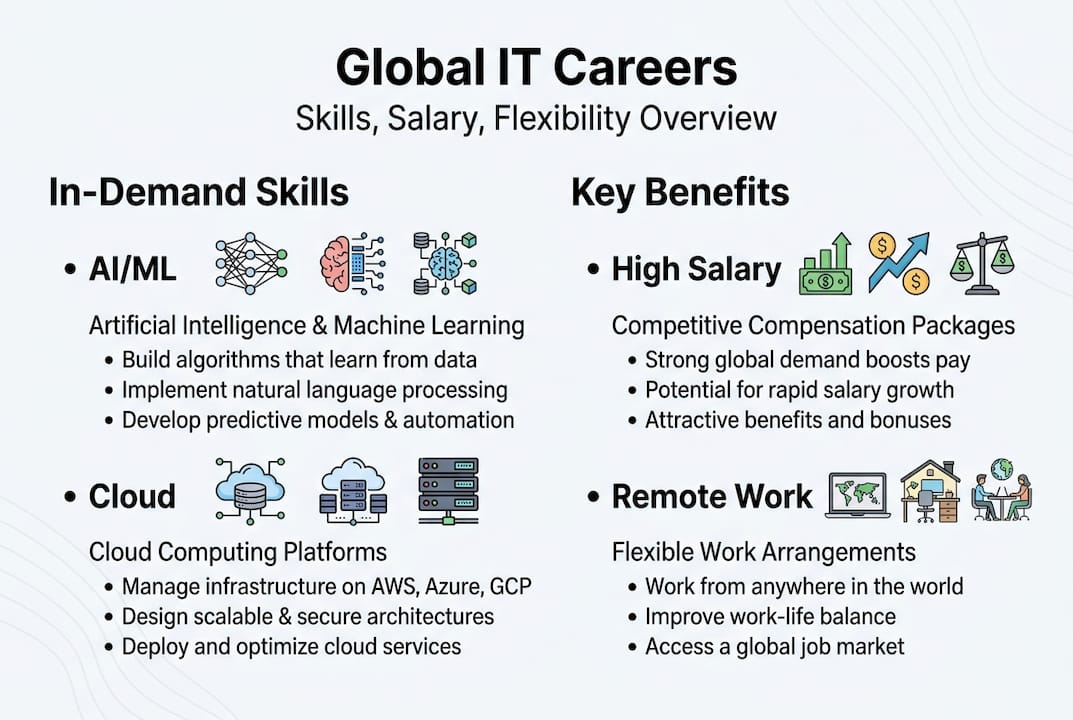
- AI and machine learning: Engineers who build, fine-tune, and deploy large language models or computer vision systems command the steepest premiums globally.
- Cloud architecture: AWS, Azure, and Google Cloud expertise remains in constant demand, particularly for solutions architects.
- Data engineering and analytics: Companies scaling their data infrastructure need engineers who can build reliable pipelines and analytics platforms.
- Cybersecurity: Penetration testers, security engineers, and compliance specialists are in shortage across every major region.
- Platform and DevOps engineering: Kubernetes, CI/CD pipelines, and infrastructure-as-code skills open doors at global-scale companies.
Geographic arbitrage is especially powerful for professionals in Latin America and Eastern Europe. US companies actively prefer nearshore LATAM talent for timezone alignment, and Eastern European engineers benefit from strong technical education systems and lower living costs. AI and ML skills carry the highest global premiums regardless of location.
Remote roles for US companies typically pay 70 to 90% of equivalent US rates. A senior software engineer in this structure can realistically earn between $120,000 and $180,000 USD, which in many regions equals three to five times the local salary benchmark.
Pro Tip: Certifications in AWS, GCP, or Azure combined with demonstrable AI/ML project experience are among the fastest ways to break into the top compensation tier for global remote roles.
Understanding which roles align with your skills matters too. The guide on types of global IT jobs helps you match your background to the right international category, while the deep-dive on AI and ML global jobs covers what those specific career paths look like in practice. When you are ready to start applying, IT job search tips will help you approach the process with a clear strategy.
Our perspective: What most guides don't say about global IT careers
With all the data in mind, here is what really separates professionals who thrive in global IT roles from those who struggle.
Everyone focuses on technical skills and salary, but the real differentiator in international hiring is adaptability and communication. Hiring managers at US and EU companies consistently report that candidates from underrepresented markets fail not because of weak code, but because of unclear async communication, hesitation during ambiguous problem-solving, and difficulty managing expectations across time zones.
The Cisco Hybrid Work Study highlights a tension worth naming: remote work boosts individual productivity and flexibility, but hybrid environments produce stronger outcomes for belonging and performance. Full-remote professionals are also at greater risk of promotion bias, being overlooked when decisions happen in rooms they are not in.
This means the choice of work model is not just a lifestyle preference. It is a career strategy. Choosing full remote for the short-term salary gain without a plan for staying visible and connected can stall your career in ways that compound over time. The practical advice on remote job realities is worth reading before you commit to any model.
Global IT careers also require continuous networking and upskilling at a pace that local markets rarely demand. The competition is international, and standing still means falling behind.
Ready to find your next global IT opportunity?
If the global IT market sounds like the right space for your next career move, the best step is to start exploring what is actually available. LetsHunt.it brings together vetted IT roles across software development, data science, AI, DevOps, and product management from companies hiring globally right now.

Whether you are looking for a fully remote position with a US company, a hybrid role in a European tech hub, or an on-site opportunity that includes relocation support, you can explore global IT jobs and filter by role, location, and work model in one place. The platform is built specifically for IT professionals who want real opportunities, not recycled listings. Start your search today and see what the global market is willing to pay for your skills.
Frequently asked questions
What are the main benefits of working in a global IT job?
Global IT jobs offer higher salaries, access to more varied and cutting-edge opportunities, and the flexibility of remote or hybrid roles without requiring you to relocate. These three factors consistently rank as the top motivators for IT professionals who pursue international positions.
Which IT skills are most in-demand globally in 2026?
AI and machine learning, cloud architecture, and data engineering are the most sought-after skills for international tech roles in 2026. These areas carry the highest salary premiums and the longest global shortage timelines.
How much can you earn by working remotely for overseas companies?
Remote roles for US companies typically pay 70 to 90% of US benchmark rates, with senior engineers earning $120,000 to $180,000 USD. In lower-cost regions, this can represent three to five times the local market salary.
Is hybrid or remote work better for global IT professionals?
Hybrid work tends to produce the best balance of flexibility and long-term career growth, while full remote offers maximum freedom but carries real risks of isolation and promotion bias. Your choice should reflect both your lifestyle preferences and your career advancement goals.