
Job boards generate 49% of all tech applications but account for only 25% of actual hires. That gap surprises most IT professionals, yet it does not mean job boards are broken. It means most people use them wrong. Whether you are a software developer hunting for a fully remote role or a DevOps engineer open to hybrid positions, understanding how job boards actually work in the tech hiring ecosystem can change your results dramatically. This article breaks down the real mechanics, the honest trade-offs, and the practical moves that separate candidates who land interviews from those who just collect rejection emails.
Table of Contents
- Understanding job boards: Not just old-school job search
- Why technology companies rely on job boards for sourcing candidates
- Job boards vs. other tech job-hunting methods: A smart comparison
- Maximizing your job board experience: Practical strategies for tech talent
- Discover more tech jobs with LetsHunt.it
- Frequently asked questions
Key Takeaways
| Point | Details |
|---|---|
| Job boards drive applications | Most IT job applications now originate from job boards, making them a key source for both applicants and employers. |
| Broad reach, targeted results | Job boards offer unmatched exposure but yield the best outcomes when paired with optimized profiles and niche boards. |
| Combine search strategies | Using job boards with networking and direct company contacts increases your hiring chances in tech. |
| Quality matters more now | With AI and ghost jobs on the rise, prioritizing trusted, specialized boards is more important than ever. |
Understanding job boards: Not just old-school job search
Job boards started as simple digital bulletin boards. Post a job, apply for a job, done. Today they are something far more layered, especially for IT professionals navigating a global, remote-first market.
Modern tech-focused job boards offer role-specific filters (think "Senior Backend Engineer, remote, Europe"), salary transparency, company culture tags, and real-time alerts. Some platforms now integrate AI-powered summaries that condense job descriptions into scannable highlights. That sounds helpful, but it introduces a new risk: if AI starts summarizing and routing jobs before you even see them, the quality and accuracy of those summaries matters enormously.
As job board evolution research highlights, AI-generated summaries may eventually bypass traditional boards entirely, which puts pressure on platforms to compete on trust, data quality, and listing accuracy rather than just volume. For you as a job seeker, that means choosing boards with verified postings and strong employer reputations is not optional anymore.
Here are the features that actually matter when evaluating a tech job board:
- Role-specific filters: Stack, seniority, and work model (remote, hybrid, on-site)
- Salary ranges: Visible compensation data saves you from wasting time on mismatched offers
- Employer verification: Reduces ghost jobs and duplicate listings
- Alert systems: Automated notifications for new postings matching your criteria
- Application tracking: Knowing where you stand in the process
"The boards that will survive are the ones that prioritize quality over quantity. Trust is the new currency in tech job search."
Ghost jobs (listings for roles that are not actively being filled) and duplicate postings are real problems. Knowing how to spot them, and using strategies for finding remote IT jobs that go beyond blind applications, keeps your effort focused.
Why technology companies rely on job boards for sourcing candidates
Here is the honest reality: tech employers know job boards are not their most efficient hiring channel. Yet they keep using them. Why?
Because volume matters at the top of the hiring funnel. A company filling a senior cloud architect role needs a wide net before it can narrow down. Job boards deliver that reach faster than almost any other channel. According to 2025 recruiting benchmarks, it takes roughly 110 applications to produce a single hire in tech. That is a brutal ratio, but it reflects the reality of competitive, specialized roles.

| Hiring channel | Share of applications | Share of hires |
|---|---|---|
| Job boards | 49% | 25% |
| Employee referrals | 7% | 40% |
| Direct sourcing | 18% | 22% |
| Career sites | 26% | 13% |
The table tells a clear story. Job boards dominate application volume but underperform on conversion. Referrals flip that equation entirely. Still, most companies cannot fill all roles through referrals alone, especially for niche design jobs in tech or emerging AI specializations where internal networks run thin.
For employers, job boards are a mandatory part of the tech recruitment workflow because they provide:
- Broad geographic reach: Essential for remote-first companies hiring globally
- Speed: Listings go live within hours, not days
- Passive candidate exposure: Even candidates not actively searching may see a well-placed listing
- Benchmarking: Employers gauge market demand and salary expectations through board activity
The 49% application share that job boards generate makes them indispensable for broad reach, even when conversion rates disappoint. You can explore current IT job listings to see how active this channel remains across specializations.
Job boards vs. other tech job-hunting methods: A smart comparison
No single method wins every time. Smart IT job seekers treat their search like a portfolio, mixing channels based on what each does best.
| Method | Best for | Weakness |
|---|---|---|
| Job boards | Volume, remote roles, global reach | Low conversion, ghost jobs |
| Networking | Hidden jobs, referrals, senior roles | Time-intensive, geography-limited |
| Company career sites | Targeted applications, culture fit | Requires prior research |
| Recruiters/agencies | Specialized roles, passive search | Less control over process |
Job boards shine when you need reach fast. If you are relocating, switching stacks, or targeting remote-only roles, boards give you access to hundreds of relevant listings in minutes. Networking, by contrast, is slower but produces dramatically better conversion. That 40% hire rate from referrals is not a coincidence.
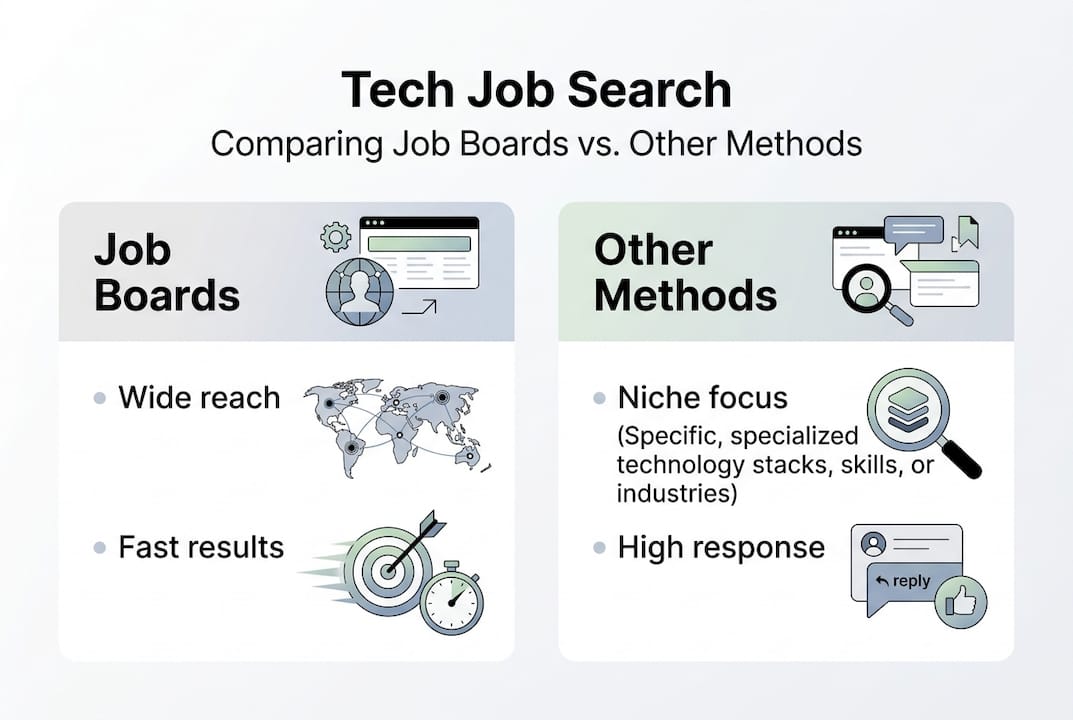
For DevOps job types and other specialized IT roles, the combination of a niche board plus a warm introduction from a community contact is often the fastest path to an offer.
The empirical data confirms that job boards generate the most applications but not the most hires. That does not mean you skip them. It means you use them strategically, not as your only move.
When to lean on each method:
- Job boards: Early-stage search, exploring the market, remote roles, volume applications
- Networking: Mid-to-late search, senior positions, company-specific targets
- Company sites: When you have a specific employer in mind
- Recruiters: Passive search or highly specialized niche roles
Pro Tip: Specialized boards deliver 3x better response rates than general ones for tech roles. Instead of posting a generic "Software Engineer" title, use precise labels like "Remote SaaS Product Manager" or "Senior Kubernetes Engineer, EMEA." Specificity filters out noise on both sides.
Maximizing your job board experience: Practical strategies for tech talent
Knowing job boards exist is not enough. How you use them determines whether you get three callbacks a week or three in a month.
Here is a step-by-step approach that works for IT professionals:
- Choose the right boards first: General boards cast a wide net, but specialized tech boards surface more relevant roles. Prioritize platforms with verified listings and active employer accounts.
- Optimize your profile headline: Use the exact job title you are targeting, not a vague summary. "Full-Stack Engineer, React and Node.js, Remote" outperforms "Experienced Developer" every time.
- Set up targeted alerts: Do not check boards manually every day. Configure alerts for specific roles, stacks, and locations so new postings reach you within hours of going live.
- Apply within 48 hours: Early applications get more visibility. Many ATS (applicant tracking systems) rank candidates partly by application timing.
- Customize each application: A tailored cover note and a resume that mirrors the job description's language clears ATS filters faster.
- Track everything: Use a simple spreadsheet to log where you applied, when, and what happened. Patterns emerge quickly.
Common pitfalls to avoid:
- Applying to duplicate listings: The same role posted by multiple agencies wastes your time and can create awkward conflicts.
- Ignoring posting dates: A listing more than 30 days old with no update is likely a ghost job.
- Keyword stuffing your profile: ATS systems are smarter now. Relevance beats repetition.
- Skipping the company research step: A board listing is a starting point, not a destination. Always verify the employer before investing time in a full application.
Pro Tip: Combining job boards with ATS tools and using precise, role-specific titles dramatically improves your response rate. Niche boards consistently outperform general ones for specialized tech roles. Pair board activity with the remote job search strategies that go beyond passive browsing.
One more thing worth noting: salary transparency is your friend. Boards that display compensation ranges upfront save you from spending two weeks in a process only to discover the budget is 40% below your target. Filter for it aggressively.
Discover more tech jobs with LetsHunt.it
You now have a clear picture of how job boards work, where they excel, and how to use them without wasting effort. The next step is finding a platform built specifically for IT professionals like you.
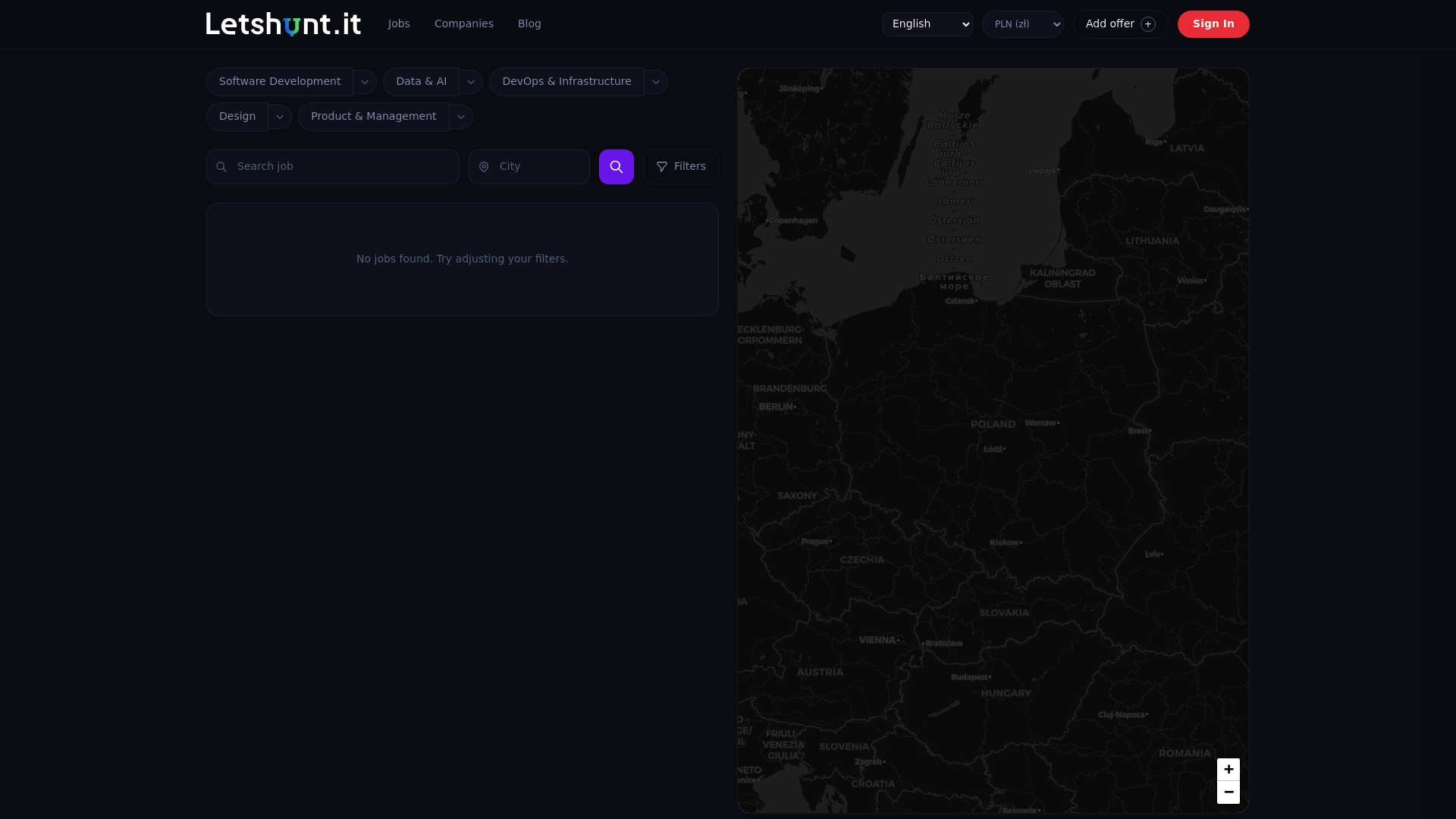
LetsHunt.it is a dedicated tech job board covering software development, data and AI, DevOps, infrastructure, design, and product management roles worldwide. Every listing is filterable by work model (remote, hybrid, on-site), location, and salary range, so you spend less time scrolling and more time applying to roles that actually fit. Whether you are actively searching or just keeping an eye on the market, LetsHunt.it gives you the focused, verified listings that general boards simply cannot match. Start your search today and put the strategies from this article to work immediately.
Frequently asked questions
Do job boards actually help you get hired in tech?
Yes, but they work best as one part of a broader strategy. Job boards drive 49% of applications in tech hiring, making them essential for reach, even though most hires ultimately come through multiple combined channels.
How can I avoid fake or ghost jobs on IT job boards?
Stick to boards with verified employer accounts and check posting dates carefully. As job board trust research shows, quality and verification are becoming the key differentiators between reliable and unreliable platforms.
What is the best way to use job boards for remote tech jobs?
Use advanced filters to isolate remote-only roles, set up daily alerts, and prioritize specialized tech boards over general ones. Optimizing your job title with remote-specific language (like "Remote DevOps Engineer") also improves how your profile surfaces to recruiters.
Are niche job boards more effective than general ones for tech roles?
For most IT professionals, yes. Specialized boards deliver 3x better response rates because both the listings and the candidate pool are filtered for relevance, reducing noise on both sides of the hiring equation.